






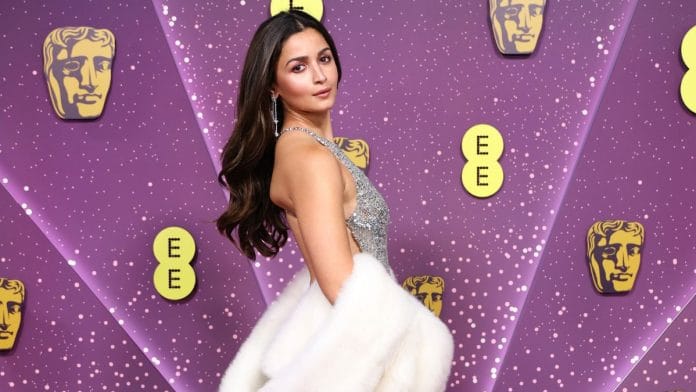



What are glass ceilings? For my parents’ generation, it was monetary issues, racial discrimination when travelling out of the country, and so on. But today, it is as simple as Alia Bhatt saying one line in Hindi at an international awards ceremony, and boom, the glass ceiling shatters.
Bhatt did not come up with the idea to start her introduction at the British Academy Film Awards with a “Namaskar”, it was preordained by the show’s writer. Bhatt was merely reading off a teleprompter. It was not a brave moment of stepping up to the man, but a talented actor performing as instructed to gather views.
The Internet has made it seem as though her short presentation was a monumental victory for Indians and Indian cinema. But let’s not get ahead of ourselves. It was just one line, and it is not as though celebrities have not reverted to their native languages at award shows before.
In 1999, Roberto Benigni gave his acceptance speech for Best Actor in Life Is Beautiful (1997) at the 71st Academy Awards in Italian. In 2009, Spanish actor Penelope Cruz, too, gave an acceptance speech in her native language at the 81st Oscars when she won Best Supporting Actress for Vicky Cristina Barcelona (2008). As recently as 2020, South Korean filmmaker Bong Joon Ho, who won the Academy Award for Best Director for Parasite (2019), gave a speech in his native language with a translator present on stage.
It is not a novel concept by any means. One line is not a speech, nor is it as monumental as social media makes it seem.
The ‘desi’ twist
What really troubles me is the idea of an actor with British citizenship representing India at the UK’s national film awards ceremony, all while wearing an Italian designer.
How can an actor who does not have “roots” in this country lose them to conquer the world? So, I ask: How did she “add a desi twist”?
Ed Sheeran singing in Hindi to Armaan Malik during his concert was certainly more desi and iconic than Bhatt’s appearance at the BAFTA Awards last night.
Is our pride so easily won that a simple “Hello” in Hindi is enough to make hearts melt nationwide? If “global milestones” are so easy to achieve, then we should just tell our athletes and Olympians to forego their training as long as they can say any greeting in Hindi on a world stage.
While we are losing it over Bhatt’s “Namasker”, where is the craze and noise over Lakshmipriya Devi’s “Khurumjari” (Manipuri for “Hello”)? Devi, in fact, won the award for Best Children’s and Family Film for her Manipuri film Boong. Why are we as a nation not mentioning that?
Also read: India Art Fair shows ecology is no longer an abstract anxiety in Indian contemporary art
Indian stars at the BAFTA
The British Academy Film Awards may have invited Bhatt for her filmography or because of her 86.8 million Instagram followers.
Even Farhan Akhtar, who walked the red carpet with his wife Shibani Dandekar, to support the Manipuri film Boong (2024) — which won the award for Best Children’s and Family Film — had a stake in the film, as it was produced by his production house, Excel Entertainment.
But the presence of Indian stars sprinkled across the BAFTA Awards felt less like India reaching the world stage and more like brown-baiting. They remained at the periphery of the “major” categories and wins, and were more of a token representation. And perhaps, the reason Bhatt was even asked to present the foreign language film award was more because she, too, is a “foreigner”. And so, the Hindi line made sense.
It was a clever, thoughtful PR move by the British film awards: they get the views and numbers and a label that says “Look, how inclusive we are,” and Indian celebs get the “visibility”.
It is not our talent that spoke at the BAFTA Awards last night, it was our numbers, our subscribers. Indian audiences will tune in to support their A-listers, and that is something that the British counted on. Much like when Indian social media went into a tizzy following Bhatt’s or fellow Hindi film actor Kiara Advani’s first Met Gala appearance, the numbers spiked.
The bottom line is about TRPs, not representation. India did not reach the world stage; India reached the desired TRPs needed to fund an extravagant night of glitz and glamour. Alia Bhatt did not make history at the BAFTA Awards; she made the ratings.
Views are personal.