






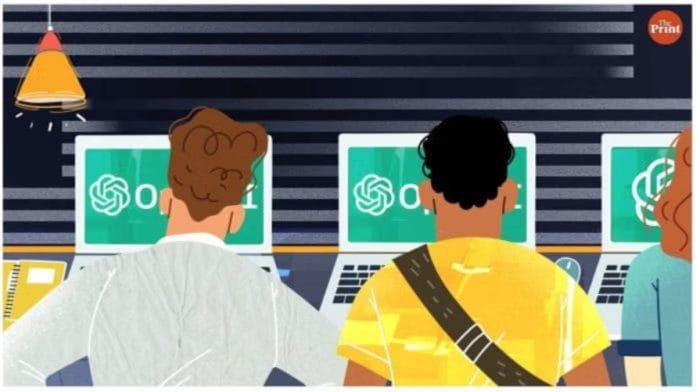



As 2025, the year of AI, comes to an end, I can’t help but feel afraid of the tech-obsessed future we now face. As a budding journalist and writer, the constant use of AI sends a shiver down my spine. In a couple of years, AI will have completely taken over our world. Rather than looking something up on Google, most people nowadays prefer to ask ChatGPT, which is now a friend, confidant, and therapist. Even my 85-year-old nani thinks AI has all the answers.
And if so, can it tell what will happen to creatives like me?
Ayesha, a graphic designer in the making, said she, too, is worried about the possible decline of her field. She is still holding out hope despite her worries about lower costs and faster results that AI remains a useful tool and not a thorn in the side of artists.
The Orwellian future
With AI becoming faster, cheaper, and easier to use in almost every aspect of online life, it has slowly taken the soul out of art. Earlier this year, ChatGPT introduced its “Ghibli-style art”—it was an insult to the animated world created by Hayao Miyazaki and others. Studio Ghibli is famous for how it reflects the emotions and inner struggles of characters, and AI was using the template to create inane images of people on demand. And for what? To liven up their otherwise dull Instagram pages. While it did initially face some backlash from anime lovers and artists, the ‘art form’ (if one can even call it that) quickly became a global trend.
But that is what AI is doing. It is taking the creativity away from the creatives by turning it into a format of ones and zeroes. It is Van Gogh by numbers all over again, killing the artist one prompt at a time. The newest form of mass-distributed art. Another way of conforming art into what the masses want rather than what the artist intended.
Ayesha, who started working as a graphic designer in April 2025, says that so far, all hope is not lost. Even though brands and consumers are relying on quicker and faster means, the touch of the artist is not something AI has mastered as of now. Using the tools of the enemy against itself, Ayesha doesn’t mind using AI to form pitches to help her visualisation. For her, AI can never add the depth and detail of human-led designs; it can never feed the soul.
From paintings to albums to scriptwriting, AI is doing it all. And I can’t help but wonder what kind of world awaits us in 2026. Or have we gone fully Orwellian? When I think of the future now, it reminds me of all the dystopian films that I watched growing up in the 2010s. When I think of my future as a writer, I think of Ray Bradbury’s novel Fahrenheit 451.
Maybe I am sentimental, maybe the world of poets and artists my mother raised me in no longer exists except in small pockets here and there. And maybe no one will ever want to go into the woods and live deliberately, and maybe you, dear reader, will just ChatGPT the referencing I am making.
In the face of all this, I do wonder sometimes if AI is all that bad. If everyone is doing it, it can’t be the worst, can it? Shiza, an Audit Senior at BDO RISE, says AI doesn’t worry her; it challenges her. AI has already made her life easier by carrying out routine checks and data analysis, freeing her up to focus more on areas such as risk assessment and client insights. The world of auditing, according to Shiza, is built on professional scepticism, something AI can’t replace. She isn’t worried about the future of AI after all, her industry is evolving, not disappearing.
Also read: 2025 and India’s tech ambitions. What we got right and wrong
A world without books
A University of Cambridge survey published in November found that out of the 332 authors, 51 per cent of them worried that AI would replace them. Almost 39 per cent had already lost income from copywriting, whereas another 85 per cent expected future earnings to decrease. A whopping 97 per cent of the novelists were against AI writing. Honestly, in front of AI, Chetan Bhagat seems like Shakespeare.
The BBC in December interviewed several young artists, almost all of whom were asked about their futures, but also the future of their field in general. A London-based graphic designer I spoke to said that while she had been in the industry for too long to be worried about AI, she was concerned for the newbies and the impact this might have on their work and their self-esteem.
It seems hard for me to imagine a world where AI is surpassing Taylor Swift on the billboards or Sally Rooney, but it’s not impossible. But I am sure that a life without books is a thirsty one.
I’ll save you the prompt, it’s a Stephen King quote: “A life without books is a thirsty life, and one without poetry is…like a life without pictures.”
Views are personal.
(Edited by Ratan Priya)