





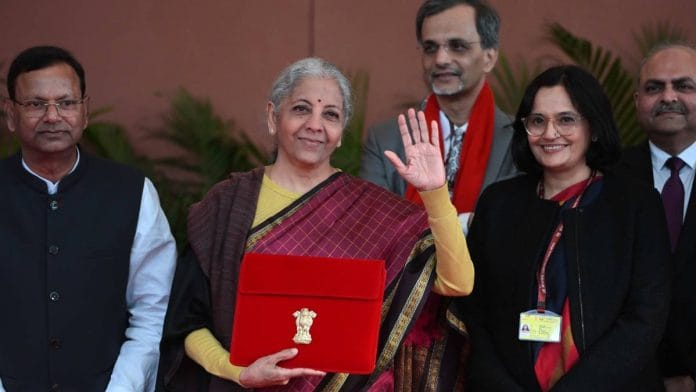



In the last Budget, Union Finance Minister Nirmala Sitaraman made a clarion call, “Trust first, scrutinise later”. The Budget proposals have not just kept her word but made a decisive shift in India’s fiscal and developmental strategy, guided by the philosophy of “action over ambivalence, reform over rhetoric and people over populism.”
The Budget proposals seek to balance sustained high economic growth with fiscal discipline and structural transformation. With India maintaining a robust growth trajectory of around 7 per cent in the present geopolitical shifts and buoyant tax collection, there is fiscal headroom to undertake structural reforms, including maintaining momentum to allocate for capex. The budget’s overarching priorities are to enhance productivity and competitiveness, and at the same time to build resilience against global volatility without losing eyes on fiscal discipline.
Despite robust growth, structural challenges continued to constrain India’s development trajectory. The manufacturing sector faces persistent bottlenecks, including dependence on high-tariff critical imports, fragmented industrial clusters, and high logistics and compliance costs. At the same time, MSMEs in India, a primary source of employment, faced chronic liquidity constraints, limited access to formal credit, and weak integration with digital financial systems.
Equally, the labour market exhibits a growing skills mismatch, particularly in services such as healthcare, tourism and emerging digital sectors. Rapid urbanisation further intensified pressure on transport, housing, logistics and energy infrastructure, especially in Tier 2 and Tier 3 cities. The challenges were not new, but in a world of reconfigured supply chains with selective global capital, addressing them has become increasingly urgent.
Initiatives in the Union Budget 2026
The Budget places strong emphasis on strengthening domestic manufacturing in strategic and frontier sectors vital for economic sovereignty. Key initiatives include the India Semiconductor Mission (ISM) 2.0, electronics component manufacturing schemes, Biopharma SHAKTI, and a dedicated programme for rare-earth permanent magnets. The revival of 200 legacy industrial clusters, the establishment of chemical parks and a container manufacturing scheme aim to build geographically diversified industrial ecosystems.
On trade facilitation, customs duty exemptions on materials for aviation, electronics, and defence inputs, as well as deferred duty payment and safe harbour provisions for non-resident manufacturers in bonded zones, make it easier and more economical. Such steps are intended to reduce India’s reliance on imports, accelerate technology-led manufacturing, and strengthen its integration with global value chains.
MSME reforms and financial Support
The Budget adopts a three-pronged strategy for MSMEs centred on finance, market access and institutional support. Measures such as the SME Growth Fund, mandatory TReDS-based CPSE procurement and secondary markets for MSME receivables shall ease equity and liquidity constraints. The introduction of ‘Corporate Mitras’ will further strengthen the managerial capacity and transform MSMEs from survival units into scalable growth engines. For millions of SMEs, policy changes do not matter as much as the impact on cash flows, access to credit and the ability to grow.
Services sector and human capital
The Budget places reliance on the service sector‘s long-term growth potential. Initiatives such as medical value tourism hubs, allied health training and animation, visual effects, gaming and comics (AVGC) labs aim to strengthen healthcare, creative and digital services. On concessions, a tax holiday for cloud and data centres until 2047, with expanded safe harbour rules and faster Advance Pricing Agreement (APA) processes, enhances India’s competitiveness as a global digital services hub, while supporting employment in sunrise sectors.
Also read: Budget 2026 squarely puts manufacturing at the centre of India’s growth strategy
Infrastructure and urban development
Public capex has expanded sharply over the last decade from Rs 2 lakh crore in FY 2015-2016 to Rs 12.2 lakh crore as proposed in the budget, underscoring infrastructure as the backbone of growth strategy. Investments in freight corridors, national waterways and the Coastal Cargo Promotion Scheme aim to lower logistics costs, while City Economic Regions focused on Tier 2 and Tier 3 cities promote balanced urbanisation, regional connectivity and productivity-led growth.
Energy security and green transition
To ensure long-term energy resilience, the Budget has introduced a Rs 20,000 crore Carbon Capture, Utilisation and Storage (CCUS) scheme and provides customs duty exemptions for lithium-ion battery inputs, nuclear projects and critical minerals. Incentives for biogas blending and domestic solar glass manufacturing shall further strengthen India’s renewable energy ecosystem. These measures align India’s industrial strategy with its climate commitments and create a foundation for sustainable and low-carbon growth, reducing vulnerability to global energy price shocks.
Trust-based tax governance and tax reforms
The Budget deepens compliance simplification by promoting trust-based governance across tax and customs administration. Key reforms include extending AEO duty deferral, increasing the validity of customs advance rulings from three years to five years, a warehouse operator-centric customs framework, and the decriminalisation of technical Income tax offences.
The introduction of automated digital lower TDS certificates, expansion of return revision window and a reduction in tax collected at source (TCS) under Liberalised Remittance Scheme (LRS) for education, medical, and tourism expenses will significantly ease tax payer burden. These reforms signal a shift from enforcement-heavy regulation to facilitative governance, strengthening compliance culture while reducing friction between taxpayers and the administration.
Long-term impact and structural transformation
The Budget is not merely an annual fiscal exercise but a blueprint for long-term economic restructuring. Overall, it seeks to sustain high growth while preserving macroeconomic stability through fiscal discipline, with a clear medium-term path for debt consolidation. Manufacturing and infrastructure reforms aim to reduce import dependence, improve logistics efficiency and strengthen India’s integration with global value chains.
Tax and duty impetus to growth sectors such as AI, lead data centres, and tourism are clear beneficiaries. Equally, people-centric investments in healthcare, education, MSMEs, and services ensure employment-led inclusive growth, while a strong push towards renewable energy, critical minerals, and nuclear power supports a sustainable transition. Trust-based taxation and regulatory simplification further enhance ease of doing business, reinforce investor confidence and underpin long-term economic resilience.
The Budget 2026-27 marks a clear pivot from populism to productivity-driven reform. By tackling manufacturing gaps, infrastructure deficits, skill shortages and regulatory frictions in tandem, it lays the groundwork for a resilient and globally competitive economy. In doing so, it translates the vision of Viksit Bharat into action where growth is faster, fairer, equitable and more sustainable. The long-term significance of the Budget lies not in individual measures, but in the institutional credibility and policy predictability it seeks to embed.
Mukesh Butani is Managing Partner at BMR Legal Advocates. Shankey Agrawal is Partner at BMR Legal Advocates and head of International Trade, Customs and GST. Views are personal.
(Edited by Saptak Datta)