









Prime Minister Narendra Modi had an interesting conversation with Muhammad Irfan, a student from one of Atal Awasiya Vidyalayas in Uttar Pradesh that he inaugurated in 2023. The PM was said to be mighty impressed with these residential schools that the Yogi Adityanath-led government built at a cost of more than Rs 1,100 crores for the children of construction workers, labourers and children orphaned during the Covid-19 pandemic.
“What do you want to do in life?” the PM asked Irfan. “I want to join Yogiji’s police,” said the boy. Modi was curious: “Yogiji’s police! Why?” Irfan said, “Because he eliminates mafias”. The boy happened to be from Ghazipur, the place where gangster-turned-politician late Mukhtar Ansari once reigned supreme.
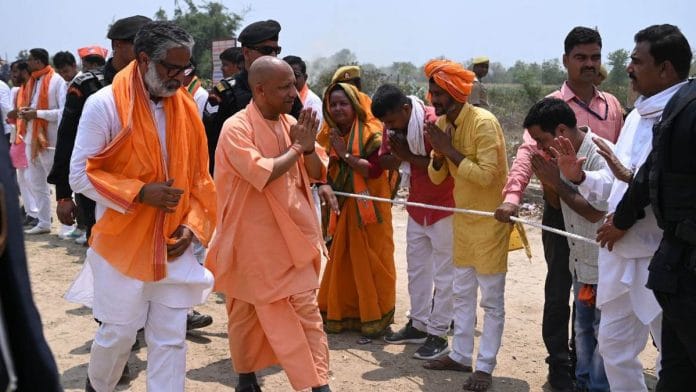
The story, recounted to me in Lucknow last week, came as no surprise. Encounter killings of criminals and the bulldozing of their illegal constructions and houses resonated strongly in the 2022 Assembly election. That earned Chief Minister Yogi Adityanath the moniker of ‘bulldozer baba’.
Four years later, these monikers still figure in public conversations, but the Yogi-led government seems to have moved on. The conversation in the corridors of power in Lucknow today is largely centred on the speed of the ‘reforms express’. As I went to meet CM Yogi at his residence last week, I was expecting him to open up on a host of controversies that, I thought, could be playing on his mind—for one, University Grants Commission’s new equity regulations that triggered protests from many Brahmin leaders, especially in UP.
Shankaracharya Swamy Avimukteshwaranand of the Jyotir Math, Uttarakhand, was making headlines again. Besides, there were many juicy political gossips to talk about—like why his deputy Keshav Maurya always seemed so eager to undermine his boss. When Avimukteswaranand, who had earlier attacked Modi, started targeting Yogi, Maurya said he bowed at the feet of “Bhagwan Shankaracharya”, who must not be disrespected.
Then there was Yogi’s curious choice of Union Home Minister Amit Shah as the chief guest for the ‘Uttar Pradesh Day’ celebrations in Lucknow.
There was so much politics to talk about, but Yogi Adityanath wouldn’t hear any of that when I met him. He would talk only about the UP economy, the reforms his government has carried out and his plans to make the state a trillion-dollar economy by 2029-30. It was around Rs 12 lakh crore when he took over the state’s reins in 2017. It is estimated to have already tripled to Rs 36 lakh crore today.
Economy, policies & programmes
My interaction with him also reminded me of the meeting that I, as a part of a select group of journalists, had with PM Modi at Arun Jaitley’s residence a few years back. The PM was so enthusiastically talking about his government’s schemes and programmes, citing figures and stats, that our heads were spinning. He wouldn’t talk about politics. I asked him whether he had read the book that was stacked right behind him on the bookshelf—Sanjaya Baru’s The Accidental Prime Minister. He shook his head to say no.
I added that the author was the media advisor to his predecessor, Manmohan Singh. “Aren’t you thinking of hiring someone for that job?” I asked him. “Yeh media advisor kya karte hain ji (What’s the role of a media advisor)?” PM Modi asked, almost innocently. We were dumbstruck. I could see a few drooping shoulders in that room. His ostentatious ‘naivete’ had killed many dreams. PM Modi moved on, resuming his talk about his schemes and programmes. It went on for well over two hours. All these years later, UP CM Yogi reminded me of that interaction—no politics, only economy, policies and programmes. Both obviously love the art and craft of governance.
I spent three days interacting with senior UP government officials in Lucknow. In 2022, barely four months after Yogi had assumed office for the second time, signs of change in his approach were clear.
He was readying for an image makeover of his government, shifting its entire focus to the economy. Three-and-a-half years later, the results are all there to see. Out of Rs 45 lakh crore worth of investment proposals that came during his tenure, groundbreaking ceremonies for a third of them have already been done, and those for an additional Rs 6 lakh crore are scheduled to be done next month. That comes to around 50 per cent of the total MoUs fructifying on the ground, which is an outstanding strike rate. While there are new MoUs being inked—worth around Rs 3 lakh crore on the sidelines of the World Economic Forum meeting at Davos last month—the government’s focus is to get them off the ground.
Also read: Rahul Gandhi should be more worried about Amit Shah the cooperation minister—than home minister
Yogi to visit Japan & Singapore
The corridors of power in Lucknow may surprise you today. You can’t miss the sense of purpose and urgency when you interact with senior bureaucrats. Yogi has a dashboard to track every department’s work. He keeps tracking it constantly. His first calls to his bureaucrats and ministers start around 6 am after he is done with his morning yoga and prayers.
Look at what the Yogi-led government has done to make UP the best in the ease of doing business. UP was the top-ranked state in the Deregulation Phase I of the Central government’s compliance reduction exercise in January 2026. Let me give just a couple of examples.
The government has put in place third-party mechanisms for several clearances. It has hired more than 3,000 licensed technical persons to approve building plans, doing away with multiple departmental inspections. It has empanelled 15 government institutes for pollution certification. Fire safety compliances were rationalised through inspections by accredited third parties. Apart from the implementation of the labour codes, there are a whole lot of other significant reforms that are changing the investment landscape in UP.
It has allowed night-time employment of women, including in hazardous sectors. Weekly hour limits have been increased to 10 hours per day. All departmental services were integrated into a single window system, which has been upgraded to Nivesh 3.0, a platform that provides defined service timelines, end-to-end online tracking of the investor journey from groundbreaking to commercial production, as per official notes.
Basically, as officials say, the ground to make UP a major investment destination has already been laid. The focus is now on bringing more and more investors. At Davos, the UP delegation held 151 meetings with the who’s who in the global corporate world—to name a few, Thomas Kurian, CEO, Google Cloud, Caroline Berson of Pepsico, Thomas Couteaudier, Group CSO, Louis Dreyfus Company and Michele Stansfield, CEO, Culdron.
They also held a meeting with Nobel Laureate and economist Michael Spence. He advised the UP delegation to focus on innovation-led growth. If UP wants to bring world research institutions, it should involve the industries, said Spence, President and Provost of University College London and former Dean of Stanford Graduate School of Business.
Yogi will be heading to Japan and Singapore later this month to woo investors. It will be followed by a visit of 200 CEOs from Japan to Lucknow in August. Essentially, the Hindutva mascot and ‘bulldozer Baba’ is preparing to head into the election early next year in a new avatar of an economic reformer. He is betting on aspirational UP to rise above caste considerations to give him a renewed mandate.
DK Singh is Political Editor at ThePrint. He tweets @dksingh73. Views are personal.
(Edited by Saptak Datta)