






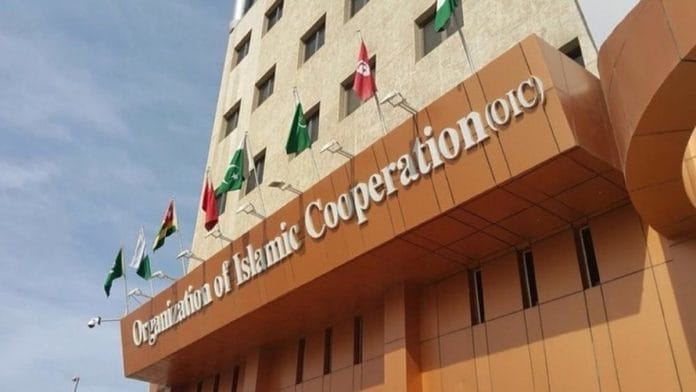



The most telling absence in the current war is not military. It is institutional. As conflict among Iran, Israel and the United States spreads across the Gulf, the Organisation of Islamic Cooperation has remained curiously peripheral. That should be more troubling than it sounds. The OIC is not a minor forum. It represents 57 member states and describes itself as “the collective voice of the Muslim world.” In a crisis that now threatens Gulf security, energy flows, maritime trade and inflation far beyond the region, that claim ought to carry visible political consequence.
The organisation was not founded merely to issue statements after the damage is done. Its Charter rests on sovereign equality, territorial integrity, peaceful settlement of disputes, and the use of negotiation, good offices and mediation when peace is endangered. In simple terms, the OIC exists so that turmoil affecting Muslim states need not be left to scattered national responses and delayed expressions of concern. The point of such a body is to provide a recognised political framework for restraint.
That is not just theory. At key moments in its history, the OIC has been more than a platform for speeches. In the southern Philippines conflict, it backed negotiations around the 1976 Tripoli Agreement and remained engaged through its Quadripartite Committee. The precedent matters not because history repeats itself neatly, but because it shows that the organisation has, when it chose to, acted as a diplomatic actor rather than a recorder of events.
That history makes the present caution harder to defend. On 19 March 2026, ambassadors of the OIC Contact Group on Peace and Dialogue called for the immediate cessation of Iran’s military attacks, provocations and threats against neighbouring countries, and backed the implementation of UN Security Council Resolution 2817. That was the correct instinct. But once the organisation has publicly recognised that such attacks must stop, the obvious question follows: Where is the visible collective effort to make that judgment matter?
This is the heart of the matter. Iran’s attacks on Gulf neighbours cannot be washed clean by calling them attacks on “American assets in the region.” That phrase may serve propaganda purposes; it does not address the underlying fact. Many facilities struck were civilian and not linked to American power. The territory hit remains the sovereign territory of the Gulf states. A state cannot repeatedly strike the territory of its neighbours and expect the violation to disappear by changing the label on the target.
That is precisely why the OIC should speak more clearly than it has. This is not a side issue in the war. It is one of its central tests. If attacks on Gulf neighbours are allowed to pass under the elastic language of “American positions,” then the OIC weakens the very principles on which its membership rests: sovereign equality, territorial integrity and protection from force by fellow members or regional actors. Its silence would not merely be diplomatic caution. It would amount to uncertainty about whether its own political compact still means what it says.
Also read: What Gulf states would say to Iran. War is temporary, geography is permanent
OIC’s mandate
Part of the explanation lies in the organisation’s design. The OIC moves through its member states, not above them. Its Summit is the supreme authority; its Council of Foreign Ministers adopts decisions and resolutions; extraordinary sessions require support from member states; and major decisions depend on consensus or supermajority. In other words, the OIC has legitimacy, but limited independent initiative. It acts decisively only when enough of its leading capitals want it to.
Yet that is also why the present quiet is so consequential. The organisation already has the machinery for a stronger role: It can convene extraordinary diplomacy, adopt collective resolutions, facilitate consultations and empower approved representatives. The issue is not whether the OIC has tools. It is whether its leading states are prepared to use them. In this case, that would mean two things: Speaking plainly about attacks on Gulf sovereignty and placing a visible mediation channel under OIC authority rather than leaving diplomacy to drift among separate capitals.
That matters because mediation space still exists. If individual states can pass messages, test diplomatic openings and try to lower the temperature, then the field is not closed. But if that space is occupied only by scattered capitals rather than by the OIC itself, the organisation risks yielding its most relevant function to improvisation by its own members. The problem is not that others are trying to calm the crisis. The problem is that the institution expressly designed to provide a common political framework has not yet made itself the obvious multilateral focal point for the effort.
Nor is this merely a regional concern. The war is pressing on one of the world’s economic nerve centres. Instability in the Gulf never stays local. It travels outward into shipping costs, insurance, inflation, energy security and growth. In such circumstances, mediation is not a diplomatic ornament. It is part of economic stabilisation.
No serious person expects the OIC to impose peace by force. It is not the Security Council. It has no army and no sanctions regime. But that is not the relevant standard. The question is whether it can convert collective legitimacy into timely political weight. A body that claims to speak for 57 Muslim states should not need reminding that repeated attacks on Gulf neighbours, combined with a widening regional war, are exactly the circumstances in which its purpose ought to become visible.
The OIC does not need a new mandate. It needs to inhabit the one it already has. Its history shows diplomacy is not alien to it. Its charter shows that restraint and mediation are not optional extras. And the present crisis, with Gulf sovereignty being constantly challenged and the global economy exposed by another member state, shows that the need for such a role is greater than at any point.
The danger is not only that the war widens. It is that the institution created for moments like this is seen as present in language but absent in consequence. If the OIC cannot speak clearly when Gulf nations are tested by force by one of its member states, its charter risks looking less like a guide to action and more like a record of intentions.
The author is an Islamic thinker and author of ‘The True Face of Islam’. Views are personal.
(Edited by Theres Sudeep)