





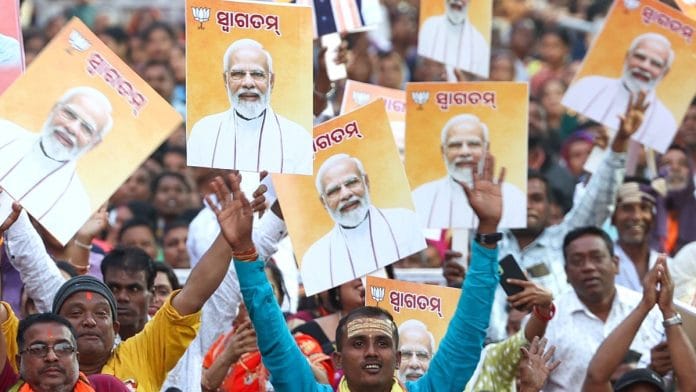



The post-2024 landscape in Odisha represents the shattering of a long-held regional myth: That Odisha is a “post-caste” polity. For decades, the coastal state was viewed as an outlier in Indian politics. The Mandal waves that submerged Bihar and Uttar Pradesh crashed harmlessly against the sea wall of Odisha’s old political order and, later, Naveen Patnaik’s welfarist hegemony. But the tectonic plates have shifted. The “Mandal plus Market” combo-pack predicted to make landfall has arrived in Bhubaneswar, bringing with it a unique Odia complexity that will define the state’s politics for the next decade.
The end of ‘Feudal Hegemony’
The irony of the current moment is palpable. Odisha’s political leadership in the past asserted that “there is no caste in Odisha,” a stance that allowed the state to avoid the violent churning of the 1990s but also froze its socio-political hierarchy in place. For years, the bureaucracy and political leadership remained dominated by a handful of upper-caste groups, even as the demographics screamed otherwise.
Naveen Patnaik, in his final years as Chief Minister, sensed the tremors. His abrupt pivot to constitute the State Commission for Backward Classes (OSCBC) in 2020 and initiate a survey of Backward Classes was a tacit admission that the “welfare-labharthi” model had hit a ceiling. He realised that distributing rice and health cards was no longer enough when the aspirational youth demanded representation in power structures. However, this realisation came too late to stem the tide of anti-incumbency, leading to the rise of the BJP.
Odia Asmita meets Odisha’s Bhagidari
The BJP’s victory in Odisha was not merely a triumph of religious consolidation. The BJP won Odisha in 2024 largely on the plank of Odia Asmita (Odia Pride), anti-incumbency and assimilating these subaltern aspirations under the Hindutva umbrella. However, the honeymoon period of cultural pride is finite.
With the state now aligned with the national ruling party, the demand is shifting from ‘protection of culture’ to ‘proportion of power.’ The state is facing a peculiar reservation paradox. While the Indra Sawhney judgment caps reservation at 50 per cent, Odisha’s Scheduled Tribes (ST) and Scheduled Castes (SC) already consume nearly 38-40 per cent of that quota due to their
demographics. This leaves a meagre percentage for the backward classes (11 per cent in government jobs and 0 per cent in technical education), despite constituting a massive 54 per cent of the population.
As the dust settles, the Indra Sawhney barrier will become the central battlefield. Can Odisha justify breaching the 50 per cent barrier by proving extraordinary circumstances?
Also read: Political parties must be treated as workplaces. POSH is a non-negotiable for women’s safety
The Constitutional ace in the hole
Odisha possesses a unique Constitutional weapon that most other states lack, one that provides the perfect justification for the “extraordinary circumstances” exception mentioned by the Supreme Court.
That weapon is Article 164(1) of the Constitution. The proviso to Article 164(1) explicitly mandates that in the states of Chhattisgarh, Jharkhand, Madhya Pradesh, and Odisha, “there shall be a Minister incharge of tribal welfare who may in addition be in charge of the welfare of the Scheduled Castes and backward classes.”
This is not a trivial administrative detail; it is a constitutional acknowledgment of Odisha’s exceptionalism. By singling out Odisha for a mandatory constitutional post dedicated to Tribal and Backward Class welfare, the framers of the Constitution admitted that the social structure of this state is distinct from the national average.
In the coming days, expect this specific Article to be cited not just in courtrooms, but in political rallies across the hinterlands of Odisha. The demand will be simple: “If the Constitution acknowledges our special status, why does the reservation policy ignore it?”
The ‘market’ factor
This brings us to the second half of the equation: The market. Odisha is the resource capital of India, sitting on vast reserves of iron ore, coal, and bauxite. Yet, the paradox of “rich land, poor people” persists.
The revulsion against corporate monopolies resonates deeply with the Odia youth. For years, the perception has grown that Odisha’s mineral wealth fuels the growth of conglomerates headquartered in Mumbai or Gujarat, while local entrepreneurship remains stifled. The state produces raw material, but the high-value jobs are exported.
The coming political narrative will pit the BJP’s business friendly approach (facilitating large mining leases and mega-industrial projects) against a rising local demand for a market
friendly approach (breaking cartels, ensuring downstream industries are local, and empowering Odia MSMEs).
The “Mandal plus Market” revolution in Odisha will not look like the agrarian assertiveness in UP and Bihar. Instead, it will manifest as a demand for the democratisation of the mining and industrial supply chain. The emerging OBC and tribal entrepreneurs are asking: Why are the transport contracts, the logistical sub-contracts, and the MSME ancillary units dominated by the same old networks?
The demand is shifting from “give us government jobs” to “give us access to capital and contracts.” The youth across the state are seeking a market economy that is fair, not one that acts as a gatekeeper for established monopolies.
Also read: Before Mandal, there was no casteism. New think-tank report says no proof it’s 3,000 yrs old
The road ahead
Odisha stands at a crossroads. On one side is the Double Engine model, which promises rapid infrastructure growth and cultural renaissance (Odia Asmita). On the other is the brewing storm of social justice, asking uncomfortable questions about who owns the mines, who runs the bureaucracy, and why the representation figures don’t match the census data.
The political party that survives the coming days will be the one that stops treating Mandal and development as enemies. In Odisha, true development now requires the dismantling of feudal economic networks. The “Idea whose time has come” is not just a caste census—it is the demand that the wealth dug out from beneath the soil of Odisha must empower the very people who live on top of it, regardless of their place in the traditional hierarchy.
Srikant Jena is a former MP and Union minister who served in the governments of VP Singh, HD Deve Gowda, IK Gujral and Dr Manmohan Singh. He tweets @srikantjena3. Views are personal.
(Edited by Theres Sudeep)