






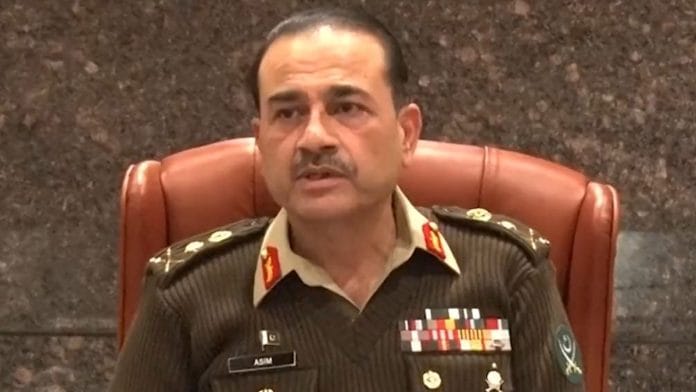



As the West Asia conflict entered its fourth week amid US president Donald Trump’s flip-flop rhetoric and Iran’s flamboyant rejection of any peace talks, one player emerged as a dark horse — Field Marshal Asim Munir. Pakistan and the speculation around its mediation dominated headlines. Some prominent Pakistani columnists even sang praises about his ‘rise and rise’.
Munir and his global image was projected across the Western press. The most powerful man in Pakistan enjoys ties with Tehran and Trump. He is US President’s “Favourite Field Marshal”. Pakistan emerging as a peace broker in the West Asia conflict is an attempt to project its image as some sort of responsible regional player.
While the External Affairs Minister may have dismissed the neighbour’s actions, New Delhi will be keeping a close watch on the Field Marshal’s moves. And that is why Asim Munir is ThePrint’s Newsmaker of the Week.
A consensus
No one knows for sure whether the country did act as a mediator between the US and Iran — even the country’s foreign affairs spokesperson, Tahir Andrabi, does not. In an Islamabad press briefing on Thursday, when asked to confirm if Pakistan had passed any peace plan from the US to Iran, the spokesperson responded that he did not know whether such a plan was passed, physically or digitally.
What one knows for sure is how Asim Munir, according to his followers, added another feather to his crown, once again establishing his dominance over the civilian government. The few anti-Army civilians who once saw red with the institution over its treatment of their beloved cricketer, Imran Khan, have now reached a consensus — the Army Chief has made Pakistan a global player. They do not care about confirmation bias. Discussions abound on “the rise and rise of Asim Munir” and even a Nobel nomination.
Multiple media outlets did report on the country’s role where the Army and the civilian government indicated willingness to host talks between US and Iran representatives in Islamabad. Then there were certain reports on X of Trump’s West Asia envoy Steve Witkoff and son-in-law Jared Kushner arriving in Islamabad. It was later debunked as fake.
The rise of a Pakistani military dictator to the apex of Pakistan’s power structure is not new. In Munir’s case, the difference is that it is no longer only a shift within the military establishment, but a broader transformation of the country’s global and political order.
The Pathan, the Hafiz-e-Quran, and a shifting Pakistan
Following the 2024 elections that were marred by allegations of irregularities and the arrest of Imran Khan, Pakistan’s coalition government has been widely viewed as weak and dependent on military-backing.
It was in this shifting landscape that General Munir consolidated his position.
In November last year, the Pakistan Parliament passed the 27th Constitutional Amendment Bill — the second such amendment in a year — with unusual speed, prompting widespread criticism from opposition leaders and analysts, who described it as a “constitutional coup.”
The amendment was widely seen as consolidating power in the hands of Field Marshal Munir. Already the most influential figure in Pakistan, he now exercises authority not only over the army but also the navy and air force. His five-year term is effectively reset, with the possibility of extension, raising the prospect of an unusually long tenure. The measure also grants him lifelong immunity from criminal prosecution.
Simultaneously, Pakistan’s only independent arm, the judiciary, was effectively clipped. A new constitutional court, with judges appointed by the government, replaced the Supreme Court, prompting several senior judges to resign in protest.
Meanwhile, Munir’s rise has also coincided with a renewed emphasis on international engagement, particularly with the United States.
Then came the Saudi-Pakistan defence deal, again hailed by many internally. This was followed by multiple defence deals with different countries, reported by Western media. However, the reports were debunked and most were not followed through.
After a period of relative isolation, Asim Munir has apparently engaged with global leaders, including holding meetings with Donald Trump in Washington and now acting as an apparent mediator in the US-Israeli aggression on Iran.
Also read: ‘Global player, next for Nobel, clear headed’—Pakistanis think Munir can bring peace to Iran
Old tricks, new man
Pakistan’s history has long been shaped by cycles of military intervention and civilian rule. Munir is different. A Hafiz-e-Quran, he frames his rhetoric within highly religious narratives, projecting Pakistan as the shining star of the Muslim world, second only to its trusted ally, Saudi. He repeatedly tells his diaspora that Pakistan is a dump truck with a singular aim — drop gravel on the shining Mercedes, that is India. That is the quintessential DNA of most Pakistani generals.
Munir’s tenure appears to mark a return to a more centralised model, in which the military not only influences but directly shapes political outcomes. Pakistan’s former military ruler Pervez Musharraf pursued a similar strategy before being forced from power amid widespread opposition.
What remains to be seen is whether he goes the Musharraf way or remains in uniform for life — an immunity he has awarded himself by twisting all state mechanisms.
The media, the mechanisms, and the military are all Munir’s. Like Pakistani author Mohammed Hanif said in his trademark wit, “Often when dictators behave this way, the geography of Pakistan changes and the generals generally have to flee for their lives”.
(Edited by Aamaan Alam Khan)