









A rare sight, but Pakistan is having its moment under the sun. In an unusual, high-stakes episode that played out on a global scale, it has, for now, acted as a messenger of “peace” and brokered a two-week ceasefire in the escalating war in West Asia.
With peace talks scheduled for the weekend in Islamabad, the country appears to hold the levers of global diplomacy. But there is more than meets the eye—hidden complexities to deeper meanings. Islamabad might be patting itself on the back with its diplomatic manoeuvres, but it is easier said than done.
It has brokered a fragile and confusing ceasefire, with Lebanon being key, between the two warring countries and is back in global prominence, at least for a while. That’s what makes Pakistan ThePrint’s Newsmaker of the Week.
From zero to hero
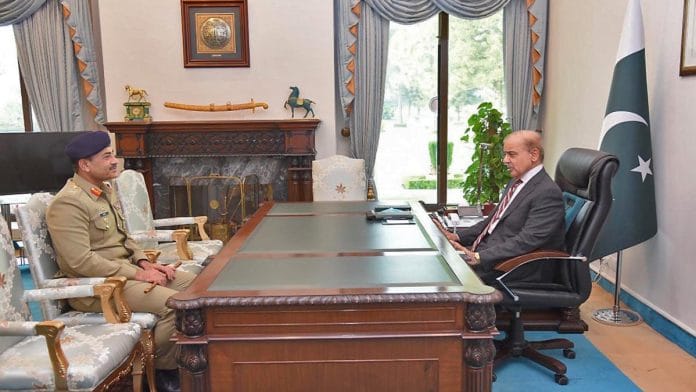
The backdrop was a Trump-era brinkmanship unfolding in March and April, marked by last-minute negotiations, backchannel manoeuvres, and US President Donald Trump’s “madman theory” of negotiation. Last week, Trump issued an ultimatum: if Iran did not meet American conditions by 8 pm Eastern Standard Time (5:30 pm IST) on 24 March, the US would proceed with a 15-point plan delivered via Pakistan’s military chief, Field Marshal Asim Munir, and launch an unprecedented strike on Iran—threatening to ‘wipe an entire civilisation off’.
Social media erupted as House Democrats called for intervention under the 25th Amendment, citing concerns over Trump’s stability.
Yet, beneath the surface of public theatrics, a careful diplomatic ballet was unfolding. Iran, despite rejecting the initial American plan as “maximalist and unreasonable,” was engaged in discussions facilitated by Pakistan.
Hours later, after midnight, Pakistan PM Shehbaz Sharif issued a tweet that had a typo—he forgot to edit the phrase “draft to Pakistan PM” before posting. There was incessant chatter over it. Was it deliberate? Was it sent by someone else—bigger powers, perhaps? There are global headlines and analyses on that.
The larger point is that the message, seemingly minor, was a signal that an offramp from the brink had been engineered, allowing Trump to claim a pause without publicly conceding. Within hours, a temporary ceasefire was announced, covering not only Iran but also Lebanon, and Pakistan’s success was the major point of discussion.
The ceasefire’s language still remains ambiguous, particularly regarding whether it extends to Hezbollah-linked operations in Lebanon, and Pakistan cannot afford missteps, but missteps abound. The Pakistani PM’s original tweet that was later redacted did not mention Lebanon. Neither does the correct version. The only mention of Lebanon is in a later tweet that also tags US officials. Neither White House press secretary Karoline Leavitt nor Trump addressed Pakistan’s announcement that Lebanon was part of the ceasefire.
Which is why, although JD Vance has landed in Islamabad, the Iranian delegation is yet to decide on a ceasefire in Lebanon, and no attacks on Iran-linked Hezbollah have to be on the table.
Also read: What can be expected from the ongoing talks in Islamabad? Odds of resolution remain slim
Regional razzmatazz
Then there is much to read between the lines. Most of the diplomatic messaging was driven not by Islamabad but by regional powers and their calculations—Washington and Tehran. On its part, the UAE has grown increasingly distant from its once ‘brotherly’ country. It has refused a rollover of loans, Pakistan is now repaying billions back to Abu Dhabi, and the country’s senators are calling the GCC country ‘a beggar’.
Islamabad’s balancing act appears to be extending into a complex domain. It has already signed a statement with the Riyadh bloc, which includes the UAE, Saudi Arabia, Qatar, Kuwait and Oman, among others. Pakistan has a defence pact with Saudi Arabia, and now a peace to broker.
It must walk a tightrope amid competing regional interests and a growing schism of sectarian politics. Munir and Sharif got a special mention in Trump’s ceasefire announcement. They had told Shia clerics at an iftar gathering in Rawalpindi last month: “If you love Iran so much, then go to Iran.”
As Pakistan tilts towards a more Saudi Arabia-led orbit, Munir’s remarks targeting Shias for their apparent support of Iran were described by Shia religious leaders as insulting and inflammatory.
Amid this, the defence minister’s comments (which were later deleted) labelling Israel as ‘cancerous’ and evil saw sharp rebuke from Israeli PM Benjamin Netanyahu. Statements like these undermine its credibility as a neutral negotiator. When Foreign Minister Ishaq Dar announced visa-free travel for those who want to cover the Islamabad talks from both countries (Iran and the US), Baloch journalists were up in arms about the restrictions they face.
Moreover, Pakistan does not recognise Israel and has no diplomatic relations with Tel Aviv. Domestic ideologies seem to be colliding with diplomatic ambitions.
Pakistan’s moment under the sun, therefore, has lessons—strategic theatre brings headlines, but transactionalism is transient. One can only wait and watch to see where this leads.
(Edited by Saptak Datta)