






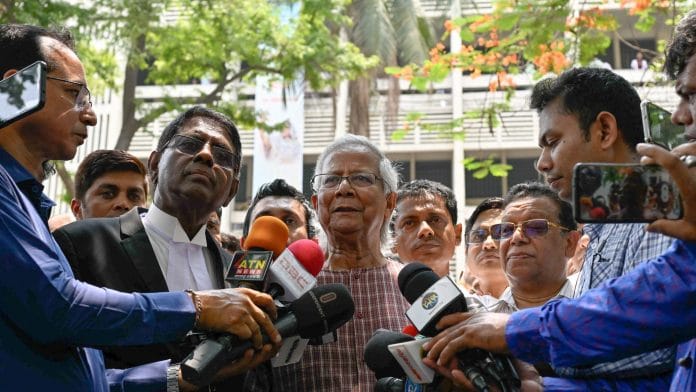



Bangladesh last week witnessed a relatively more peaceful election in decades, with Tarique Rahman-led BNP securing a landslide victory. The return of the Dark Prince, as he was called, ended the era of the Begums and that of the interim regime, under Bangladesh’s most prominent global face, and former Chief Advisor Muhammad Yunus.
When the Nobel Prize-winning economist was appointed to lead Bangladesh’s interim government in August 2024, many widely saw him as a steady hand—a caretaker figure who could shepherd the country from mass unrest toward democratic elections. Eighteen months later, his tenure seems to have left the country more polarised domestically and more estranged internationally, particularly in its once-close relationship with India.
Eighteen months after the Dhaka siege, Bangladesh has yet another opportunity to reset its pieces. And the world is watching. But under Yunus, the country and its politics have lost much of their secular credentials. It’s a gargantuan task before Rahman from here. And that is why Bangladesh under Yunus is ThePrint’s Newsmaker of The Week.
Bangladesh’s new lows
Under Yunus, violence surged, cultural institutions were attacked, media houses were torched, and minorities were mercilessly attacked even as the country saw economic, political and social decline. And relations with India hit new lows.
Tasked with restoring democratic institutions, reforming the security sector and stabilising a fragile economy, Yunus pledged to chart a rights-based, accountable path forward. His administration banned the Awami League, opened investigations into alleged atrocities under Hasina and even ratified the UN Convention on Enforced Disappearances.
But while some of the most egregious abuses, including enforced disappearances and extrajudicial killings, appeared to decline, human rights groups declared that structural reform was stalled.
Yunus’s administration initiated sweeping legal cases against figures tied to the Awami League. Police filed tens of thousands of criminal complaints in the weeks after he took office, naming nearly 400 former Awami League officials in more than a thousand cases.
In February 2025, authorities launched “Operation Devil Hunt,” a security operation that led to more than 8,000 arrests, many of them reportedly Awami League supporters.
The trial in absentia of Hasina on charges related to the 2024 crackdown further complicated ties with India, where she remains in exile. Dhaka formally requested her extradition; New Delhi did not publicly respond.
Economically, the interim government inherited a system riddled with corruption and fiscal stress. By December 2024, Bangladesh recorded the “weakest banking system in Asia”—20.2 per cent (Tk 3,45,765 crore) of total loans were in default—the highest in the region, according to the Asian Development Bank’s 2025 report on ‘Non-performing Loans Watch in Asia’.
While 11 reform commissions were established, few of their recommendations have been fully implemented.
Also read: Ready smile & mild manner to ‘bowing before ruling party’—Om Birla’s evolution as Speaker
A foreign policy shift
If the domestic record was mixed, the diplomatic fallout was starker. For decades, India was Bangladesh’s closest regional partner, bound by geography, trade and shared history dating to the 1971 liberation War.
Under Yunus, Dhaka recalibrated. Trade and visa channels were reopened with Pakistan, the former adversary in the independence war. Ties with China deepened significantly. During a March 2025 visit to Beijing, Yunus secured billions of dollars in loans, investments and grants, and Chinese firms pledged major industrial projects in Chattogram—home to Bangladesh’s most important seaport.
What shifted was ties with New Delhi. After Hasina’s refuge in India, matters worsened after Yunus publicly described India’s northeastern “Seven Sisters” states as landlocked and suggested that Bangladesh’s ports could provide them access to global markets, remarks made without explicitly referencing India.
Indian officials rejected any suggestion of dependence, and diplomatic tensions spilled into trade and migration issues, including tighter visa restrictions and port access limits.
Even in his last speech, he raked up references to India’s northeastern states, without explicitly mentioning India.
Also read: K-pop is on trial after Ghaziabad sisters’ deaths. Probe hints it was their only escape
Minorities and more
At home, Yunus’s reform agenda also encountered resistance from conservative groups. Proposals from a Women’s Affairs Reform Commission to criminalise marital rape and ensure equal inheritance rights triggered large protests led by Hefazat-e-Islam.
Minority communities reported fresh anxieties. In July, mobs attacked Hindu homes in Rangpur. After the killing of a prominent student leader, Sharif Osman Hadi in Dhaka, Hindu Dipu Chandra Das, a Mymensingh-based Hindu, was hung to a tree in the city’s Bhaluka region and set on fire over blasphemy charges. In the Chittagong Hill Tracts, long-standing ethnic tensions persisted. Shrines were attacked, baul singers were arrested and even press freedom declined.
Two of its leading dailies, The Daily Star and Prothom Alo, saw repeated attacks since 2024, culminating in an arson attack last December, where both the media houses were torched, with staff members inside.
As Bangladesh turns the page under its newly elected leadership, Yunus’s legacy remains divided. What was once seen as a moral reset under him instead became an era of drift with lofty unfinished promises of reform amid deepening polarisation and institutional paralysis.
In attempting to dismantle the legacy of Hasina, the interim administration often appeared to replicate the very tools of political retribution it once condemned. And while Yunus’s strategic overtures to China and Pakistan may have expanded short-term leverage, they came at the cost of fraying Bangladesh’s most consequential bilateral relationship with India.
(Edited by Saptak Datta)