






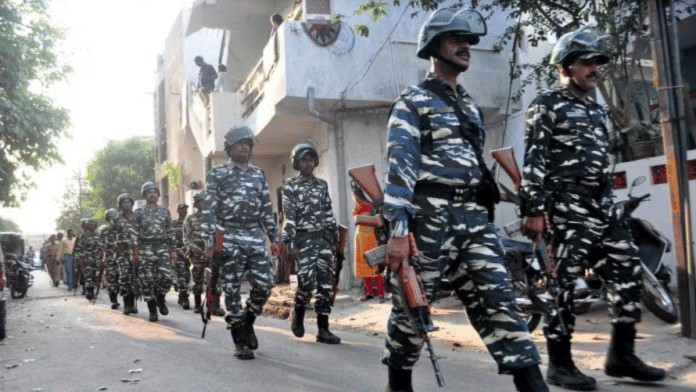



The bill introduced in the Rajya Sabha on 25 March is ironically titled Central Armed Police Forces (Administrative Reforms) Bill 2026—it has created intense angst among the serving and retired personnel of the five Central Armed Forces.
Normally, reform should cover the entire gamut of problems festering in an organisation. But this bill focuses only on creating a permanent place for the IPS officers at the rank of Inspector General and above in the CAPFs through enactment of a law—even though these posts were already reserved for them under rules framed by the forces’ existing Acts.
The proposed law—certain to pass given the ruling dispensation’s majority in both houses—is going to be another “Shah Bano” moment by reversing the Supreme Court ruling. The court had directed the government to implement its own policy by granting these cadres full “Organised Service” status along with all associated benefits.
Not a reform
The implementation of the order would have ensured that cadre officers were promoted to all vacancies up to Inspector General by gradually eliminating IPS deputation to that rank within two years. Even limited compliance would have eased stagnation within these forces.
More importantly, it would have addressed the financial distress that these officers face due to stagnation through Non-Functional Financial Upgradation (NFFU), a scheme introduced to tackle similar issues across Organised Services. It is important to note that out of 62 organised services, all except the five CAPFs have been granted both OGAS and NFFU.
The Supreme Court order was the culmination of a long and arduous legal battle, in which the courts had always ruled in favour of the cadre officers. Yet the government, in its wisdom or perhaps goaded by the IPS lobby, has repeatedly appealed these rulings or interpreted them to the cadres’ disadvantage, failing to implement them in letter and spirit.
The Supreme Court should have settled the issue, leaving no scope for further debate. That hope, however, is stymied by the present bill, and another legal battle lies ahead for the officers of the CAPF Cadres.
The apex court’s order presented an opportunity to the government to strengthen these forces by utilising the expertise of cadre officers—attained through years of ground operations and leading troops from the front, and to enhance the operational effectiveness of institutions that are a crucial component of the national security matrix.
Touted as a revolutionary reform in administration of the CPMF, the bill actually does the opposite. It overturns the Supreme Court’s ruling and retains the IPS leadership that often lacks both the connect and the ground-level expertise needed to address the forces’ challengs. This stands in contrast to the founding Imperial Police (IP) and early IPS officers, many of whom joined at entry levels and understood these organisations. Their contribution to wellbeing and growth of these organisations cannot be overlooked. However, the same cannot be said about the present set of IPS officers directly deputed to senior positions.
It is important to understand that modern security forces require domain specialisation and cannot function effectively under strict bureaucratic control. The CAPFs handle border guarding, counter-insurgency, disaster response, and internal security. These roles require long-term institutional experience and continuity.
Instead of legitimising the induction of leaders from outside, the government should have encouraged the development of professional leadership of CAPF cadres. India like other modern democracies, must move toward maintaining professional autonomy in these important security organisations, as both police and paramilitary forces operate under distinct professional doctrines.
Operational effectiveness across such diverse conditions depends on continuity of command and institutional memory—which the Supreme Court order mandated. The proposed law reverses this by promoting leaders with limited field familiarity, thereby disrupting doctrinal continuity and thus undermining long-term operational efficiency.
The proposed law is therefore regressive. It does not promote operational efficiency and it is not reformative. It is an apparent move to protect the hegemony and career progression of a particular service—the IPS—at the cost of the wider objective of these forces.
History shows that when the interests of a few powerful groups become more important, institutions lose credibility and fail to achieve their founding purpose. The CAPFs exist for India’s security, not as a career ladder for any service. Any compromise here cannot be justified either legally or administratively. It is a strategic miscalculation to bring in this law.
Also read: Why the CAPF Bill is a victory for internal security
Institutional trust
Some important constitutional and legal questions also arise. A governance structure that permanently excludes career officers from leading their own institutions raises serious questions under Articles 14 and 16 of the Constitution, which provide for equality of opportunity.
Another key issue is whether Parliament can overrule a well-considered judgment of the Supreme Court. The bill, once it becomes law, is bound to be challenged in the courts.
Even a cursory look at the aims and objects of the bill makes it clear that the raison d’être is not national security. The objectives of the bill relate to abstract reasons of coordination, intelligence sharing and IPS’ status as an All India Service created under Article 312. These aspects have been discussed at length in the courts and, therefore, are not likely to stand legal scrutiny.
The debate in the public domain over the bill is confined to a contestation between CAPF and IPS, or simply a struggle for promotional avenues by the cadre officers. There are larger issues that are getting obscured in these narratives and the most important of which is the question of national security.
In every democracy, the durability of institutions ultimately rests on an often overlooked foundation—the confidence and morale of those who enforce these laws. Every state draws its legitimacy from three pillars: public trust in institutions, fairness in the rule of law, and the confidence of those entrusted with enforcing those laws. India’s Central Armed Police Forces stand at the intersection of all three. They enforce the law during elections under the supervision of the Election Commission of India, control riots, fight insurgency, respond to disasters, and hold the line when institutions face moments of stress.
When those tasked with enforcing the system feel the rules governing them are shaped without their voice, it raises a profound question: can a system retain full authority if those who protect it feel unheard? This does not question the loyalty or professionalism of the CAPFs—both have been proven time and again. It rather points to a deeper principle of governance: the strength of a state is measured not only by how firmly it commands its forces, but also by how fairly it listens to them. Institutions ultimately endure not merely through authority, but through the trust of those who serve them.
Sanjiv Krishan Sood is a former Additional Director General of the Border Security Force (BSF). He tweets @sood_2. Views are personal.
(Edited by Ratan Priya)