









In a major political development, Kulman Ghising, Nepal’s energy minister in the Interim Cabinet of the Prime Minister Sushila Karki-led government, submitted his resignation on 7 January. His resignation came amid mounting pressure, following reports that he had joined the Rabi Lamichhane-led Rashtriya Swatantra Party and merged his Ujyalo Nepal Party, which was just launched on 3 December 2025.
While Ghising reportedly denies joining any party, the recent meetings with Rashtriya Swatantra Party (RSP) Chairman Lamichhane have already made headlines regarding the merger. Meanwhile, talks about the merger and Ghising’s position in RSP seem inconclusive. Ghising was reportedly asked by the Prime Minister to resign to safeguard the independence of the interim government’s mandate as a non-partisan entity.
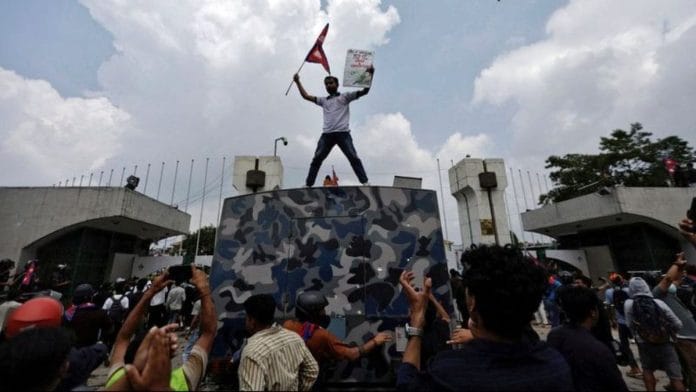
Now, as the elections in Nepal draw closer to the set date of 5 March, major traditional political parties have begun to try different permutations and combinations before heading to the polls. The outcomes of the Gen Z movement are seen as an opportunity for newbies in Nepalese politics to make a mark and take the centre stage.
However, a major question arises as to who could be the frontrunners—the old guard or the new, or will the country yet again see another political uprising following the results?
Old guards vs the new
Among the new guards, the RSP appears to have a clear edge in the elections, as it continues to bank on youth candidates who hold impressive educational and professional credentials. The RSP was launched in July 2022—just four months ahead of the fourth general elections in November 2022. A popular media personality turned politician, Lamichhane, has led the party since its inception.
To the surprise of many, the party emerged as the fourth-largest national party in the 2022 federal elections, winning 20 out of 272 seats in the House of Representatives. Lamichhane became a key ally in the coalition government led by Prime Minister Pushpa Kamal Dahal, also known as Prachanda, and held the positions of deputy prime minister and home affairs minister in the cabinet.
Interestingly, since Nepal became a democratic republic in 2008, the country has witnessed the emergence of dozens of new parties at the national level. In 2016, former Prime Minister Baburam Bhattarai, a longtime Maoist leader, left the Maoist Centre led by Prachanda and formed the Naya Shakti Party. However, it failed to make a mark and disappeared quickly.
Similarly, the Bibeksheel Sajha Party, founded by journalist-turned-politician Rabindra Mishra in 2017, also faced a similar fate and has now merged with the RSP.
Why do the newcomers fail? For two key reasons: First, they lose mass appeal due to unclear agendas and overdependence on populist appeal. Second, they evolve into one-man shows with weak institutional structures. Without a clear vision, relatable priorities, and strong second-line leadership, initial public enthusiasm fades, and the movement struggles to sustain credibility and relevance over time.
Meanwhile, RSP, despite its brief stint in politics, has made remarkable advancements. What worked for RSP was the merit-based selection of candidates and its broader appeal in the urban spheres. However, the party has been untouched by controversies.
Lamichhane has faced charges of misappropriation of funds and even served a jail term. He also had to resign as the home minister and deputy prime minister in 2023, following allegations that he was a US citizen, after the apex court verdict.
However, amidst the options available to voters in Nepal, especially among the young voters who were at the heart of the Gen Z movement, RSP might emerge as the game-changer.
While RSP’s original agenda was to fight corruption, bring youth into mainstream politics, and prefer quality candidates over nepotism, its induction of Balen Shah has been viewed as politically rewarding. Shah is a popular figure among the youth, having won Kathmandu’s mayor election as an independent candidate in May 2022, defeating the Nepali Congress candidate with over 20,000 votes.
Balen is undoubtedly popular among the youth, and his identity as a Janjati leader from the Madhes region could further add to his appeal. Balen was also leading the race for interim prime minister after the Gen Z movement in September 2025, but he ultimately extended his support to Sushila Karki.
However, winning the core voters of the traditional parties would be a key challenge for the RSP. Youth may have voiced and won during the Gen Z movement, but national elections would see people across generations participating to win the elections.
Also read: Nepal has a new foreign minister—balancing act with army or diplomatic fix?
Old guards are still old
Former Prime Minister KP Oli’s resignation during the Gen Z movement was a big blow to the traditional political framework of Nepali politics. From Oli’s CPN-UML to the Nepali Congress and the Maoist Centre, all top parties faced backlash during the movement. Based on the outcomes and anguish of the public, particularly the youth, a change of guard in the traditional parties was anticipated.
However, almost all top traditional parties—CPN-UML and Nepali Congress—have retained their leadership, and even the forces within the parties have failed to bring in new leadership. When the belief gained popularity that Oli needed to take a back seat and pave the way for new leadership, especially following the events of the Gen Z movement, he won his third consecutive term at the 11th General Convention of the CPN-UML in December 2025.
None of the factions within the CPN-UML camps, including one led by Nepal’s former President Bidya Devi Bhandari, could dent Oli’s Chairmanship. Now it is unlikely that Oli would give up his ambition of occupying the prime minister’s office again after the March election.
The Nepali Congress Party, on the other hand, is struggling to maintain order within its ranks. In a clear divide between the top leadership. The general secretaries, Gana Thapa and Biswo Prakash Sharma, have demanded holding a special convention to introduce leadership changes, primarily focusing on the change of leadership, especially doing away with the Deuba stronghold on the party and bringing a new generation of leadership, if not youth.
Away from the CPN-UML and the Nepali Congress, the Maoist Centre Party was the first to create an alternative political unity after the Gen Z movement. As a wake-up call from the Gen Z movement and with the approaching elections in mind, Prachanda’s Maoist Centre has joined hands with Madhav Nepal’s CPN (Unified Socialist) and other smaller left parties to merge into a unified Nepali Communist Party.
From winning the first democratically held elections in 2008 to becoming the third-largest party, the Maoists have, however, lost substantial appeal among the electorate over the past decade.
The Maoist Centre, under Prachanda’s leadership, formed the government twice after the 2022 parliamentary elections in coalition with the CPN-UML and Nepali Congress in various configurations and permutations. Meanwhile, Prachanda’s quest to remain in power, despite lacking a clear political mandate and his unwillingness to be in the opposition, has often contributed to Nepal’s political instability. At the same time, the accusation of nepotism under his leadership has also dented the party’s image.
Even then, Prachanda has managed to lead the top office multiple times, because mostly in coalitions, Prachanda has always held game-changing numbers.
However, this is not the first time Prachanda has merged the Maoist Centre into a united Communist front. In 2018, Prachanda and Oli merged their respective parties, branding it as the Nepal Communist Party. While Left Unity remains an ideological base for such efforts, none of these leaders has relinquished their individual leadership quest in the government, and hence, alliances and unities in Nepal fall apart quicker than expected.
Also read: Bangladesh’s February elections are in the Jamaat’s hands. They want a ‘unity government’
Way forward
Despite the new political equations emerging in the backdrop of the Gen Z movement, the behavioural approach of political parties, whether old or new, to politics remains largely unchanged. Power-centric politics, patronage, and short-term manoeuvring continue to define political conduct. It is evident among both the old guard and the new generation, rendering change more rhetorical than substantive.
Therefore, while RSP seeks to benefit from Balen Shah’s popularity, the biggest challenge before them is managing the power struggle between Shah and Lamichhane, as both fall into the same league of popular youth leaders. Meanwhile, the old guard still sees hope in traditional politics and hopes to retain their voter base in the elections. There would be no surprise if the new guards join the old in yet again forming a coalition after the March elections.
However, for a stable and prosperous Nepal, the way forward lies in strengthening democratic institutions, ensuring political stability through inclusive dialogue, and upholding the rule of law. Economic reform, good governance, and national unity must be prioritised to restore public trust and steer the country through its evolving political dynamics, which cannot happen until the parties reform themselves and adopt a people-centric approach.
Rishi Gupta is a commentator on global affairs. Views are personal.
(Edited by Saptak Datta)
Gen Z or Gen Zilch ? And what is worth this obsession with wishing Gen Z will change everything ? Weren’t we all hot blooded when young ? But to be leaders one must always have the acumen of foreseeing the consequences of actions too. Just howling and protesting and vandalizing is not a sign of progressive protest ! Nation building or society building is a painstaking exercise which takes years if not decades.