






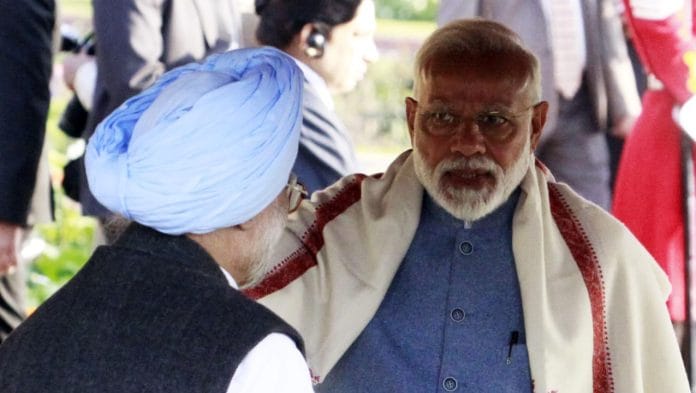



Perhaps the first prime minister to forcefully articulate the government’s stand on Naxalism was the soft-spoken Manmohan Singh. Less than two years in office, he famously termed the ultra-Left guerrillas “the single biggest internal security threat”.
It’s useful to recall these words at a time when two claims are being made: that the Congress (and other non-BJP parties) nourished the insurgency, and that the Modi government has successfully eliminated Naxalism by its 31 March deadline.
Facts suggest otherwise. There may have been occasional and isolated statements by different leaders, but all ruling parties—in states or at the Centre—have nearly unanimously led the assault on the guerrillas.
How the UPA responded
How did the UPA government, often perceived to be ‘soft’ toward Naxals, respond to the insurgency?
On 21 September 2004, diverse guerrilla outfits came together to form the Communist Party of India (Maoist), the organisation that laid the ferocious ambush on the security forces in the following decade. The same day, the UPA held a meeting of the chief ministers of Naxal-affected states in Delhi. A fortnight later, the Union Home Ministry constituted a task force to tackle “the menace of Naxalism more effectively and in a coordinated manner”. It comprised the nodal officers of the nine Naxal-affected states.
Bastar had not yet turned into a theatre of violence. The lanes of Dantewada and Bijapur had not been strewn with landmines. The guerrilla ranks were weak, and so was their weaponry.
Even then, the UPA had intensified its efforts.
In the summer of 2005, under the UPA’s watch, Chhattisgarh launched Salwa Judum. It was led by Congress’s Mahendra Karma, when the state gave assault rifles to Adivasi boys and pushed them into battle against their own brethren.
In April 2006, PM Singh, addressing the second meeting of the Standing Committee of Chief Ministers on Naxalism, termed it “the single biggest internal security challenge ever faced by our country”. His entire speech could be read as a revelation. The most modest of our prime ministers, who rarely voiced what could be called hardline views, articulated his concern in unequivocal words.
Noting a “unanimity” among political parties “to give the problem a very high priority”, Singh outlined a series of measures: strengthen local police, introduce better weapons, fortify police stations, enhance intelligence, incentivise policemen, and protect personnel from undue harassment for actions taken against Naxalites. He even spoke about the need to develop ‘para-policemen’.
“We will not be stingy when it comes to dealing with internal security of our country,” said Singh.
The UPA’s approach is perhaps best illustrated by the alleged fake encounter of Cherukuri Rajkumar in 2010, the Maoist emissary who had been involved in talks with the Union government. Home Minister P Chidambaram had faced constant opposition from activists over his ‘high-handedness’.
Far from being complacent or complicit, the UPA had led a sustained assault on the insurgency. Before the BJP came to discredit dissenters as ‘urban Naxals’, the UPA had told the Supreme Court that “the ideologues and supporters of the CPI (Maoist) in cities and towns” “have kept the Maoist movement alive and are in many ways more dangerous than the cadres of the People’s Liberation Guerrilla Army.”
Also read: Acts of God cases are Acts of State now. The courts are not convinced
Leadership in states
Each of the Naxal-affected states formed their own strategies, often drawing lessons from each other. In Andhra Pradesh, the Telugu Desam Party’s N Chandrababu Naidu took it as a mission, which continued during YS Rajasekhara Reddy’s government, as the state successfully eliminated the Naxal presence from its territory.
Within months of Mamata Banerjee becoming the chief minister of West Bengal, the state saw its biggest encounter—among the biggest ever in the country—when Mallojula Koteswara Rao alias Kishenji was killed in November 2011.
Years later, it was Congress’s Bhupesh Baghel who defied widespread criticism and refused to yield to Naxalism in Chhattisgarh. Along the way, each state also formed their own anti-Naxal units: Greyhounds in Andhra Pradesh, C-60 in Maharashtra and District Reserve Guard in Chhattisgarh.
In fact, it was the BJP government’s negligence that made the Congress the victim of the deadliest guerrilla attack on any political party in India. Several top leaders in Chhattisgarh, including state president Nand Kumar Patel, Karma, and former Union Minister VC Shukla, were killed in a single Naxal ambush in May 2013. The BJP was then in power in Chhattisgarh. It was widely reported that the BJP government had neglected the security of the Congress convoy, which was returning from Bastar. The attack came just months before the Assembly elections; the party could never recover from its aftermath.
A sustained decline
When Prime Minister Narendra Modi took office in May 2014, Naxalism was already on the decline. In 2013, I had reported about a confidential resolution of the Central Committee of the CPI (Maoist) in which they admitted that their organisational strength, manpower and weapons stood considerably depleted.
The guerrillas could still ambush security forces in the following years and inflict big casualties, but they consistently lost their strength thereafter.
It was inevitable. Naxalism was never a localised insurgency with limited demands such as the Naga militancy in the Northeast. It was always conceived as a pan-Indian movement, with a stated aim to occupy power at the national level with clear political-social objectives. The goal of ‘Red Flag over the Red Fort’ was simply too ambitious for a guerrilla army in 21st-century India.
For nearly a decade, the Naxals seemed invincible. But soon, the Centre began pumping paramilitary forces into Naxal zones, and state police began raising their own units. The first CRPF battalion entered Chhattisgarh in 2003. By 2017, the state had 28 paramilitary battalions. Security forces had acquired incredibly superior weapons and surveillance equipment, before which the Adivasi guerrilla found it difficult to hold ground.
There were other factors. Various governments aggressively built a network of roads, making guerrilla hideouts vulnerable. Mobile phones and solar chargers reached previously inaccessible hamlets. And perhaps the most crucial change—the middle class turned away. No underground movement survives without the moral and philosophical support of people in cities, colleges, and institutions. They don’t provide any material or logistic—let alone armed—support to the insurgency. But they do prepare a foundation that seeks to legitimise the battle, that lends the insurgency a moral cover, that clothes violence in the language of justice. With the advance of neoliberalism, the support for the jungle and the marginalised waned. As restless youth discovered the digital mode to express their outrage, the language of protest vanished from the streets.
There was another factor, unique to the Modi era. With a couple of companies aligned with the establishment commanding natural resources lying underneath the jungle, the resistance was crushed even sooner. But perhaps society had already surrendered the space for a resistance movement. It also explains the spate of recent surrenders. The guerrilla fighters have realised that they can no longer sustain their struggle in the jungle. The people for whom they believed they were fighting have simply turned their gaze elsewhere.
Much of the groundwork had already been laid. The present government has simply moved in at the time of consolidation.
Ashutosh Bhardwaj is an independent journalist. He tweets @ashubh. Views are personal.
(Edited by Prasanna Bachchhav)