






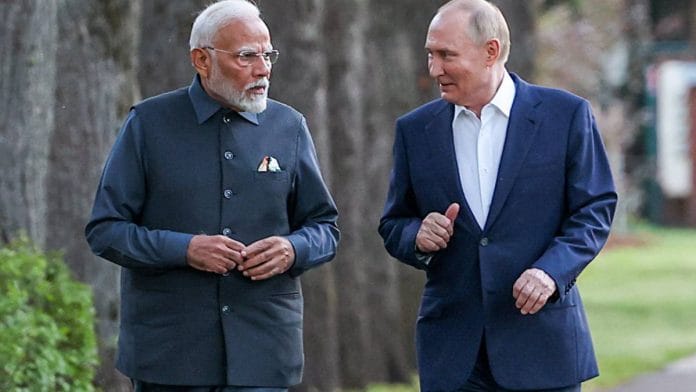



Russian President Vladimir Putin’s visit to India was clearly a signalling effort by two powers that find themselves under considerable international pressure. They wanted to put on a brave face and suggest that they are not, that they have agency and options too. But their weakness also means that they can’t be too aggressive in substantive policy, lest these be unnecessarily provocative, which would be counterproductive.
Hence, a fine balance was needed to demonstrate agency but gently. Whether this works or not depends only on whether the intended targets of the message—the US, China and Europe—are convinced.
It is highly doubtful they would be so convinced because the reality of Russian and Indian weakness cannot be overcome by bear-hugs and car rides, especially considering the shallowness of the actual results from the visit. There was even an agreement on postal cooperation, which really sounded like scraping the bottom of the barrel of bilateral initiatives. It would probably have been wiser not to even include it.
Consuming one’s own unrealistic talk about multipolarity appears to have diverted attention from the material requirements of power, or more accurately, the lack of it. This is true of both Russia and India. Both are significant powers in absolute terms. Unfortunately, in relative terms, which matters much more in the roughlands of international politics, they have both become progressively weaker.
Relative power
Bilateral relations are largely a product of a set of equations based on relative power and interest, not interpersonal ties. The latter is never entirely absent, but they are usually layered on top of these existing power calculations rather than being determinative on their own. But in India, these interpersonal elements are given far too much importance.
This is surprising because the troubles India is currently facing are the consequence of just such a misreading of the supposed interpersonal equation of Prime Minister Narendra Modi with US President Donald Trump. Maybe the hope is that President Vladimir Putin is more honest and straightforward with his personal equations than US President Donald Trump was. After all, how can Indian strategy be without a little fantasy?
Nevertheless, material power is ultimately more relevant, and this is where the two countries have found themselves in difficulty. Putin’s horrendous and unjustified invasion of Ukraine has weakened Russia not only directly through the loss of personnel, equipment and money but also indirectly. Count the strategic cost to Russia: The Western alliance has strengthened, particularly in the crucial Scandinavian region, with Sweden and Finland joining NATO. Moreover, Russian actions have convinced more European powers that they need to get serious about their own defence, though this is at least partly the consequence of the rise of Trumpism in the US.
Trumpism is a weird combination of nativism and unilateralism, difficult to place on any normal ideological spectrum, that appears more focused on the Western Hemisphere and unwilling to defend Europe. The new US National Security Strategy is only the latest indicator. The US had already informed Europe that it had to pull its own weight, and this time, the US appears serious.
Though this at least was not directly Russia’s fault, Moscow will be affected by its consequences. Over time, such an autonomous European defence capability will only make Russia relatively even weaker. Continuing to feud with Europe, which collectively is still about ten times wealthier than Russia, will only make Russia ever more dependent on China. Starting this unnecessary war was imprudent. Continuing it at the enormous cost Russia is bearing only underscores the lack of strategic sense that defines this phase of international politics.
India, equally, has been shown that it is weaker than New Delhi had assumed. Trump, in his fickle and foolish ways, has shown that India’s options are limited. Trump’s tariff pressures meant that India has quietly reduced its purchase of Russian oil to appease Trump, though Russian oil is a cheaper option. There was much talk of new arms deals with Russia, but this also appears to have been shelved, again possibly because of fear of setting off Trump.
Of course, the Indian defence secretary had already stated earlier that India would not be announcing new deals during Putin’s visit. There may have been practical reasons. The SU-57, one of the potential rumoured deals, is a fighter jet that India had already passed on once, after burning its fingers and losing several hundred million dollars in development costs. It is at best a 4.5-generation fighter in a world with many fifth-generation aircraft.
Pakistan will most likely get a Chinese-built fifth-generation combat plane sooner rather than later, and India will be left to play catch-up again. China is building several fifth-generation aircraft, including a long-range bomber, while Russia is struggling with technology that is far behind current frontline aircraft that are being fielded by either the US or China.
Also read: India-Russia persist with ties not due to Soviet-era nostalgia. They see a new strategic logic
Russia not the answer
The other agreements that were rumoured to be on the table, like more S-400 or new S-500 anti-aircraft missiles, may be more useful to India, but they are hardly pathbreaking or need a state visit to accomplish. The Indian S-400s appear to have performed better in Operation Sindoor than the Russian ones did in the Ukraine war, possibly more because of Pakistani incompetence. Still, it is definitely a system the Indian military appears happy with and one of the few pieces of Russian military equipment that is still technologically competitive.
As regards the leasing of another nuclear submarine, which was yet another excited rumour before the visit, its purpose is a little unclear, considering that India now has its own nuclear submarines on which its sailors can train and learn. In any case, despite some breathless commentary by the Indian media, none of these came to pass. It is of course unclear if fear of Trump was the reason why these deals were not reached or whether there were other reasons, but the impression gaining ground is that India did not want to provoke Trump.
Maybe it was for the best. Russia is not the answer to India’s main problem, China. In the current strategic context, Russia will not help India against China. For those who still fondly misremember the 1971 case, it would be even wiser to get over the amnesia regarding Russia’s abandonment of India in 1962. Then, as now, Russia’s constraints are far greater than New Delhi is willing to recognise, and the consequences will be for New Delhi to bear.
Rajesh Rajagopalan is a professor of International Politics at Jawaharlal Nehru University, New Delhi. He tweets @RRajagopalanJNU. Views are personal.
(Edited by Saptak Datta)