






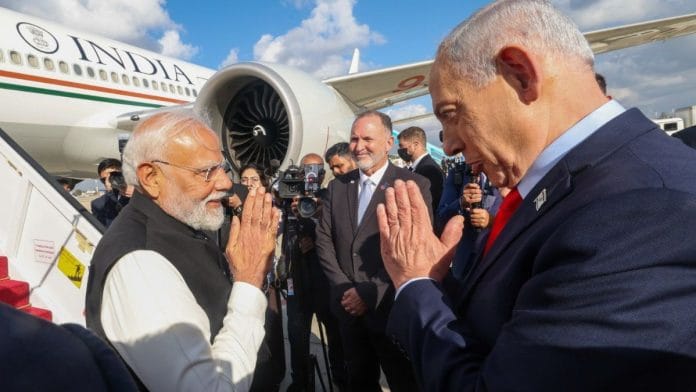



Prime Minister Narendra Modi’s visit to Israel has not only dominated domestic headlines but also gained sharp attention in international circles. The timing is significant. Israeli Prime Minister Benjamin Netanyahu has recently urged the formation of a new regional bloc, describing the Middle East as divided between “radical Sunni and Shia axes”.
He proposed what some analysts are referring to as a “hexagon alliance”. In that wider geopolitical framing, every diplomatic gesture carries a deeper meaning.
India’s relationship with Israel is not new. Defence cooperation, intelligence sharing, and technology exchange—these ties have grown steadily over decades, cutting across political parties in India. But when Modi visited Israel at a time when new blocs are being imagined, it inevitably raises questions.
Is India positioning itself within a shifting regional architecture? Is this about security partnerships, counter-terror cooperation, and technology? Or is it a careful balancing act, given India’s long-standing ties with Gulf countries and its large diaspora population across the Middle East?
A mutually beneficial relationship
India has, for the most part, tried not to get trapped in the Sunni-Shia and this-bloc-versus-that-bloc binaries of West Asia. Our approach has been practical rather than ideological. We built ties with Israel, but we also kept doors open with Iran, Saudi Arabia, the UAE, and other Middle East countries. We spoke to everyone.
In a region where alliances change faster than headlines, India’s strength has never been choosing sides loudly. It can sit across the table with all sides—sometimes quietly, sometimes strategically, without turning diplomacy into drama.
That is precisely why India’s Israel policy has always carried two parallel tracks. On one hand, India has historically stood in support of Palestine and consistently spoken the language of human rights and a two-state solution. On the other hand, it has steadily deepened strategic ties with Israel. For decades, New Delhi managed to hold both positions without collapsing into contradiction.
The relationship between India and Israel has largely been mutually beneficial. For India, Israeli cooperation in defence, intelligence, water management, and agricultural technology has been significant. When several Indian states were struggling with drought and inefficient farming methods, Israeli drip irrigation and agri-tech partnerships became practical, not ideological, solutions.
For Israel, India offered something equally important—a vast market, a growing economy, and a large democracy willing to engage openly at a time when Israel often faced diplomatic hostility from many parts of the world. It has always been about national interest.
That has always been my understanding of India’s foreign policy. But watching the social media debates around this visit has been… revealing.
Also read: British rule couldn’t make India a Christian country. Marco Rubio is no threat
Strong diplomacy
I have seen comments saying India should not maintain close ties with Israel because it is “offensive” to Indian Muslims. I find that argument deeply flawed. It assumes that Indian Muslims think only through a global religious lens, that their primary loyalty lies elsewhere. It reduces them to a single emotional identity and ignores the fact that they are citizens of India first, with the same stake in national interest as anyone else.
If the argument were framed around humanity, civilian suffering, and moral positions on war, among other similar discrepancies, then it would be a different discussion. That is a conversation worth having. But when it is framed as “this hurts Indian Muslims,” it slips into something else. It implies that Muslims in India cannot distinguish between foreign policy and faith, between geopolitics and identity. And the truth is, many Arab states have already normalised ties with Israel (Abraham Accords).
Now, take our own neighbourhood. Bangladesh is currently facing serious concerns over violence against Hindu minorities. Does that mean India should cut off diplomatic and strategic engagement with the Bangladeshi government because it might hurt Indian Hindus emotionally? Of course not. Nations operate on interests, stability, and long-term strategy. Human rights concerns must be raised, but diplomacy does not work through emotional boycotts.
What unsettles me is how quickly everything is being filtered through loyalty tests. As if every community must have its own foreign policy. As if Indian Muslims must think one way, Indian Hindus another. Where does this end?
It feels like we are slowly dividing India into small, suspicious camps, each policing the other’s loyalties, leaving very little space for a larger idea of shared citizenship or even shared humanity. And that, perhaps, is more dangerous than any diplomatic visit.
Furthermore, when it comes to “hexagonal alliance,” it is worth stepping back from the dramatic framing. For now, it appears more rhetorical than real. No government has publicly endorsed it. Two of the countries—Greece and Cyprus—that Netanyahu named are members of the International Criminal Court (ICC).
With an ICC arrest warrant reportedly hanging over him in relation to Gaza, those countries would be legally obligated to act if he were to enter their territory for now. That alone shows how complicated and fragile such grand alliance-building can be. Diplomatic speeches are one thing. Sustainable blocs are another.
Amana Begam Ansari is a columnist and writer. She runs a weekly YouTube show called ‘India This Week by Amana and Khalid’. She tweets @Amana_Ansari. Views are personal.
(Edited by Saptak Datta)
Why this muhammadan girl is worried about India-Israel relation, why does it concern you?
I mean it is none of your business. Hindus would determine India’s FP muhammadans have no business. You worry about your pakistan okay. India is not your country you are a tenant.