







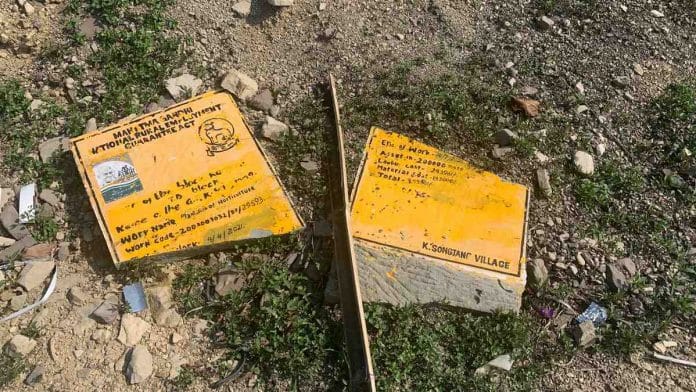



The Mahatma Gandhi National Rural Employment Guarantee Act, or MGNREGA, was repealed by the BJP’s determined efforts on 18 December 2025. Gone is a law that guaranteed any rural household 100 days of work on demand, within a 5-km radius of their village, to be paid at no less than the state minimum wage rate, with payments to be made within 15 days.
In its place, Parliament has passed the Viksit Bharat Guarantee for Rozgar and Ajeevika Mission (Gramin) Bill, or VB-GRAMG. It marks the end of a long-fought-for era that brought with it many gains.
For the first time in the history of the world, a national government attempted to recognise the right to work as a universal entitlement in rural India with MGNREGA. Despite many alarmist predictions, it did not make the Indian economy “collapse” nor did it prove to be a “total waste of money”.
Most studies showed that it did the opposite. It kickstarted the rural economy, brought depressed wages closer to minimum wage levels for the first time, acted as a bulwark during the economic downturn of 2008, and later cushioned the economic disaster that followed Covid in 2020. Most importantly, it gave dignity to the worker, brought women into the workforce, and served as a means of empowering vulnerable workers against exploitation, feudalism, and unemployment resulting from market instabilities.
What provoked the repeal of this law and its replacement with a new piece of legislation? It is, in fact, all about the money.
Also Read: MGNREGA was democratic state-building. VB-GRAMG turns welfare back to mai-baapism
Govt’s discomfort with MGNREGA
The contentions about the successful implementation of MGNREGA began soon after it started being implemented. MGNREGA is demand-driven, and therefore the only law that could not be constrained by budgetary allocations. With every passing year, it became apparent that there was resistance from a powerful economic class even to allocate the 1 per cent of GDP that MGNREGA was estimated to require, or even the 0.5 per cent that was eventually, and reluctantly, provided.
The distaste for a rights-based framework was made clear by Prime Minister Modi in Parliament in 2015—when he referred to MGNREGA as a “living memorial to [Congress] failures”. We would argue that this suggests a desire to divert money elsewhere and from an ideological position against rights.
Every year, important discussions about Union Budget allocations would focus on pending liabilities from the previous year and the consequent underfunding in the budget itself. The Indian economy was growing, but there was no share for the working poor in the minds and hearts of the affluent class. In 2020, the budget went up in real terms when Covid forced the government to provide an additional Rs 40,000 crore to MGNREGA to save the lives and livelihoods of crores of workers who had been aggressively pushed into reverse migration from cities where they were part of the “growth-led” Indian economy.
Even with the increased allocation in 2020, the year ended with pending liabilities, indicating how much MGNREGA had served as a lifeline for rural India. Soon after Covid, budgets were reduced again, returning MGNREGA to its familiar problems of failing to meet demand.
As workers began to exercise their rights, and even take issues to court, the government realised that it had no choice but to either implement the programme or fundamentally change the nature of the employment guarantee for the rural unemployed. It chose to change the law decisively. Perhaps to stave off political fallout, the new law was initially presented as an enhancement of workdays, from 100 to 125, for all rural citizens.
But what does the new law really do?
A way to save and extract money
The new law is essentially a way for the Government of India to save money and to legally empower itself to do so. It also allows the Centre to extract money from states for whatever conception of “Viksit Bharat” it chooses to roll out.
The claim that the new law provides an employment guarantee is incorrect. The only guarantee it gives is to “empower” the central government to allow partial implementation in notified areas alone. This takes away the core entitlement of MGNREGA of providing work on demand across rural India. The central government will decide on the financial allocations to each state under normative conditions defined and controlled by it.
Meanwhile, all responsibility for implementation in notified areas is shifted to state governments, which are now liable to pay unemployment allowances and compensation for delays in wage payments. Most diabolical is the legal provision mandating a 60-40 cost-sharing ratio — forcing states, without consultation or consent, to contribute 40 per cent of the normative allocation determined by the Centre.
The two major economic rights laws, MGNREGA and the National Food Security Act (NFSA), placed almost the entire financial burden on the central government so that states could not object to implementation on the grounds of lack of resources. Signs of trying to save resources in food allocations for the poor are already visible, and it may not be long before states are asked to share that burden as well.
It remains to be seen how this new model of fiscal centralism, which flies in the face of federal principles, will be viewed by states and the courts. Or perhaps the Centre will simply choose not to run the programme where states object, thereby saving even the 60 per cent it has promised, while blaming states for the failure to provide employment.
Also Read: Why the VB-GRAMG Bill strikes at the heart of MGNREGA
What will happen next?
What happens to the Indian rural worker, and how will the 125 days of employment be provided? The short answer is that there is no employment guarantee.
The 125 days is a deliberate and cynical ploy to confuse people. Large sections of the media have already projected the government’s misleading assurance, without questioning how its contradictory logic will work. People across rural India have been misled by the assurance that their employment guarantee has been enhanced to 125 days. However, it’s a matter of their life and livelihood, and they are well aware of how difficult it has been even with a strongly enabling law. People in urban areas may be taken for a ride by propaganda from spokespersons, but rural workers will soon know when their demand for work is rejected.
Undermining minimum livelihoods will have repercussions. Protests have already begun in different parts of the country and are bound to grow as rural distress drives more people onto the streets. The passage of the VB-GRAMG law in Parliament, amid a din, torn papers, and a refusal to send it to the standing committee for further discussion, does not mean the debate is over.
Given the 15 crore people at work across the country, this bulldozed law is likely to have strong political consequences, which could eventually result in the return of the people’s right to work in the statute books.
Aruna Roy and Nikhil Dey are social activists and co-founders of the Mazdoor Kisan Shakti Sangathan (MKSS). Views are personal.
No where in the article author had presented its ideas with facts. They have just asserted that it’s not right such as below statement:
The only guarantee it gives is to “empower” the central government to allow partial implementation in notified areas alone.
How new law is doing that they are not explaining. We can expect the same from authors that they can be partial, but, how can The Print editing team let it publish