









With Iran’s grip on the Strait of Hormuz still tight, the Union Ministry of Petroleum issued a Natural Gas Control Order on 9 March under the Essential Commodities Act, prioritising households and hospitals. Long queues, however, still formed at distribution centres across the country, while restaurants warned of distress and possible shutdowns.
Indian society and the state have a long history of grappling with supply shocks, especially before the advent of modern agricultural technologies and regulatory frameworks. From Kautilya’s Arthashastra t
Dealing with famine
For premodern states, shocks to the food supply were much more of a concern than fuel shortages. In the earliest surviving text of Indian statecraft, the Arthashastra, kings were envisioned as directly correcting the supply. They were, according to Kautilya, supposed to “gather a stockpile of foodstuffs and then grant favours: work on forts or irrigation projects in exchange for foodstuffs; or distribution of foodstuffs…” (Book 4, Chapter 3, Verse 17.)
Two inscriptions from the 3rd–2nd centuries BCE suggest that local officials took stockpiling seriously. The Sohgaura copper plate in Uttar Pradesh’s Gorakhpur declares, “The order of the Mahamatas (possibly Mauryan officials) of Shravasti: These two storehouses… of fodder and wheat… are used in urgent need: not to be taken away.” Far to the east, but probably in the same period An edict found in Mahasthangarh, Bangladesh, records an official order to a granary custodian: The local residents, struggling after a flood, were permitted to withdraw both paddy and copper coins from the district storehouses.
Not all early Indian states were bureaucratised enough to attempt such relief measures. Several centuries after the Arthashast
However, other authorities stepped in. Stephen notes multiple cases, such as at Alangudi in 1054, where the village assembly mortgaged common lands to the local temple. In return, they received a loan of temple jewels and vessels “to maintain the people” and resume cultivation. It seems that temples, with substantial holdings of both liquid capital and real estate, were able to at least partially blunt the impact of famines. But this required villages and individuals to become temple dependents through financial or service relationships, as noted by historian Leslie Orr in her paper “Slavery and Dependency in Southern India” for The Cambridge World History of Slavery. Some villagers ended up as indentured labourers. This pattern continued into the 1200s, as states in the region, struggling with political turmoil and long-standing mercantile, aristocratic, and temple privileges, proved unable to impose themselves successfully on agricultural supply chains.
Also Read: India has lost the language for Iran
Preventing famine?
It took a violent rupture to create new models for state intervention. In the late-13th century, the ferocious Turco-Afghan aristocrat Alauddin Khilji seized the throne of the Delhi Sultanate. Facing Mongol pressure from the north—along with an army he could not pay at market rates—Khilji instead imposed his will on the market. As historian Irfan Habib writes in ‘The Price Regulations of Alauddin Khalji: A Defence of Zia Barani’, the chronicler Barani claimed that Khilji extracted half the grains produced in the upper Gangetic plain as tax. Peasants were compelled to sell surplus to grain-carriers at low prices, who in turn sold it at prices ordained by the Sultan. Unlike his contemporaries in the south, Khilji was both willing and able to crush those who defied his orders, thanks to his market superintendents, spy networks, and mobile cavalry-based armies.
These measures, though, were limited to Delhi rather than the wider Sultanate, and did not survive Khilji’s death. But the key point is that the Indian states were increasingly able to make supply-side interventions, due in part to their growing bureaucratic abilities. Soon after Khilji, as Habib writes in ‘Usury in Medieval India’, Sultan Muhammad bin Tughlaq ordered wells dug in the countryside and provided cheap loans to cultivators, demanding repayment in grain. All these further insulated the supply.
By the time of Mughal rule, according to Habib, this had become “a familiar, almost routine, administrative practice” in north India. The Mughal state did not attempt to control the entire grain supply chain; instead, it focused on producers. From Akbar onwards, cultivators could request taqavi, interest-free loans for seeds and cattle (though, in practice, local officials probably demanded a cut). While the grain market was fairly stable, the Mughals strained the system through ever-escalating revenue demands and a volatile system of jagirs or revenue assignments to an ever-growing mountain of functionaries. By the late 1600s, an agrarian crisis was in full swing, with Jat, Satnami, and Sikh peasants in revolt against the Mughal crown.
Also Read: The story of India’s forgotten Afghans — horse-traders, mercenaries, kings
The withdrawal and return of the state
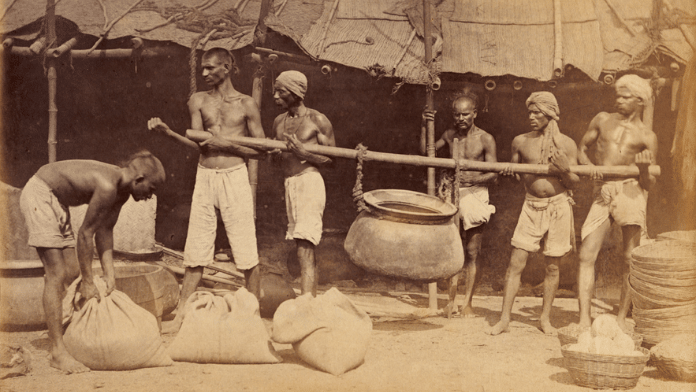
In the regulatory vacuum, grain merchants, primarily Baniyas, ran amok. In ‘Usury, Dearth and Famine in Western India’, historian David Hardiman studies the sahukar, the Baniya trader-cum-usurer of western India. The sahukars provided loans to pay taxes; for agricultural equipment, for livestock, for seed; they advanced grain in lean months. At harvest, they collected everything, with interest, directly from the threshing-floor, leaving farmers with a bare subsistence. The grain then disappeared into sahukar stockpiles and was released onto the market at prices suitable to them. The sahukars, however, could not, by custom, take the peasants’ ancestral land rights. In fact, after all the exploitation, they did attempt to keep farmers alive during times of crisis (even if only to prevent them from migrating away). They might provide a trickle of rations to rural clients during famine. In larger cities, Baniya associations even occasionally distributed cooked food — Hardiman notes examples in 1631–32, 1832–33, and 1899–90.
Indian rulers typically pressured Baniya traders to release stockpiled food supplies, as they did during a drought in Rajasthan in 1891, and again in 1899, when officials opened a shop to sell grain at cost, forcing the traders’ prices down. However, British authorities, believing in the principles of the free market and contract law, intervened on the side of the traders even in times of acute distress, dispersing desperate protestors or allowing usurers to take over peasants’ ancestral lands as property. This effectively made cultivators an inconvenience in the roaring debt speculation business.
By removing itself from supply-side interventions, the British Raj allowed pre-existing practices to run riot, for better or for worse. Moreover, British railways could quickly transport grain far away from agrarian areas, at a scale that the Mughal-era sahukars c
The Essential Commodities Act of 1955, which the Union government invoked last week, signaled the re-entry of the Indian state. Having watched Bengal starve just twelve years prior, leaders of the newly independent India were determined never to see its like again. As such, Indian leaders insisted on a right to intervene in markets during shortages—a right which had a long history of its own in the premodern past. If queues at the gas agencies shorten, it’ll turn out that Kautilya, at least on this front, was absolutely right.
Anirudh Kanisetti is a public historian. He is the author of ‘Lords of Earth and Sea: A History of the Chola Empire’ and the award-winning ‘Lords of the Deccan’. He hosts the Echoes of India and Yuddha podcasts. He tweets @AKanisetti and is on Instagram @anirbuddha.
This article is a part of the ‘Thinking Medieval‘ series that takes a deep dive into India’s medieval culture, politics, and history.
(Edited by Insha Jalil Waziri)