









I’m not an F-up,” she always says. But little did Apurva know, it takes more than having a stable job to shake that label. She started smoking weed while studying at IIT-Kanpur. It quickly spiralled into owning a bong, grinders, rolling paper, and knowing how to score in every city—this 420 fascination became a lifestyle. Having no father figure and an emotionally absent mom, this neo-Buddhist Dalit girl slowly turned into a self-proclaimed “girl who likes to smoke up”. A one-dimensional personality.
Across societies, substance abuse has long followed the fault lines of oppression. Native American communities in the United States struggle with alcoholism rooted in dispossession and cultural erasure. African Americans face higher rates of drug criminalisation and addiction shaped by slavery, segregation and systemic racism. These patterns are now widely understood as outcomes of historical trauma, not individual weakness. India, however, remains reluctant to apply the same lens to caste. When Dalits drink, smoke, or spiral into addiction, the dominant explanation is moral failure. Rarely do we ask what centuries of humiliation, violence and exclusion do to the human psyche and body over generations.
Data already tells us what public discourse refuses to admit. National surveys consistently show that alcohol and tobacco use are higher among Scheduled Castes than among upper-caste groups. The National Family Health Survey (NFHS-5) records a higher prevalence of alcohol consumption among Scheduled Caste and Scheduled Tribe men compared to forward castes, a pattern mirrored in tobacco use among both men and women.
Maharashtra, often projected as a progressive state, is no exception. Studies by Oxfam and state public health departments show disproportionate substance dependence in Dalit-dominated rural belts and urban slums, particularly among men engaged in informal, hazardous labour. Yet numbers alone do not explain why these patterns persist across generations.
To understand this, one must confront inter-generational trauma—a concept still treated with suspicion in India, as if acknowledging psychological inheritance weakens personal
responsibility. Trauma does not vanish with time; it embeds itself. When a community lives for centuries under graded inequality, is denied dignity, pushed into stigmatised labour, subjected to routine violence, and told repeatedly that they are less than human, the stress response becomes chronic. Cortisol levels remain elevated. Anxiety becomes an inherited behaviour. Silence becomes survival. Substance use, then, is not indulgence; it is regulation.
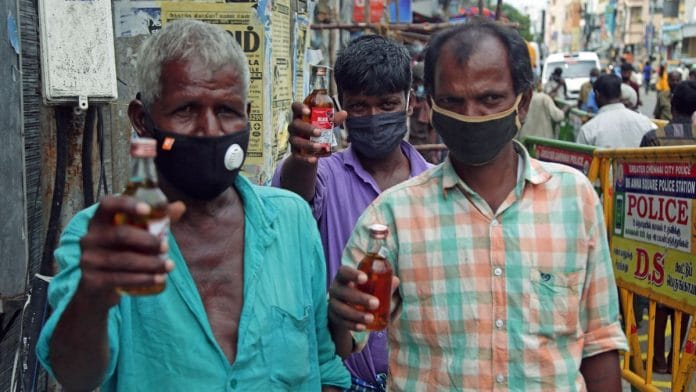
In Maharashtra, the geography of addiction often overlaps with the geography of caste. Sugarcane cutters, sanitation workers, tannery labourers, construction hands, many from Dalit communities, operate in physically brutal environments with little job security and no mental health support. Alcohol becomes a painkiller, antidepressant, and social glue. Country liquor shops cluster around labour camps and Dalit bastis not by coincidence, but because markets follow vulnerability. The state taxes the bottle, while condemning the drinker.
Also read: Dalit dating in India is a choice between dignity and loneliness
Moralising language, invisible struggle
What makes caste trauma distinct from other forms of deprivation is its inescapability. Poverty can change; caste sticks. A Dalit child may grow up watching a parent humiliated at work, addressed by caste name, or denied basic respect. These experiences shape self-perception long before adulthood. Research in social neuroscience increasingly shows that chronic social stress alters neural pathways related to impulse control and reward. Addiction, in this sense, is not merely learned behaviour; it is embodied memory.
Mental healthcare systems in India are neither equipped nor inclined to recognise this. Public de-addiction programmes focus on abstinence without addressing the cause. Counselling frameworks imported from Western psychology speak of “individual triggers”, while ignoring structural violence. For a Dalit man in a Maharashtra village, therapy that refuses to name caste is not neutral; it is erasure. As one Dalit rights activist from Marathwada puts it, “You cannot heal a wound while pretending the knife does not exist.”
Women in Dalit communities carry a different, quieter burden. NFHS data shows lower alcohol consumption among Dalit women compared to men, but significantly higher tobacco use than upper-caste women. Chewing tobacco becomes a socially permissible coping mechanism in lives defined by unpaid labour, domestic violence, and economic precarity. Yet policy discourse rarely recognises this as addiction at all. Dalit women’s suffering is normalised to the point of invisibility.
The moralising language around addiction also does real damage. When substance use is framed as a lack of willpower, the solution offered is punishment or shame. Families internalise blame. Communities fragment. Meanwhile, the structural conditions remain untouched. Contrast this with how addiction among urban, upper-caste youth is discussed—as stress, burnout, or existential crisis. Same substance. Different sympathy.
There is also an uncomfortable political economy at work. The Indian state profits enormously from alcohol revenue, much of it extracted from marginalised communities. In Maharashtra, excise duty constitutes a significant portion of state income, even as alcoholism devastates Dalit
households. Welfare schemes address the symptoms ie. hospitalisation, malnutrition, domestic violence, but never the root. It is easier to police bodies than to dismantle caste.
Also read: Now Haryana has a drug problem too. And unique ways of fighting it
Not a personal vice
Breaking this cycle requires a shift from moral judgement to public health and social justice. Trauma-informed policy must recognise caste as a determinant of mental health. De-addiction programmes need to be community-based, culturally grounded, and explicitly caste-aware. Mental health workers must be trained to understand how humiliation, exclusion and inherited stigma shape behaviour. Employment, dignity, and psychological safety are as essential to recovery as sobriety.
Most importantly, India must abandon the convenient fiction that caste no longer matters. Addiction in Dalit communities is not a personal collapse; it is a social indictment. It reflects what happens when a civilisation normalises inequality for centuries and then feigns surprise at its consequences. Until caste oppression is addressed as a lived, embodied trauma and not a historical footnote, the bottle will remain both refuge and ruin.
Apurva has attended vipassana meditation course twice, even helping as a server. But addiction is hard to shake off when it becomes a personality trait and an escape mechanism.
India likes to speak of addiction as a personal vice because that absolves society of responsibility. It allows caste Hindus to tut-tut at Dalit addiction habits, while continuing to benefit from a social order that produces despair as efficiently as it produces labour.
As long as caste remains untouched, addiction will keep finding new forms (bottles, sachets, pills) because trauma always seeks an outlet. Until India is willing to dismantle the conditions that make numbness necessary, every sermon on sobriety is just another act of denial dressed up as concern.
The question, then, is not why Dalits drink more. It is why India refuses to see what it has done to them.
Vaibhav Wankhede is a creative marketer and writer. Views are personal.
(Edited by Theres Sudeep)
Alcohol and tobacco are a part of human civilisation. Right from a King to a beggar, every one drinks alcohol. Most doctors booze and smoke weed. It is their money, their health, and their choice. Intelligent and unintelligent people smoke and drink. Even children do it. A family known to me have normalised them to such an extent that doing them in front of their toddler is just like breathing oxygen and drinking water. Caste doesn’t matter. Upper caste drunkards and dalit teetotallers exist. Women do it more than men. Just go to a women’s public toilet, it will be filled with smoke of tobacco/ weed. Only the point of view differs—one may see it from caste angle, another may give two hoots to it. That toddler of today will most likely become a smoker and a drunkard in future thinking it is normal. Like how most women have normalised obesity, alcohol and tobacco are also normal.
Next up – liver cirrhosis checks caste documents. This is what happens to fanatics of identity.
Do you actually want to see a caste blind society ? I don’t think you want to. You don’t bring any data whatsoever to show that there are more alcohol shops in Dalit area then in other areas.
Dude are you going to blame caste for porn addiction tomorrow ? Seriously what is this shit ? They all depend on these anecdotes and BS victimhood epistemology to soothe themselves.
No one gives a damn in an urban space about your caste, how many kids (urban) in today’s generation have you seen talking about caste ? You will cling on to it even if you become a millionaire because you need something to blame the society instead of blaming yourself.
I was seeing this video of a girl from the dharavi slums who is trying to become a model. She literally became the face of a luxury brand – forest essentials. You know what will happen when people like her might have a fall in her life ? You will go and pull her down by blaming this society instead of saying “pick yourself up”. Man I hope she doesn’t meet your kind who are so depressing.
To finally break your argument completely- what about the Jews ? They are most persecuted group on this planet. No one comes to close to their suffering. Dalit activists would love to see themselves as that kind of victims but you are not.
Jews are the most successful community in this planet. So why are you not successful like the Jews, given that historically you have not gone through anything similar to them.
Dalit community will continue to fail because of people like you who don’t want to give them light. If you had actually made it about beating the society instead of blaming it, maybe you would have not have to sitting here and making shitty articles about “alcohol” which is drank by everyone.
I wrote this long comment because I just want this identity BS to end in this country.
The issues of Dalit sugarcane cutters, needs to be addressed. Much of this is caused by govt patronizing sugarcane unconditionally. That’s why, we need farm laws.