









The backdrop is everything… they tell the story of the people living there. Every backdrop has a story behind it and I believe it contributes immensely,” Tamil Director Pa. Ranjith had once said.
For years, Dr BR Ambedkar was treated like an ‘untouchable’ by Bollywood’s casteist filmmakers. Forget the foreground, he was erased even from the backdrop of scenes for a long time.
Take, for instance, the 1982 Hollywood classic Gandhi. Not only is there no mention of Ambedkar as a character, there isn’t even a passing reference to him in the three-and-a-half-hour-long film. This is extremely surprising, given Ambedkar’s stature in India’s history—as the father of the Constitution, the country’s first Law Minister, and one of the most vocal advocates for the oppressed classes and for women.
Biographies tend to feature the principal opponents of the historical figures they depict. Ambedkar was known for putting Gandhi on the defensive over his socio-political and religious positions, eventually leading him to resort to a fast unto death over the issue of separate electorates for Dalits.
In a way, Richard Attenborough’s Gandhi, though a Hollywood production, turned out to be a perfect illustration of how India’s governing class treated Ambedkar until the 1990s. His portrait was missing from the Central Hall of Parliament for over 40 years after Independence, despite his role as the chief architect of the Constitution. It took nearly 32 years after Independence for Ambedkar to begin appearing in Indian films. Even school and college textbooks barely covered him or his contributions. For a long time, he was largely absent from TV, radio, and other audio-visual media.
India’s upper castes, who constituted the governing class, had simply turned a blind eye to Ambedkar’s immense contribution as a builder of modern India. Unsurprisingly, this neglect was reflected in Hindi cinema.
Also read: A new TV show on B.R. Ambedkar raises questions of responsible representation
Negligible representation
Portraits of political leaders from upper caste, or savarna, backgrounds, such as MK Gandhi, Lokmanya Tilak, Jawaharlal Nehru, Lal Bahadur Shastri, Subhas Chandra Bose, and even Swami Vivekananda, were predominantly featured as backdrops in Hindi films made by savarna producers and directors.
Even when Bollywood did tell stories about Dalits—which was rare in itself—Ambedkar remained absent. A telling example is Bimal Roy’s Sujata (1959), in which the Brahmin protagonist, Adhir Chaudhary (Sunil Dutt), falls in love with an ‘untouchable’ woman, Sujata (Nutan). Adhir is ‘liberal’ enough to have portraits of Rabindranath Tagore, Gandhi, and Vivekananda in his home, but not Ambedkar.
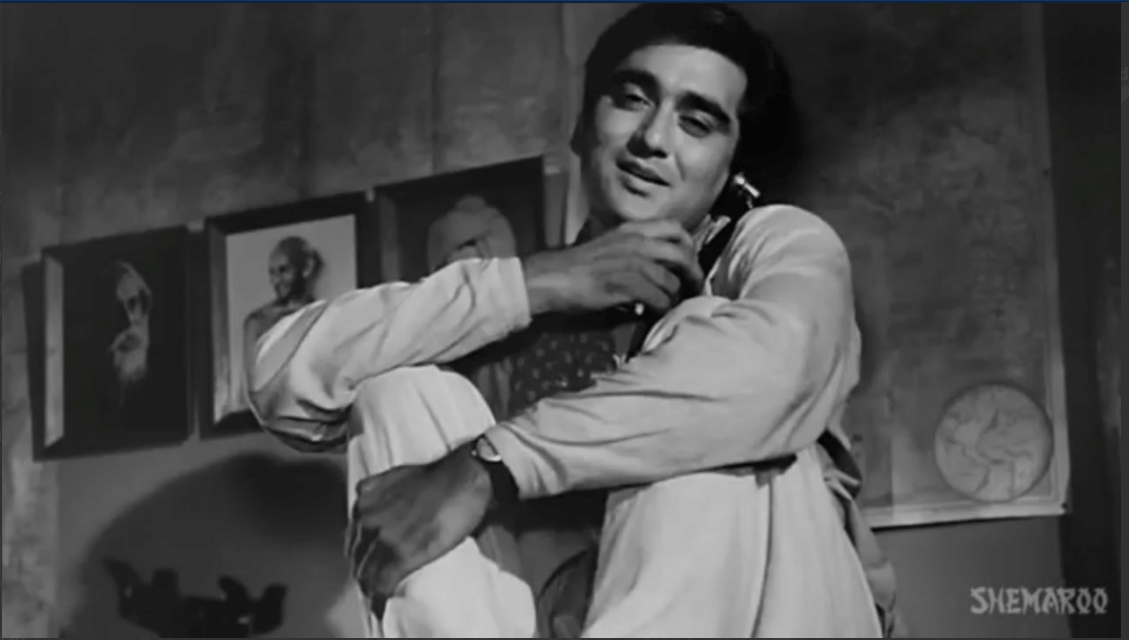
One could argue why a Brahmin, however progressive, should have had a portrait of Ambedkar in his home in the 1960s. That may be a fair point. But consider Tapan Sinha’s Zindagi Zindagi (1972), in which Sunil Dutt plays a doctor from an ‘untouchable’ family. The film features not one but two inter-caste love stories, yet Ambedkar is entirely absent from the backdrop here as well.
His absence in Hindi cinema was not limited to the homes of lead characters; it extended to the walls of courtrooms, police stations, and government offices.
Director Jabbar Patel’s biopic sought to change this, although gradually. In his English-Hindi film Dr. Babasaheb Ambedkar (2000), Patel created a vivid portrait of Ambedkar’s life, education, and political journey. He brought to life Ambedkar’s famous duel with Gandhi, brilliantly juxtaposing their contrasting worldviews. The film found critical success despite limited screenings and producers’ reluctance to release it in multiple languages. In Tamil Nadu, for instance, it was not released publicly for nearly 12 years after its completion, with authorities reportedly unwilling to take it to a wider audience.
Hailing from the Marathi film industry, Patel was perhaps the first director to use framed portraits of Ambedkar in his film’s backdrops, beginning with his 1979 classic Marathi political drama Sinhasan. Incidentally, that was the same year that the Sharad Pawar-led Maharashtra government began printing volumes of Ambedkar’s unpublished writings and speeches.
No one had used backdrops to create an omnipresence of a figure like Ambedkar as brilliantly as Jabbar Patel did. In his Marathi Smita Patil-starrer Umbartha (1982), a large portrait of Ambedkar could be seen on the walls of Patil’s office in a women’s ashram. Ambedkar appeared in the backdrop again, in Patel’s award-winning inter-caste love story Mukta (1994).
Also read: Unlike in the West, Dalits have built statues to resist historical oppression
BSP phenomena of the ‘80s
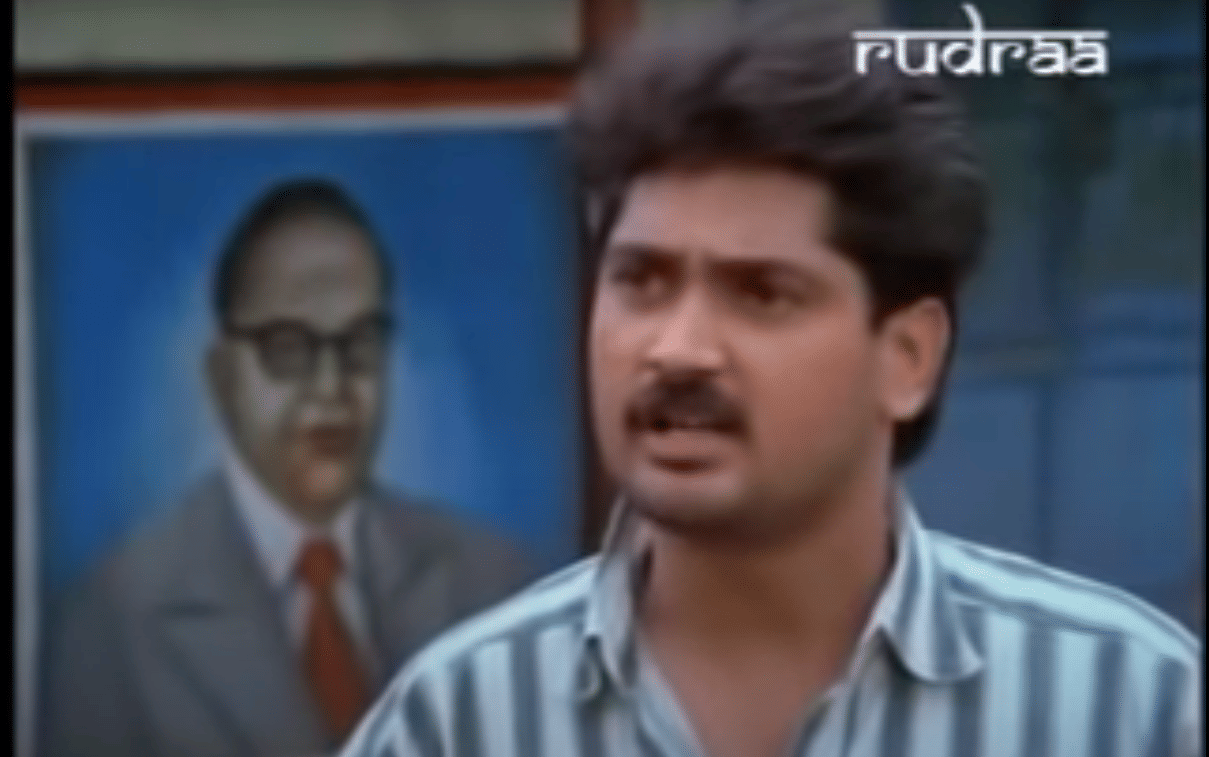
However, barring some Marathi films, Hindi cinema did not feel Ambedkar was backdrop-worthy films till 1985. This was around the time the Kanshi Ram-led Bahujan Samaj Party (BSP) emerged as a powerful political force, especially in north India.
This new wave Bahujan assertion manifested in Ambedkar’s statues being erected in every nook and corner of cities and towns, though BSP did not formally come to power until 1995. Kanshi Ram was part of the Dalit Shoshit Samaj Sangharsh Samiti (DS4) and the Backward and Minority Community Employees Federation (BAMCEF) — an association of SC, ST, and OBC minority employees — all of which followed the practice of mounting Ambedkar portraits on their office walls, inside government buildings.
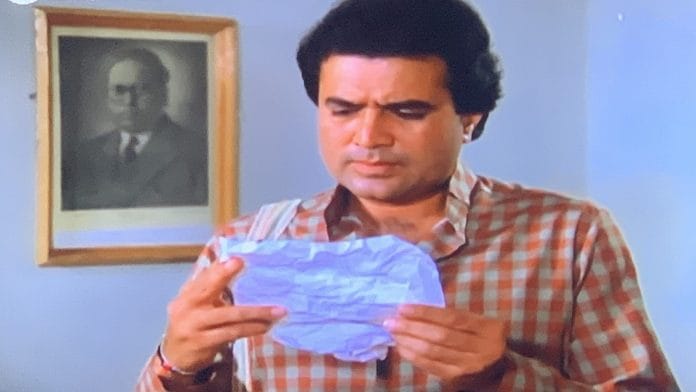
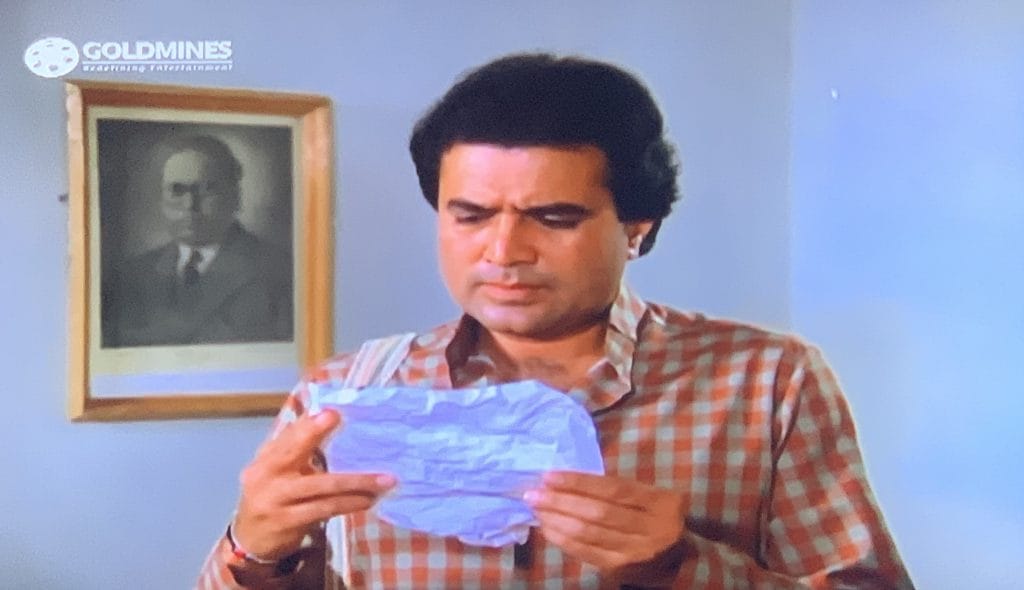
As the BSP wave grew, Ambedkar slowly found resonance in Hindi cinema. The first evidence of this in a big mainstream movie was probably the 1985 Rajesh Khanna-Smita Patil starrer Akhir Kyon? In the film, Patil’s character Priya works in the government-run Doordarshan network, and has an Ambedkar portrait right above her office chair in her cabin. I suspect that director J. Om Prakash, who was Punjabi by birth, may have had some knowledge of the Punjab-born Bahujan leader Kanshi Ram and his work.
After the Rajiv Gandhi government fell in 1989, subsequent Prime Minister V.P Singh’s government accelerated Ambedkar’s brand and his portrait was finally installed in the Central Hall of Parliament. Ambedkar was also posthumously awarded the Bharat Ratna, India’s highest civilian honor, in 1991.
Soon after this, in 1992-93, the Ministry of Information and Broadcasting and Doordarshan released a biographic Hindi serial on Ambedkar’s life titled “Special feature on Dr. B. R. Ambedkar“.
Also read: Unlike Colston or Columbus, Ambedkar Memorial statues deserve their place in public spaces
Mainstream representation
The process of mainstreaming Ambedkar has been slow, but today, his image in Hindi movies is more prevalent than ever.
India’s Oscar entry for 2017, Rajkummar Rao-starrer Newton, prominently features Ambedkar on the walls of the protagonist’s house, covertly depicting the lead character Newton, as a Dalit man.
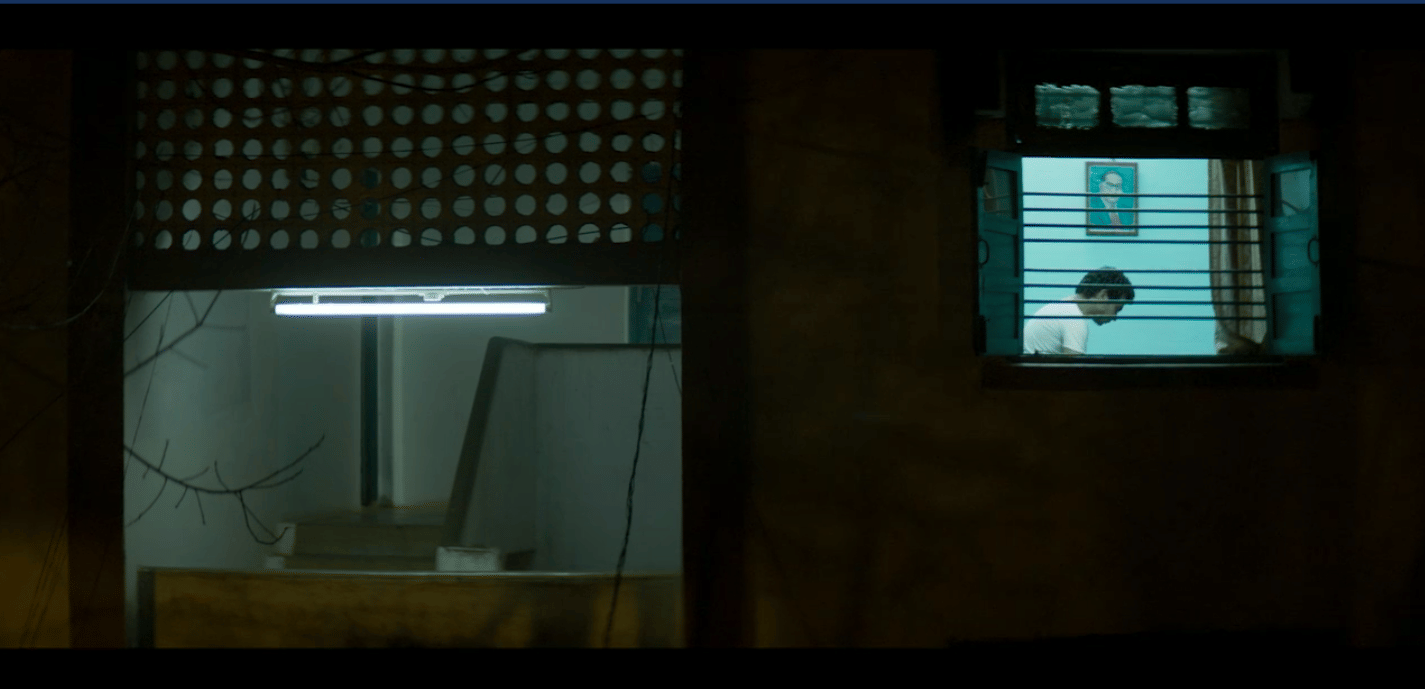
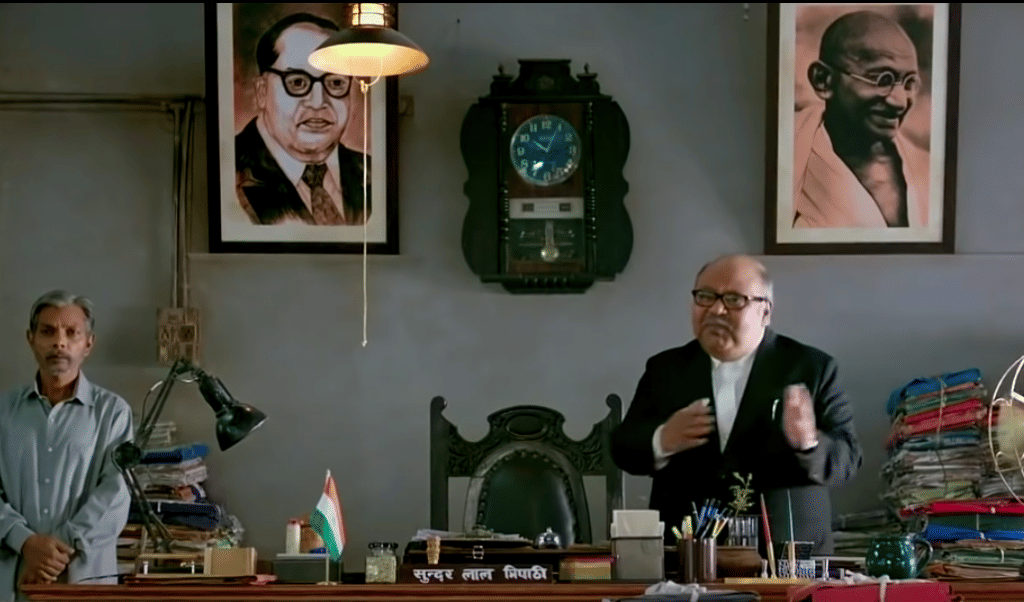
In the 2017 Akshay Kumar-starrer Jolly LLB 2, Ambedkar’s portrait can be spotted right behind the judge’s desk in his chamber, alongside Gandhi, in multiple scenes.
Whether it is Newton (2017), Jolly LLB 2 (2017), Mukkabaaz (2017), Article 15 (2019), Netflix’s series Sacred Games (2018), or its latest movie Raat Akeli Hai (2020), we see Ambedkar’s image becoming a regular occurrence in Hindi films.
TV serials such as Ek Mahanayak – Dr B.R. Ambedkar on Zee Entertainment’s &TV, and Dr. Babasaheb Ambedkar: Mahamanvachi Gaurav Gatha, a Marathi serial on Star
Pravah/Hotstar with more than 250 episodes, have been immensely popular in recent years. They have also been dubbed and broadcasted in multiple languages.
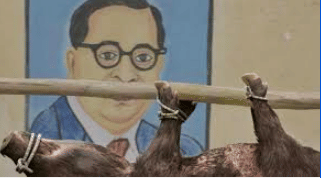
Meanwhile, Marathi film director Nagraj Manjule has successfully carried forward the legacy of Jabbar Patel through his socially sensitive films that explore contemporary caste dynamics, such as the award-winning Fandry (2013) and Sairat (2016). The scene in Fandry in which the Dalit character Jabya has to carry a dead pig in front of his school, while passing a wall mural of Ambedkar in the background, remains one of the most poignant scenes of Indian cinema.
Tamil film director Pa. Ranjith also uses walls as a canvas rather succinctly. In his first movie Attakathi (2012), Ranjith features both Ambedkar’s statue and his framed photo mounted on school walls. In Kabali (2016) and Kaala (2018) Ranjith goes a step further when he juxtaposes Ambedkar and Gandhi in the former, and adds Dalit Bahujan greeting ‘Jaibhim’ in the dialogue in the latter, when a police officer joins a protest and reveals himself as Dalit. In Kaala, a Buddha Vihara (a Buddhist Colony) was showcased in an Indian film for the first time.

Also read: Black Lives Matter must fire up India’s anti-caste movement to fight its central villain
Still more to change
Today, even in movies that are not directed by Dalit directors, or are not about caste identity or discrimination, we can see B.R. Ambedkar’s portraits as part of the backdrop — be it on walls of homes, police stations, or courtrooms. This is indicative of a greater acknowledgment of Ambedkar’s role in nation-building.
Ambedkar’s rise in visual and popular culture may have initially coincided with the rise of the BSP, but it has now reached another level. Today, no political party can ignore Ambedkar, especially because OBCs and Muslims have also started following him.
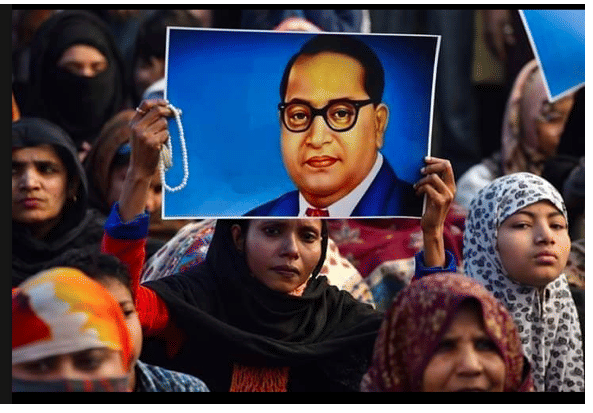
He is no more just a ‘Dalit’ icon. He is a symbol of Bahujan assertion, women empowerment, student movements, and more importantly, human rights and democratic values. This was seen during the nationwide anti-Citizenship Amendment Act protests, when posters, photographs, and writings of Ambedkar were shared widely. His images occupied a central position not only in New Delhi’s Shaheen Bagh, but in protests across India. Even a Gandhian like historian Ramachandra Guha was arrested outside Bangalore’s Town Hall while holding a photograph of Ambedkar.
As director Pa. Ranjith said, backdrops have tremendous power in cinema because they capture social realities without dialogues or music. Directors featuring Ambedkar in their backdrops may not be explicitly espousing his political ideology, similar to how it doesn’t mean much when they feature or mention Gandhi. If anything, it shows that directors are more aware of their socio-political reality, and are trying to showcase it.
Whatever the reasons may be, there is a palpable mainstreaming of Ambedkar, in the country that neglected him for so long in reel and real life.
If merely mounting a portrait of Ambedkar took so long, then imagine the grand chasm that still exists in the popular understanding of the leader. The fact that you have to be of a progressive mindset to open your walls to his portrait says that he is still regarded as a social justice hero or as a radical Bahujan leader, not as the founder of Indian Republic. We have a long uphill battle before we can see his ideals seeping into the plots and screenplays of average film makers, and before we can see an increase in the diversity of actors, characters and storylines.
The author is an independent writer and critic on Indian cinema, socio political issues and is a proponent for diversity. Views are personal.
Nice article.. in marathi film “Kokanastha” they show the Dalit panther activist and proudly saying “Jay Bhim” in this film main lead Sachin khedkar which is shown Brahmin in film is also show that saying “Jay bhim”.
Thanks Ravi Ratan Sir and print for publishing such a in detail article.?
Thank you
The print……………..Sir /Madam
Keep it up.Thanks to the editor and the writer .(Who i think may be secular or a dalit)only these people talk about Him. Do make an article on NCERT for not throwing light on his great ideas. Atlast, new india will be formed from schools.
Thankyou
Theprint for bring this detailed article on babasaheb ambedkar.
Correct observation.Well why aren’t you questioning the torch bearers of social justice- the Communusts- who couldn’t get his portrait in Parliament though they were in alliance with ruling parties? The Congress party? The great historians..Habib,Romila Thapar,Jha?The NCERT?Did they not recognize him as an Architect of Constitution? Torch bearer of social justice? Were and are all of them Savarnas? Unmask all of them if you truly belueve in Ambedkar.Else all these articles are waste of time.
Correct in your observations. Well why aren’t you questioning Habib,Romila thapar,Jha and their group of so called great Historians who have not written about him and his contribution to the bation and society? The communists who never tire of talking social justice,why they ignored him? Will you have the courage to unmask them and their double faced existence?
Most ppl won’t be able to name any member of constitution drafting assembly except Ambedkar.
Thanks to vote bank he today is most hyped leader after Nehru.
But no appeasement lasts forever.
Very nice article
Observations was lit!? Hats off to you sir!
Again print dividing Hindus, bjp is only uniting hindu