






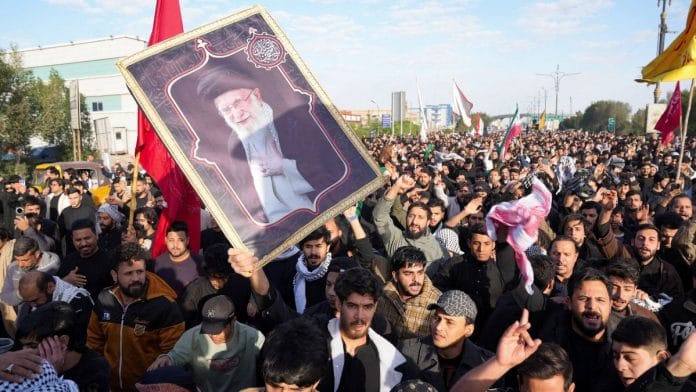



Assassination is an enduring feature of societies and empires. The Jewish Sicarii and Persian Hashshashin — from where the word “assassin” originates — are among the better-known perpetrators of this form. But the assassination (or targeted killing, take your pick) of Iran’s Supreme Leader Ali Hosseini Khamenei has been shocking to many. It is a clear war of choice, carried out amid negotiations with Iran and with no imminent threat from that country. Killing the head of a state is a staggering violation of both international law and norms.
Of course, the US has long treated itself as the exception, removing inconvenient leaders at will during the Cold War. In the early 1960s, it targeted national leaders such as Fidel Castro (Cuba), Patrice Lumumba (Congo/Zaire), and Rafael Trujillo (Dominican Republic) for assassination. In 1986 and 2003, it struck the compounds of Muammar Qaddafi (Libya) and Saddam Hussein (Iraq), respectively, with the clear intent of killing them.
Targeted killings patently violate both international law and US domestic law. The only exception is when defending against an imminent attack, and no one has made the case that Khamenei was actively plotting a strike on the US or Israel. This was the premeditated assassination of the head of state of a sovereign nation, carried out to engineer regime change.
What does the US achieve by weakening this norm? The global proliferation of AI, sensors, and hypersonic weapons means that anyone can play that game. The leaders of other major countries might wonder what awaits them if they enter into strategic competition with the US, and whether they should be planning their own decapitation strikes.
The implications for the subcontinent should also be obvious. Even if Narendra Modi is too petrified (or compromised) to take a stand, the Congress party and Sonia Gandhi have rightly criticised this outright violation of international norms.
But leaving aside superpower impunity, the question is: do assassinations work as a political tool?
The theory is that assassinations might allow a government to avoid the heavy costs of war while still achieving its objectives. However, this is clearly not the case here, since the war is continuing despite the assassination.
Also Read: Has Modi forgotten India’s farmers? India-US trade deal hurts Atmanirbharta for pulses
Limits of decapitation
Will Khamenei’s assassination and this campaign lead to regime change? Unlikely. The Iranian establishment is a dense and overlapping network of institutions that has been designed to sustain itself under attack. Article 111 of Iran’s constitution, in fact, anticipates sudden leadership loss and provides for an interim leadership council pending succession. It is true that significant numbers of Iranian leaders have been killed in the past year, but there is plenty of bench depth.
It’s also worth noting that the death in 2013 due to illness of Venezuela’s Hugo Chavez — who often accused the US of trying to kill him — not only failed to produce regime change, it led to further consolidation under his successor, Nicolas Maduro. Which is why Donald Trump had to kidnap him 12 years later. And the regime continues under Delcy Rodríguez, albeit more cooperatively for now.
Since very few heads of government have been killed by adversaries in modern times, one way to try and guess what could happen in Iran after the war is by looking at the experience of countries that have targeted the leaders of militant or terror groups.
There is some empirical evidence that decapitation strikes on militant groups can help governments reduce violence, terminate wars more quickly, and defeat insurgencies, but the effect isn’t huge. And there are enough counter-examples to give one pause. Israel killed many Hamas leaders and operatives, but in the absence of a satisfactory political settlement, it was unable to foresee, let alone stop, the 7 October 2023 attacks. Nonstop US drone strikes on Al Qaeda and Taliban leaders failed to prevent a Taliban victory in Afghanistan in 2021. Al Qaeda offshoots remain active in the Sahel and Yemen 15 years after Osama bin Laden’s killing.
Assassinations can even make things worse. The 2006 killing of Abu Musab al-Zarqawi, the leader of the Islamic State’s predecessor group, allowed more strategic actors such as Abu Omar al-Baghdadi and Abu Bakr al-Baghdadi to build the Islamic State into a feared transnational organisation.
All we know for now is that the US has ripped up a foundational international norm for no evident benefit in terms of war termination or rapid regime change.
Amitabh Dubey is a Congress member. He tweets @dubeyamitabh. Views are personal.
(Edited by Asavari Singh)