






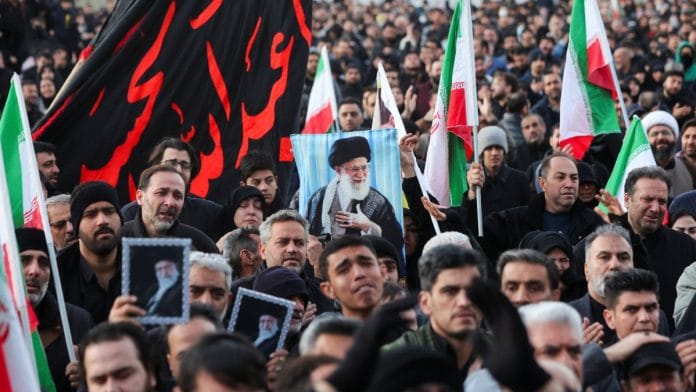



The inevitable has happened. The Israel-US war on Iran — Operation Epic Fury — began on Saturday at 01:15 am ET, with air/missile strikes killing Ayatollah Ali Khamenei. Iran has confirmed the death of its supreme leader. As per Israel Defense Forces, seven other senior political and military leaders, including Minister of Defence Aziz Nasirzadeh and Chief of IRGC Mohammed Pakpour, have also been killed.
In the last 30 hours, Israel-US forces have continued to target political and military leadership, command and control, nuclear infrastructure, air defence, ballistic missiles, naval assets, and other military targets. Iran has retaliated by targeting Israel and US military bases in Bahrain, Qatar, the UAE, Kuwait, Jordan, and Saudi Arabia.
President Trump, in a video posted on Truth Social, said that the US had begun major combat operations in Iran as it has continued to develop its nuclear programme and plans to develop missiles to reach the US.
Let there be no doubt that the political aim of the war is regime change in Iran. One does not assemble a naval and air armada, the biggest since 2003, only to force a favourable outcome of negotiations leaving a despotic regime intact. This was also apparent when Oman’s Foreign Minister Badr bin Hamad Al Busaidi let the cat out of the bag by saying that Iran had accepted zero stockpiling of enriched uranium with monitoring and verification by IAEA/US in the Oman-brokered talks in Geneva. Negotiations, as in June last year, were used for strategic deception. Both President Trump and Prime Minister Benjamin Netanyahu have exhorted the Iranians to rise and bring down the regime.
What is the likely military strategy of US-Israel? And more importantly, what will be Iran’s political aim and military strategy?
Iran’s political aim and military strategy
Iran’s political aim is crystal clear — to ensure regime survival which has been in power since 1979. The Islamic Republic of Iran had replaced an oppressive and unpopular monarchy under Reza Shah Pahlavi. After 47 years, the Islamic Republic has become even more draconian and unpopular than the monarchy due to the imposition of Shiite shariat and taking the country to economic ruin in its quest for leadership of Islamic Ummah and development of nuclear weapons and the resultant sanctions. The brutal crackdown on popular protests caused by oppression and economic deprivation, particularly on women protesting against imposition of Sharia laws, has added fuel to the fire.
One of the major factors that led to the successful Mullah revolution was the declaration of neutrality by the erstwhile Imperial Army. To safeguard against this, the Islamic Republic created its own loyalist army in the form of the Islamic Revolutionary Guards Corps — Sepah — which includes the Basij militia that dominates every segment of the society to enforce the writ of the theocratic state. The Islamic Republic of Iran Army — Artesh — functions as a regular conventional army.
The leadership of the Islamic Republic and the IRGC is aware that in the event of a regime change, it will face certain death on the streets or by law. Hence, it would rather embrace martyrdom than to capitulate. Given the importance of martyrdom for Shias, they hope that their cause may live on to win a likely civil war. Hence, Iran’s best bet is to drag the US into a prolonged and costly ground war to defeat it through exhaustion, as happened in Vietnam, Afghanistan, and partially in Iraq. However, the US has no plans to put boots on the ground, and will rely only upon its air, missile and drone power, naval blockade, and intelligence-led special forces operations, to which Iran has no answer.
So, what would be Iran’s military strategy?
The likely military strategy of Iran would be to absorb the destruction caused by prolonged air, missile, and drone campaign and create a military embarrassment for US-Israel by carrying out a crippling strike on prestigious military or civilian assets to force a recoil or, as a worse case, an angry response in the form of a ground invasion due to the resultant domestic pressure. Iranian strikes may include sinking of an aircraft carrier along with a number of ships, destruction of air assets on ground, destruction of oil wells/refineries of Gulf nations and other adjoining countries or targeting their civilian populations.
With adequate forewarning, the political and military leadership would be in deep underground shelters after the experience of Operation Rising Lion. However, as is already evident, no hideout is safe enough. If required, the leadership of the Islamic Republic of Iran Army may be replaced to prevent its possible declaration of neutrality. IRGC and IRIA will fight conventional war in event of a ground invasion and the Basij militia, which claims a membership of one million volunteers apart from the 90,000 permanent cadre, will fight a guerrilla war. In addition, the Houthi and Hezbollah proxies will target US-Israel and allies in their sea/land spheres. Due to the unpopularity of the regime, a people’s struggle is unlikely.
Also read: India has to do the Israel-Iran-Arab world balancing act. Stay away from Shia-Sunni rivalry
US-Israel military strategy
With a crystal clear political aim of regime change without boots on ground, US-Israel would plan to use a sustained air, missile and drone campaign to decapitate the political and military leadership along with the destruction of the command and control infrastructure. Simultaneously, the air defence, ballistic missiles, and other military, power, and economic assets would be destroyed.
Special Forces and anti-regime guerrilla fighters will complement the operation from within. Electronic and cyber operations would ensure absolute information blackout apart from direct targeting of weapon systems.
Depending upon the progress of the operation, amnesty for the rank and file of the leaderless IRGC, IRIA, and Basij militias may be announced to win their neutrality. Once the neutrality of the military is ensured, the masses on the streets are expected to do the rest.
US-Israel will endeavour to neutralise Iran’s operational strategy of causing a military embarrassment using their air defence shields — the most advanced in the world — and keeping critical assets like aircraft carriers at a safe distance.
Prognosis
It is too early to be judgemental about the outcome. The US and Israel have the proven capability to execute their operation strategy. Iran’s civilisational resilience is beyond doubt. In addition, the regime has a highly motivated religious army — IRGC and Basij — which dwarfs the IRIA.
The US’ plan hinges on the decapitation of the political and military leadership, ensuring the neutrality of the leader-less rank and file of the military and a popular uprising against a draconian regime. Iran has to safeguard its leadership, retain the loyalty of its military, engineer a major military embarrassment for the US, and motivate or coerce the masses to support the regime against the external enemy.
It is empirical wisdom that few plans survive the actual war. What will the final outcome be? Only time will tell.
Lt Gen H S Panag PVSM, AVSM (R) served in the Indian Army for 40 years. He was GOC in C Northern Command and Central Command. Post retirement, he was Member of Armed Forces Tribunal. Views are personal.
(Edited by Aamaan Alam Khan)