






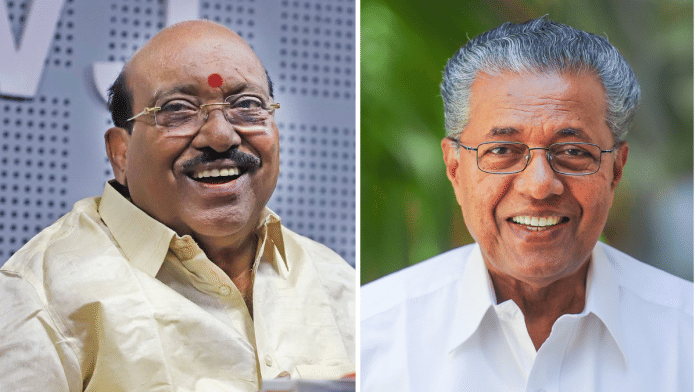



Vellappally Natesan, once hailed by Chief Minister Pinarayi Vijayan as Kerala’s Pravin Togadia, is redefining the state’s communal politics with some support from the Left government. The general secretary of the Sree Narayana Dharma Paripalana Yogam, which represents Kerala’s numerically significant Ezhava community, is back in the news with yet another communal remark, this time targeting a journalist by calling the reporter a “terrorist” at a press conference.
Kerala, which prides itself on its secular moorings, has lately given Natesan a free pass to deliver hate speech. His rabble-rousing became a flashpoint in April last year when he made statements demonising the Muslim-majority Malappuram district. Soon after, Vijayan hailed his leadership at an event held to mark the 30th anniversary of his election as SNDP Yogam general secretary, completely ignoring his polarising rhetoric delivered just days ago. This patronage has only emboldened Natesan.
A pattern seems to have emerged. Vijayan refuses to be drawn into Natesan’s divisive statements, but offers him patronage that further emboldens him.
Local body poll aftermath
Ahead of the recent local body polls, the chief minister gave him a ride in his official vehicle for the Global Ayyappa Devotee event, organised under the aegis of the state government. The significance of this symbolic act was not lost on anyone, with even minority groups supportive of the Left government accusing it of majoritarian appeasement.
The local body poll results saw the Left suffer setbacks in the Muslim-majority Malabar region as well as Christian-dominated central Travancore. While Vijayan put on a brave face in the aftermath, Binoy Viswam — state secretary of ally Communist Party of India (CPI) — chose to highlight Natesan’s dubious role and publicly disowned the chief minister’s act of giving him a ride.
In the latest instance, Natesan lost patience with a reporter outside the Sivagiri Mutt when he fact-checked the Ezhava leader’s claims on non-functioning educational institutions in Malappuram. The reporter was only guilty of asking what prevented the Vijayan government from allotting institutions during its two terms and why he was still blaming the Indian Union Muslim League (IUML) education minister from a decade ago.
The following day, Natesan called a press conference and branded the reporter a “terrorist”, while referring to his past association with the IUML as a student activist. Natesan also targeted Binoy Vishwam, calling the CPI members “traitors”.
Also Read: ‘Why not BJP?’: Meet Mumtaz Thaha, the party’s first Muslim woman councillor in Kerala
Natesan as a Marxist tool?
The SNDP Yogam general secretary, who continues to bat for a third term for Vijayan, has intensified his attacks on the opposition United Democratic Front (UDF). He has even claimed that there were no riots during Vijayan’s two terms, while reminding people of the Marad riots under AK Antony in 2002-2003. This is an unusual approach, given that the riots, which claimed 13 lives, remain largely forgotten in Kerala’s collective psyche. Even the Bharatiya Janata Party (BJP) hasn’t raked the issue up as part of its election propaganda.
However, in what seemed like a coordinated move, Communist Party of India-Marxist (CPI-M) central committee member AK Balan echoed Natesan. He warned people of Marad redux if the UDF came to power, and claimed that the Jamaat-e-Islami would control the home ministry.
It is becoming increasingly evident that Natesan enjoys the backing of the state government on his utterances and is perhaps laying the groundwork for a polarising campaign in the lead-up to the assembly polls.
‘Kerala’s Togadia’
In 2015, Natesan led the Samatva Munnetta Yatra across Kerala, calling for Hindu unity, after charting an electoral understanding between the SNDP and the BJP for the local body polls.
During the Yatra, the state government led by Oommen Chandy offered a solatium of Rs 10 lakhs to Noushad, an auto-rickshaw driver in Kozhikode, who died trying to save the lives of migrant labourers in an open drain. Natesan gave a communal angle to it by raking up the religion of the man, drawing widespread condemnation across the political divide, including from Pinarayi Vijayan, VS Achuthanandan and then Congress chief VM Sudheeran.
The culmination of the Yatra saw the launch of the Bharat Dharma Jana Sena (BDJS), the political outfit of the SNDP, led by his son Tushar Vellappally. Vijayan wrote a series of articles in the CPI-M organ Deshabhimani and People’s Democracy, accusing Natesan of betraying the renaissance values instilled by Sree Narayana Guru, taking the SNDP to the BJP stables.
Today, the BDJS continues to be the only significant ally of the BJP in Kerala, but Natesan is in the good books of Vijayan. This is bizarre, given that it was the CPI-M – through VS Achuthanandan – that accused Natesan of financial misappropriation, a charge that continues to be heard in the courts. Natesan was also quizzed by the Enforcement Directorate in 2018. All this explains his dual loyalty to the Left and the BJP.
Social engineering vs political mobilisation
According to Marxist leaders, journalist-turned-Rajya Sabha MP John Brittas mediated between Vijayan and Natesan soon after the change of guard in 2016.
Unlike the CPI-M’s historical approach in Kerala, Vijayan’s tenure has seen a switch from class-based political mobilisation to social engineering. While it may have partly been necessitated on the account of Kerala society undergoing a change of character in the post-liberalisation phase, with the neo-middle-class outnumbering the working-class cadres of the party, Vijayan has taken that to a whole new level.
According to Congress veteran Cherian Philip, who was a part of Vijayan’s inner circle during his first term (2016-2021), this brought unexpected rewards, beginning with the 2018 bypoll held in the Congress stronghold of his native Chengannur. And nowhere was the strategy more successful than in the 2021 Assembly election, when Vijayan won another term, bucking a four-decade-old trend.
Social engineering basically involves extending patronage to community leaders in exchange for votes. This has expanded to dog-whistle politics and the pitting of communities against one another. For instance, in 2021, the Left tapped into Islamophobic sentiment among Christians in Central Travancore and tailored its campaign to reap electoral gains, while simultaneously mobilising around issues such as the Citizenship Amendment Act (CAA) in Muslim-majority Malabar.
Also Read: Laying groundwork for local body & assembly polls, Kerala BJP begins door-to-door Muslim outreach
A case of diminishing returns
The Left Democratic Front (LDF)’s drubbing in Kerala in the 2019 Lok Sabha election was considered an isolated event by the CPI-M — an impact of the Sabarimala protests and Rahul Gandhi contesting from Wayanad. Buoyed by the performance in the Assembly poll, in which the Left swept the Muslim-dominated seats beyond IUML strongholds in Malappuram, the CPI-M doubled down on CAA and Palestine in the 2024 Lok Sabha election.
Only there was a repeat of 2019, with the CPI-M reduced to a solitary seat, level with the BJP, which opened its account through actor Suresh Gopi in Thrissur.
Beyond 2019, there was something that bothered the CPI-M about its performance in 2024 — the loss of its Ezhava vote bank to the BJP in seats such as Alappuzha and Attingal, where the latter finished a close third. Perhaps Natesan’s hate campaign against Muslims was driven by the Left’s necessity to win back its core voters. This explains why Vijayan has treated Natesan’s hate speech with kid-gloves.
Now, the question that remains is whether the Left under Vijayan will go for a change of course following the defeat in the local body polls amid the CPI’s reservations.
It won’t.
Wither Kerala’s social fabric
According to a veteran CPI-M leader who spoke to me on condition of anonymity, the Marxist party – particularly Vijayan – sees the local body poll verdict differently from the CPI and the mainstream media.
When the party met to take stock, one question that lingered was: why did the majoritarian focus and anti-Muslim rhetoric in the campaign not sway the Christians of Central Travancore? The strategy was aimed at consolidation of Hindu and Christian votes, with CPI-M already on a strong wicket in Malabar.
According to Vijayan’s calculation, even if there was a backlash against the Left from Muslims, the CPI-M has enough leverage in Kannur and Palakkad to win 30 of the 60 seats in the Malabar region. But that calculation went awry in Central Travancore, where the Christians went back to the UDF with a vengeance.
The CPI-M veteran pointed to the party’s better performance in the Hindu-dominated pockets in Thiruvananthapuram, Palakkad, Alappuzha and Thrissur. He stated that it is likely that the UDF will be targeted even more heavily, invoking Jamaat-e-Islami and the likelihood of IUML’s PK Kunhalikutty being accorded the position of deputy CM in the coming days. “There is no question of a change of course now,” he said.
How such a strategy would play into the BJP’s hands and whether it will affect Kerala’s social fabric is anyone’s guess.
Anand Kochukudy is a Kerala-based journalist and columnist. He tweets @AnandKochukudy. Views are personal.
(Edited by Prashant Dixit)