






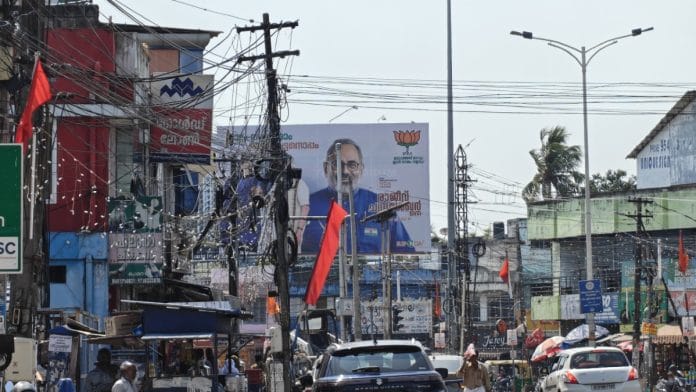



Until a decade ago, it wasn’t fashionable to identify with the Bharatiya Janata Party in Kerala.
The stigma attached to the BJP wasn’t on account of its poor political returns. Being a “Sanghi” (term for a Sangh Parivar-adherent, used pejoratively) also tantamounted to being socially regressive. Kerala is, after all, the land of Renaissance figures such as Sree Narayana Guru who preached “One Caste, One Religion, One God for all”.
Kerala’s first democratically elected Communist government in 1957 did not materialise in a vacuum. It was the culmination of a century-long Renaissance movement, in a society where Brahminical edicts on caste were ritually followed by the royalty to perpetuate their power.
So, when did Kerala become a catchment area for the Hindutva ideology?
Modi effect
A lot of people attribute it to the ‘Modi effect’—Narendra Modi’s appeal to a section of Keralites. True, there is a section of people in Kerala who are swayed by the Modi phenomenon. However, it was also a latent sense of anger against ‘appeasement’ that manifested as Modi fandom for many.
It must be remembered that in Kerala, even the Nair community who form a major bloc of the ‘Savarna’ class today were victims of Brahminism not too long ago. They had to endure purity rituals practiced by the Nambudiri Brahmins with only graded access to places of worship until the Temple entry proclamation of 1936.
There are also ‘apolitical’ voters supposedly tired of voting for the Left Democratic Front (LDF) and the United Democratic Front (UDF), who want to try out a third alternative, which happens to be the BJP.
Also read: Don’t be fooled by Congress’ low-profile campaign in Kerala. It has its best shot since 2001
Thiruvananthapuram Corporation 2025
The local body poll results in December ahead of the forthcoming Assembly elections turned out to be disappointing to the BJP from a vote-share perspective. However, the party made a major statement by capturing power in the Thiruvananthapuram Corporation.
It was the culmination of its impressive run in Kerala’s capital city beginning with its breakout performance in 2016, when it pushed Congress to the third position to emerge as the primary opposition.
This happened in the aftermath of the ‘pro-minority government’-tag that came to be associated with the Oommen Chandy government in 2011.
Oommen Chandy’s trapeze walk
Communalism never grows in a vacuum.
It was a series of poor judgements made by the Chandy government that set the stage for the BJP’s arrival in the Kerala Assembly through its breakout in Nemom in 2016.
The Indian Union Muslim League (IUML) which had numbers in its favour flexed muscles to ensure that it got what it wanted, including a controversial fifth ministerial berth, leaving a bitter aftertaste. There were unwieldy controversies from ministers lighting the traditional Kerala lamp to the handling of the Education portfolio, with charges of favouritism invoked.
That would explain how the BJP that polled merely six per cent votes in the 2011 Assembly polls managed to raise its vote share to 10 per cent in 2016.
Also read: Minorities are backing UDF again. Will it break LDF’s streak in Kerala?
Pinarayi Vijayan’s first term
Pinarayi Vijayan’s first term was also not short of instances that helped the BJP consolidate.
Vijayan’s cardinal mistake was the undue haste with which he tried to implement the Supreme Court order on Sabarimala shrine, to try and make political capital out of it. This was done when he simultaneously slow pedalled on implementing a similar court order on the Church dispute between the Malankara Syrian Orthodox Church and the Jacobites.
Vijayan forgot that the BJP had emerged as a player in Kerala politics and could exploit the issue to influence the Left cadres. Vijayan, nevertheless, found a way to tide over it: By undertaking ‘social engineering’ to split the UDF’s Muslim vote bank.
Spectre of political Islam
The IUML inadvertently played into Vijayan’s hands by ill-advisedly taking the Jamaat-e-Islami on board. The Jamaat had long been an ally of the Left in Kerala, making common cause on issues like anti-Americanism. However, the 2014 assent of Narendra Modi at the Centre convinced the Jamaat to drop its schismatic differences with the IUML to ally with the mortal enemy.
The Jamaat had a bigger goal: To try and shape the thinking of Muslim youth on the lines of political Islam, thereby radicalising the Muslim community to combat Hindutva. However, the spectre of political Islam only widened the cleavage that had developed between the two minority communities in Kerala, helping Vijayan secure another term.
Pinarayi Vijayan’s second term
Vijayan’s second term was witness to the Communist Party of India (Marxist) oscillating between minority and majority appeasement.
Having won a second term on the back of social engineering, Vijayan escalated it to try and break the IUML away from the UDF ranks, or at least a faction of it, to perpetuate power. However, it did not bear fruit beyond swaying a splinter faction of the Sunni outfit Samastha Kerala Jemiyyathul Ulema, from where IUML draws most of its cadre.
The appeasement strategy continued nevertheless, as the CPI(M) doubled down on Palestine and flogged the Citizenship Amendment Act (CAA) in the run-up to the 2024 Lok Sabha polls—eventually alienating a section of its own Ezhava base to the benefit of the BJP.
Left’s soft-Hindutva voyage
Post elections, however, the CPI(M) swung 180 degrees, taking the soft-Hindutva route.
The LDF wasted no time in wooing the Nair Service Society (NSS) which was at the forefront of the anti-Sabarimala agitation in 2018, promising to make amends in its affidavit in the Supreme Court on Sabarimala. The CPI(M) also unleashed Vellappally Natesan—general secretary of the Sree Narayana Dharma Paripalana (SNDP) Yogam—on the Muslims, to spew drivel on the community.
The soft-Hindutva voyage culminated in the Global Ayyappa Conclave held in the run-up to the local body polls. However, the LDF suffered an unexpected setback with the Sabarimala gold theft scandal, as veteran CPI(M) leaders like A Padmakumar were sent behind bars by the High Court-monitored Special Investigation Team.
Also read: BJP vs CPI(M) in Nemom is litmus test for Rajeev Chandrasekhar. But Congress could decide outcome
The Hindu vote swing
Even as the voting patterns of the Muslim community are examined granularly, the swing among the Hindu blocs does not get enough attention. It would be curious to note that a section of the Hindu vote has seamlessly transferred between the BJP in the 2019 and 2024 Lok Sabha polls and the Left in the 2020 and 2025 local body polls, as well as the 2021 Assembly polls.
Vijayan’s experiments with identity politics and scant regard for ideology seemed to have influenced a section of the Marxist cadres to oscillate between the LDF and the BJP. However, it would be wrong to blame Vijayan entirely for this phenomenon.
This could also be a result of the lingering memories of the Chandy government (2011-2016) when IUML imprudently extracted its pound of flesh. And now, to the spectre of Political Islam represented by the Jamaat-e-Islami seemingly percolating IUML ranks.
2026 Assembly election and BJP
The forthcoming Assembly election result therefore would make for a compelling analysis.
The million-dollar question: Would the overt consolidation of minorities behind the UDF cause a reverse polarisation of sorts? What are the chances of BJP cadres and Left cadres transferring votes seamlessly, even in the absence of a ‘deal’ (as the Congress alleges) between the Left and the BJP?
The BJP’s performance in the Assembly polls will determine the fate of the UDF largely in this election. One reason why the UDF cannot possibly secure a landslide victory unlike the past would be the BJP’s emergence.
If the election goes down to the wire as some surveys predict, or if the LDF manages to snatch victory from the jaws of defeat, it will only reiterate how Kerala is breaking ground for the BJP in the not-so-distant future.
Anand Kochukudy is a senior journalist based in Kerala. He tweets @TheKochukudy. Views are personal.
(Edited by Theres Sudeep)