






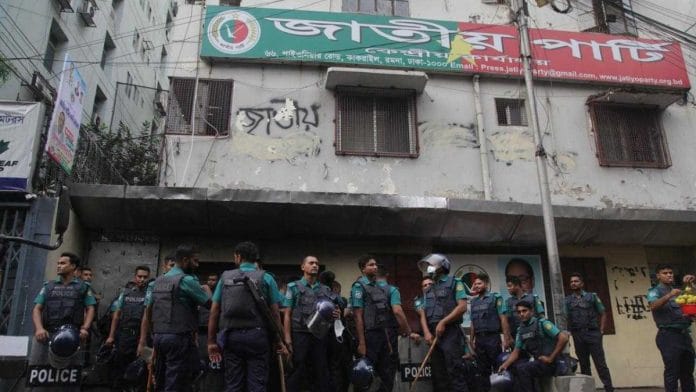



The Jatiya Party, once one of Bangladesh’s most established political parties, has come to symbolise for many the political entrenchment and moral ambiguity that fuelled resentment against the post-2009 political order and helped precipitate the mass uprising of July 2024.
To understand why large segments of Bangladesh’s public now regard the party as an enabler of authoritarianism, and argue that it has no legitimate place in the country’s politics, it is necessary to trace its evolution and the controversies that have accumulated around it in recent years.
The Jatiya Party was founded in 1986 by Hussain Muhammad Ershad, a former army chief who seized power in a coup in 1982 and later transformed his military rule into a civilian political vehicle. In its early years, the party served primarily as the political arm of Ershad’s regime. Despite his removal in the mass uprising of 1990, the party retained a presence in Bangladesh’s contentious political landscape.
Over the decades, it became known less for a clear ideological agenda and more for its ability to navigate shifting political currents. For much of the 21st century, the Jatiya Party was a fixture in Bangladesh’s parliamentary system, often playing a supporting role to larger parties, especially the Awami League, which governed Bangladesh from 2009 until its ouster in 2024.
In the years leading up to that ouster, the Jatiya Party contested elections in alliance with the Awami League-led Grand Alliance, effectively helping bolster the ruling party’s broad coalition. In the 2018 general election, Jatiya Party candidates ran alongside the Awami League’s coalition despite widespread allegations of electoral irregularities. They subsequently took seats in parliament both as an opposition bloc and under the umbrella of the governing alliance, a dual role that raised questions about the party’s independence.
Jatiya Party’s ‘culpability’
Critics argue that the Jatiya Party helped legitimise electoral processes and government authority that lacked credibility. Its participation in successive elections meant that it was often seen not as a check on power, but as part of a political establishment that enabled the consolidation of authority under the Awami League.
This perception grew during the controversial election cycles of 2014, 2018, and 2024, which were marred by allegations of voter intimidation, boycotts by major opposition parties, and concerns about fairness and transparency.
When nationwide student-led protests in July 2024 forced Prime Minister Sheikh Hasina into exile, the Jatiya Party found itself in a peculiar position. To many protesters and observers, the party’s proximity to the Awami League regime made it part of the establishment the uprising sought to overthrow.
In the days following the upheaval, movements demanding accountability and structural reform didn’t just call for the banning of the Awami League but also for the exclusion of parties that had helped sustain its rule. Platforms such as July Unity, formed in the wake of the uprising, explicitly demanded that allied parties be barred from politics and that their registrations be revoked.
The backlash intensified as new political alignments took shape. Jamaat-e-Islami, despite its own deeply controversial history, publicly urged interim chief adviser Muhammad Yunus to ban the Jatiya Party for its role in sustaining the former regime. The demand gained further traction when the newly formed National Citizen Party (NCP), emerging from the student movement, echoed similar arguments, accusing the Jatiya Party of “prolonging fascism” and forfeiting its democratic legitimacy.
These pressures have only grown with recent political developments. The return of Tarique Rahman, the acting chairman of the BNP, has reenergized mainstream opposition politics and consolidated anti-authoritarian sentiment.
At the same time, the evolving understanding between the NCP and Jamaat has reshaped the opposition space, leaving little room for a party so closely associated with the old order. Khaleda Zia’s death has further shifted the political mood, deepening public reflection on legitimacy, sacrifice, and resistance—none of which favour a party widely seen as complicit in repression.
Within this new configuration, the Jatiya Party’s electoral prospects appear increasingly fragile. Attacks on its offices, public demonstrations against its leaders, and calls for legal action underscore the depth of hostility it faces.
While party leaders deny being accomplices to authoritarianism and argue that electoral participation alone does not constitute guilt, such defences have resonated weakly in a climate shaped by moral reckoning rather than procedural argument.
Also read: Zomato to Zepto—gig work doesn’t need a ban, it needs a safety floor
Jatiya Party and a systemic issue
Many Bangladeshis see these criticisms as part of a systemic problem: parties that once lent credibility to dominant incumbents subsequently benefited from the protections of establishment politics, even as dissenting voices were marginalised.
In the political environment that has emerged since the uprising, where the interim government has banned all activities of the Awami League and its affiliates, the Jatiya Party’s continued political activity strikes as incongruous with the stated goals of democratic renewal.
The Jatiya Party has responded to these accusations with a mix of defence and occasional concession. Party leaders have rejected claims that they were “accomplices” in an authoritarian project, noting that numerous other parties participated in the same elections and insisting that participation alone does not constitute guilt. They argue that the party complied with electoral regulations and that revoking its registration would be unjust in the absence of proven violations. In some statements, senior leaders have portrayed the criticism as part of a political conspiracy aimed at marginalising alternative voices.
At times, more introspective voices within the party, such as its secretary-general, have expressed a degree of contrition, acknowledging that past political judgments may have been errors and that these decisions may have contributed to public resentment. Yet such responses have done little to persuade activists, civic movements, and political organisations that view the party’s historical role as fundamentally compromised.
This sentiment has, at times, translated into direct action. The Jatiya Party’s central offices have been attacked, and its leaders have faced public demonstrations accusing them of collaboration with the old order. Some critics have even called for legal proceedings against party leaders.
Whether the Jatiya Party survives these challenges, and under what conditions it might participate in future elections, will depend on how Bangladesh navigates this historic moment. As the country prepares for national elections under an interim government on 12 February 2026, the debate over the Jatiya Party has come to encapsulate a larger struggle over who gets to define the rules of democratic engagement in a post-uprising era.
Faisal Mahmud is the Minister (Press) of Bangladesh High Commission in New Delhi. Views are personal.
(Edited by Prashant Dixit)