






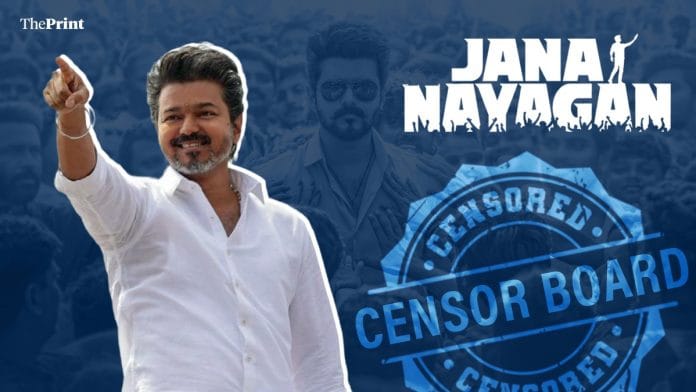



Jana Nayagan or People’s Hero, the final film of actor-turned-politician Vijay as a superstar lead, has run into a serious legal tangle, just three months before Tamil Nadu Assembly elections.
The Madras High Court has posted the matter for its next hearing on 21 January. Until then, the film cannot be released. This has caused major losses for the producers. With reported investments of around Rs 500 crore, advance collections of Rs 50 crore already made, and theatres booked for a 9 January release, the delay has disrupted the entire release plan and logistics.
For Vijay, this is a setback, both as an actor and politically. This is his first serious attempt at electoral politics, with ambitions of becoming the Chief Minister of Tamil Nadu.
What was meant to be a theatrical event took on a political tone and ended up as a legal battle.
After launching the Tamilaga Vettri Kazhagam (TVK), Vijay attacked both the ruling Dravida Munnetra Kazhagam (DMK) in the state and the Bharatiya Janata Party (BJP) at the Centre. His political entry was fast and dramatic. He attracted huge crowds at public rallies and gained momentum quickly. However, the Karur stampede became a turning point. It dented his political image and raised doubts about his readiness to capture power so early.
Some observers have also linked the Jana Nayagan controversy to internal politics within the Tamil film industry. They point to a possible power struggle involving Udhayanidhi Stalin, the deputy chief minister and a key figure in the industry. The dispute is seen as one of one-upmanship involving Red Giant Movies, the DMK-linked distribution company. Vijay chose to bypass Red Giant for the release of Jana Nayagan, which allegedly angered the ruling party’s first family.
Soon after Parasakthi received censor certification after 25 cuts and modifications, the DMK began attacking the Union government for holding up Jana Nayagan. Chief Minister MK Stalin accused the BJP-led Union government of turning the Central Board of Film Certification (CBFC) into a political tool.
He charged that the censor board has joined central agencies such as the CBI, the Enforcement Directorate, and the Income Tax Department, and has become “a new weapon” of the Union government to intimidate political rivals.
TVK supporters were quick to hit back, accusing the DMK of shedding crocodile tears. And they accused the BJP of being soft on Parasakthi but stubborn in its approach toward Jana Nayagan.
Stalin did not specify whether his criticism referred to Parasakthi—a film based on Tamil Nadu’s anti-Hindi agitation—or to Vijay’s Jana Nayagan.
Also read: Vijay’s TVK could corner 23% vote share if it goes solo in TN polls, finds DMK’s confidential survey
The film and its theme
At its core, Jana Nayagan portrays Vijay as a saviour of the poor and downtrodden, who is helping fishermen, standing up to corrupt systems, and being projected as a future chief minister. This political messaging became more evident because another film, Parasakthi, was also scheduled for release around the same time. Parasakthi evokes Tamil political sentiments of the 1960s, when anti-Hindi agitations were at their peak. It’s an emotional space the DMK has historically occupied.
In both films, the dialogues, lyrics and scripts are heavily loaded with regional identity, political subtext and double meanings.
The Jana Nayagan trailer opens with one man asking another about a person called Thalapathy Vetri Kondan. The script presents Vijay as an activist fighting corruption and institutional decay. His character speaks in sharp Tamil dialogues aimed directly at entrenched power brokers. For many viewers, this inevitably elevates Vijay into a real-world political symbol, almost a tinsel-town version of Jayaprakash Narayan or Anna Hazare.
Certain dialogues make the political intent unmistakable. Lines such as “I have no intention of turning back. I am coming” clearly signal his future political ambitions and hint at a chief ministerial pitch.
The songs reinforce this image further, projecting Vijay as a people’s leader championing women’s empowerment, exposing the misrule of local governments, and promising systemic change.
As Vijay’s final acting role, Jana Nayagan is also a tribute to his 30-year film career and is being regarded as a symbolic farewell to cinema. In short, it is a political action drama charting a journey from actor to chief minister.
The legal battle
Justice PT Asha of the Madras High Court initially cleared the film for release. However, the Central Board of Film Certification (CBFC) objected, stating that the producers had not removed certain scenes which, according to the board, could endanger national security.
Following this, a division bench led by the Chief Justice stayed the single judge’s order and fixed 21 January as the next hearing date.
A battery of top lawyers was engaged by Vijay and the production house. The Union government was represented by Solicitor General Tushar Mehta, who appeared via video link.
The Congress angle
The controversy took another political turn after a tweet by Congress leader Praveen Chakravarthy, who openly supported Vijay and Jana Nayagan. This changed the narrative in Tamil Nadu politics.
The DMK, which is part of the INDIA coalition along with the Congress, objected strongly. Cross-fire between Congress and DMK leaders played out on social media. Tamil television channels hosted prime-time debates largely favouring the DMK government.
For a brief period, it seemed both Jana Nayagan and Parasakthi would receive certification. While the DMK supported Parasakthi after it received CBFC clearance, it also shifted to supporting Vijay and blaming the Union government for the delay.
Congress MP Manickam Tagore went a step further, accusing Prime Minister Narendra Modi and Home Minister Amit Shah of using the issue to push Vijay and TVK toward the NDA alliance.
Strong observations by the Chief Justice eventually cooled the political noise. The court questioned why the release date had been fixed without obtaining certification and whether there was false urgency being created to pressure the judiciary.
The court made it clear that such tactics would not work.
TVK responded by stating that it had full faith in the judiciary and would wait for the legal process to conclude.
Looking at the theatrical, political and legal dimensions together, a few conclusions stand out.
First, Vijay handled the crisis calmly. He avoided public attacks on the Union government or the CBFC and chose to seek legal remedies instead.
Second, though new to politics, Vijay challenged two giants — the DMK in the state and the BJP at the Centre — showing political audacity.
Third, the DMK successfully redirected the controversy toward the BJP, hoping to consolidate minority votes and prevent them from shifting to TVK.
And finally, in April 2026, nearly five crore Tamil voters will elect 234 MLAs to the Tamil Nadu Assembly. By then, voters may have forgotten the dialogues of Jana Nayagan, but they may still be humming its songs.
The author is a veteran journalist and a political analyst. He tweets @RAJAGOPALAN1951. Views are personal.
(Edited by Prashant Dixit)