






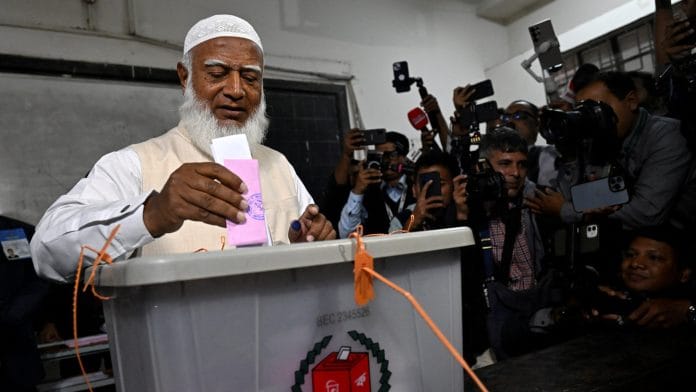



The 13th general election in Bangladesh, held earlier this month, marked Jamaat-e-Islami’s (JeI) strongest electoral performance in the party’s forty-seven-year history. Contesting as the lead of an 11-party alliance, it secured 77 of the 299 seats in the Jatiya Sangsad, emerging as the country’s largest opposition bloc. Despite JeI’s limited electoral experience, having remained banned for several years, pre-poll media reports suggested it was confident of forming a government. This confidence was reflected in its energetic campaigning, active demonstrations, and expanding support base. Yet the Bangladesh Nationalist Party’s (BNP) landslide victory underscored enduring fault lines in Bangladesh’s polity that continue to shape voter preferences. As JeI positions itself as the primary opposition in parliament, it is necessary to examine why its electoral gains fell short of a governing mandate.
Election Promises Without Policy Architecture
The JeI’s 2026 election manifesto outlines a 26-point agenda aimed at building a just, democratic state, prioritising youth empowerment, ensuring proportional representation in elections, and fostering a transparent, investment- and business-friendly economy. Yet these reflect the party’s intent rather than a concrete development plan. The manifesto has therefore been criticised for being slogan-heavy and unclear on measurable targets. According to Fahmida Khatun of Dhaka’s Centre for Policy Dialogue, the party’s economic agenda contains two structural gaps: uncertain implementation timelines and vague financing mechanisms for enhanced sectoral allocations. For instance, the manifesto pledges to raise public investment to 20 percent of GDP and increase foreign direct investment to US$ 15 billion. However, it sets no target for private sector investment, the primary driver of growth and employment. Moreover, the JeI does not specify a timeline for achieving its proposed US$ 2 trillion economy. The manifesto also promises to create seven crore jobs, but, again, provides neither a timeline nor a corresponding investment plan to ensure delivery.
Consequently, such proposals struggled to convince voters seeking pragmatic measures to rebuild the country’s fragile economy, curb rising inflation and address currency devaluation. The absence of clearly delineated provisions to create employment opportunities also likely alienated the country’s youth, many of whom had revolted against the former Awami League government in July 2024, for its ‘unfair’ quota reservations in jobs, which ultimately led to former Prime Minister Sheikh Hasina’s ouster. Therefore, despite the JeI’s alliance with the National Citizen Party (the political party created by student leaders who had led the July revolution), the dearth of structured plans appears to have disoriented young voters.
Gender Discourse and Electoral Costs
The JeI’s positions on women’s participation in public life have historically reflected its conservative ideological orientation. Before the election, however, the party sought to present a more moderate and reform-oriented image. This repositioning was reflected in its manifesto, which outlines a vision of a technology-driven, modern society and emphasises the creation of a safe, dignified, and participatory environment for women.
However, the JeI’s new approach appeared at odds with reportedly conservative remarks made by its party chief, Shafiqur Rahman, on the role of working women, including suggestions that their primary responsibilities lie within the domestic sphere. Observers also pointed to an interview he gave to a news organisation, in which he stated that, due to “biological differences”, women could not lead Jamaat-e-Islami, describing female leadership within the party as “impossible” under Islam. These remarks drew criticism from sections of civil society ahead of the elections and may have affected the party’s appeal among female voters.
This episode suggests that while the JeI’s expanding base reflects growing acceptance in certain constituencies, its position on women’s roles may continue to shape the limits of its broader electoral appeal—particularly in a political system and society shaped by the 1971 Liberation War’s egalitarian narrative and decades of women’s prominence in national leadership.
Foreign Interference and Sovereignty Concerns
Anti-Awami League narratives circulated by opposition forces during the July 2024 movement often carried a discernible anti-India undertone. This was linked to perceptions of former Prime Minister Sheikh Hasina’s close ties with New Delhi, which had prompted debate in some quarters regarding India’s perceived influence in Bangladesh’s political trajectory. Following her ouster, questions of safeguarding national sovereignty featured prominently in public discourse and became an important expectation from the next elected government.
Against this backdrop, JeI’s political re-emergence was accompanied by speculation that the party may have benefited from the United States’ stated interest in “restoring democracy” in Bangladesh. These perceptions were further reinforced by reports of American diplomats engaging with the party. It was also reported that a US diplomat had downplayed concerns that Jamaat might seek to impose its interpretation of Islamic law. The BNP alleged that JeI had reached a “secret understanding” with the United States and warned that such an arrangement could have implications for Bangladesh’s peace, stability, and sovereignty.
Meanwhile, China has also engaged with the JeI. The Chinese Ambassador to Bangladesh, Yao Wen, met Shafiqur Rahman in September 2024, marking the first visit by a foreign diplomat to the party’s Dhaka office since 2010. He described the group as a “well-organised political party”. Soon after, there were several exchange visits between Beijing and the JeI. Reports of these engagements appear to have contributed to public discussion regarding the party’s ability to retain its autonomy in the context of foreign outreach.
The Enduring Appeal of Political Lineage
In the power vacuum that followed the overthrow of the Hasina government and the ban imposed on the Awami League, the BNP emerged as the only major party remaining in contention. However, in the absence of an active and widely visible leadership presence beyond the ailing former Prime Minister Khaleda Zia, it faced challenges in consolidating broad-based public support. This created space for the JeI to mobilise with renewed organisational momentum in constituencies where the BNP had yet to re-establish itself. The subsequent return of BNP Chairman Tarique Rahman from his self-imposed exile in London added a new dynamic to the political landscape.
As the son of former Prime Minister Khaleda Zia and former President Ziaur Rahman, Tarique Rahman was widely seen as representing a natural succession of leadership within Bangladesh’s political landscape. This perception was reinforced by his mother’s demise shortly after his return, which generated significant public empathy for the BNP in the days preceding the election and contributed to a strategic advantage. The appeal of dynastic continuity has continued to shape South Asian politics, including within democratic systems. Bangladesh’s own political history reflects this trajectory, with leadership transfers from Sheikh Mujibur Rahman to Sheikh Hasina, and from Ziaur Rahman to Khaleda Zia and now to Tarique Rahman. In this context, many voters appeared to favour their familiarity with the BNP’s approach to governance and leadership over the Jamaat’s narrative that electoral victory would place political power directly in the hands of the people rather than within established political families.
The Memory of 1971
Like dynastic continuity, the memory of the 1971 Liberation War remains central to Bangladesh’s national identity and continues to influence political attitudes. The JeI’s historical legacy is closely linked to this period: its predecessor, Jamaat-e-Islami Pakistan, opposed Bangladesh’s independence and was subsequently accused of atrocities against the muktijoddhas—the liberation forces. This association has, over time, contributed to the party being labelled “Razakar” in public discourse, a highly charged term in Bangladesh connoting a “traitor” or “collaborator.” It has also underpinned repeated bans on the party and the prosecution of some of its leaders by the International Crimes Tribunal for war crimes related to 1971. The enduring resonance of this history appears to have constrained the party’s broader electoral appeal.
In contrast, former President Ziaur Rahman’s role in the Liberation War conferred a measure of political legitimacy on Tarique Rahman, which, at least for the present, appears to offset his relative political inexperience and contributed to the BNP’s historic victory.
These factors suggest that while Jamaat-e-Islami has expanded its organisational footprint and electoral relevance, it remains constrained by structural, ideological, and historical limits. The party had twice partnered with the BNP in coalition politics, functioning as a junior ally within a broader opposition front. Today, however, as it seeks to assert itself as an autonomous political bloc, it must navigate a more complex terrain. Carving out an independent niche will require reconciling its ideological commitments with the demands of a diverse electorate, addressing the legacy of 1971, and presenting a credible alternative in governance beyond moral rhetoric. In a polity shaped by dynastic loyalties, liberation memory, and pragmatic economic expectations, JeI’s challenge extends beyond electoral participation to broader political repositioning. Its role as the largest Opposition in Parliament offers both an opportunity to consolidate support and increased exposure to public scrutiny.
Sohini Bose is an Associate Fellow with the Strategic Studies Programme at the Observer Research Foundation.
This article was originally published on the Observer Research Foundation website.