






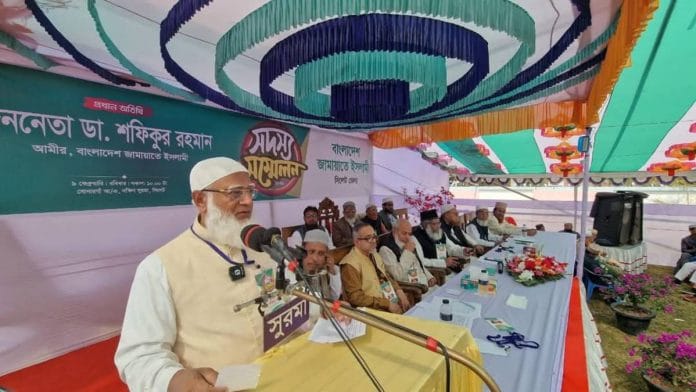



In Bangladesh’s unsettled political terrain, the 2026 election may be remembered less as a breakthrough for Jamaat-e-Islami than as the point at which its advance began to plateau. The party has re-emerged from years on the margins with renewed visibility, yet the same election result that signalled its relevance also illuminated its weaknesses that are unlikely to fade. As ambitions turn toward power, those constraints may become more pronounced.
Whether this is the beginning of Jamaat-e-Islami’s end will depend in part on the performance of its rivals. A disciplined spell in office by the Bangladesh Nationalist Party, particularly if it avoids familiar pitfalls around corruption, public order, inflation and the management of ties with India, would leave little room for Jamaat to grow. The same is true if newer parties, such as the National Citizen Party move beyond rhetoric and establish themselves as credible governing alternatives. Under those conditions, Jamaat-e-Islami’s recent gains may already mark the outer edge of its electoral reach.
Within its core ranks, Jamaat does not have leaders equipped for the intricacies of contemporary statecraft. Efforts to compensate by drawing in outsiders introduce their own complications. New recruits may bring expertise, but they also carry the risk of diluting internal cohesion or empowering figures whose loyalties are uncertain. Recent disputes around advisory roles offer a glimpse of how fraught such balancing acts can become.
At the same time, the party’s defining internal unity can make it inward-looking. A structure that works well for internal mobilisation may prove less effective when broader engagement is required. Politics at scale demands an ability to reach beyond established networks and to appeal to constituencies that do not share the same ideological commitments. Jamaat has often struggled on this front. Its tendency to view the political field in us-vs-them binary terms, dividing allies from outsiders, reinforces discipline but limits expansion.
This inwardness is mirrored in questions of representation. The party has historically found it difficult to integrate women and religious minorities into positions of meaningful authority. While women may be active within parallel or auxiliary wings, they remain largely absent from the centres of decision-making. Religious minorities, for their part, have little incentive to align with a framework that is explicitly majoritarian in tone. In a country defined by social and cultural diversity, such exclusions are not simply moral concerns; they narrow Jamaat-e-Islami’s electoral horizons. Any political force that cannot convincingly accommodate broad segments of society will struggle to claim the middle ground.
Also read: Gold prices are falling during war. It’s a clear sign that real economic shock is coming
The 1971 shadow
As the party’s profile grows, another issue is likely to return with greater force: the legacy of 1971. The war of independence is not merely a historical reference point but the foundational narrative of the Bangladeshi state. Any political organisation whose past intersects uneasily with that moment cannot indefinitely sidestep scrutiny. Expansion, in this sense, brings exposure.
For Jamaat, this presents a structural dilemma. The larger its political footprint becomes, the harder it is to avoid renewed attention to its historical record. Efforts to recast or soften that past are unlikely to convince sceptics, yet direct engagement risks reopening wounds that still carry emotional and political weight. This is terrain where the Awami League retains a clear advantage.
Despite an erosion of support in some urban areas, the Awami League continues to draw strength from its association with the liberation struggle, particularly in rural constituencies. Whenever debate turns to questions of history and legitimacy, that association becomes a powerful political asset.
Set against these longer-term issues is a more immediate concern about administrative capacity. Jamaat’s reputation for discipline and organisational coherence does not automatically translate into an ability to govern effectively. Modern statecraft requires not only a clear ideological compass but also a wide pool of experienced policymakers, administrators and specialists across sectors. On this measure, the party appears underprepared.
Its reliance on a relatively narrow circle of loyalists, combined with difficulties in attracting high-calibre professionals from outside its ideological orbit, leaves it at a disadvantage. Attempts to bridge the gap through external appointments have produced uneven outcomes, increasing the likelihood of inefficiency, miscalculation and internal friction. These are not abstract risks. In a political environment where voters are increasingly focused on delivery rather than promises, shortcomings in governance can quickly erode support.
Competence, or at least the perception of it, is becoming as decisive as credibility. A party that cannot demonstrate administrative effectiveness will find it difficult to sustain momentum, however strong its organisational base may be. Jamaat’s challenge, therefore, extends beyond electoral strategy to the more demanding task of building the institutional capacity required for governance.
None of this suggests that the party is on the verge of disappearing from Bangladesh’s political scene. Its ability to mobilise, its ideological clarity and its disciplined structure remain significant strengths. But the same attributes carry inherent tensions. What helped Jamaat survive years of marginalisation may also inhibit its ability to evolve into a broader, more inclusive political force.
The path ahead will depend not only on Jamaat but also on its competitors. A competent and restrained BNP administration would likely compress the space available to it. The emergence of credible alternatives from newer parties could further fragment the electorate. Meanwhile, any successful effort by the Awami League to reassert the political resonance of 1971 would reshape the terms of debate in ways that favour its own narrative.
For Jamaat, then, the central question is not simply whether it can win more votes, but whether it can adapt. Without a shift toward greater openness, deeper professionalisation and a more flexible ideological posture, the party risks confirming that its recent success marks a peak rather than the beginning of sustained ascent.
Ahmede Hussain is a Bangladeshi writer and journalist. He is the editor of ‘The New Anthem: The Subcontinent in Its Own Words’ (Tranquebar Press; Delhi). He has just finished writing his first novel. He tweets @ahmedehussain. Views are personal.
(Edited by Ratan Priya)