





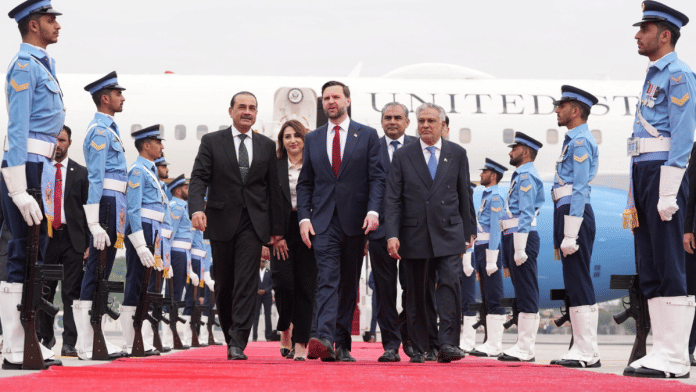


The American and Iranian delegations left Islamabad on 12 April after holding talks that ended with unresolved issues. This means peace remains elusive, though still a distant possibility, depending on how both sides increase costs for the other to maximise their leverage and calculate their options. Not that serious observers expected much from these discussions, but they remained cautiously optimistic since the Pakistan-brokered ‘Islamabad talks’ held over the weekend marked the first face-to-face, direct negotiations between Iranian and American officials since the 1979 Iranian Revolution.
In reality, little was expected from this first meeting, nor was a breakthrough likely, considering the huge trust deficit between the two sides and the disparity in the negotiating teams. Notwithstanding that the US delegation was led by Vice President JD Vance, he — along with his two colleagues, Jared Kushner and Steve Witkoff — lacked the experience to convince the Iranian team, which comprised far more seasoned and educated negotiators. Iranians, in any case, have been tough negotiators.
Perhaps the American side also carried a chip on its shoulder — the burden of Donald Trump’s expectation that he had all the leverage to make Iran accept everything that the US offered. So, despite the US team leaving without budging from its core positions, this could hardly be termed a success, as they found the Iranians willing to talk but unwilling to compromise on American terms. Iranian speaker Mohammad Baghar Ghalibaf told Vance: “If you fight, we will fight; if you come forward with logic, we will respond with logic.”
Contrary to what Trump may have believed, the Iranians seemed confident of their edge in controlling traffic through the Strait of Hormuz. Not surprisingly, the US team saw the challenge and decided to quit further talks without allowing both sides to bring in their respective team of experts for detailed discussions. As a result, the talks ended in 21 hours, even though initial expectations in Islamabad were that they might continue longer.
Interestingly, it had also been expected that the two sides would follow a routine diplomatic process, which involved first exchanging position papers and agreeing on Terms of Reference (ToRs) before sitting down for substantive discussions. It appears that neither side made use of the expert teams they had brought along. While the American side accused Iran of refusing to budge on the Strait of Hormuz and the nuclear issue, Iran’s foreign minister, Abbas Araghchi, argued that the problem lay with the US, as Trump kept shifting the goalposts during the talks. Reportedly, Vance spoke several times with Trump during the negotiations for briefings and further instructions.
In a sense, this was a learning process for the American delegation, an opportunity to understand what to expect and how to deal with an Iranian negotiating team, should they meet again. While neither side has commented on further meetings, sources in Islamabad say that the failure to strike a deal does not necessarily signal the end of negotiations.
Also read: Pakistan is fence-sitting on Iran War. Tehran prefers it there
Talks fail and the US turns to pressure
As the teams returned, Trump looks to be strategising to increase US leverage vis-à-vis Iran to extract some form of compromise at a later stage. His order now for the US Navy and its allies to block the Strait of Hormuz is a counter-blockade meant to stop Iran from extracting financially from the conflict. This economic pressure is intended to further hollow out the Iranian state and force it to reconsider its position.
Whether this will impress Tehran is an open question. An American counter-blockade, meant to force countries such as China that trade with Iran, may also impact US allies in Europe, which could then prompt them to engage with the American president. Not to forget the cost for American people. What we are witnessing is a continuation of the same strategic game — both sides trying to increase costs for the other in the hope that one will blink first.
Right now, one only hopes that the ceasefire announced for two weeks on April 7 will likely hold until 21 April. Observers are not even sure that the US is keen to resort to bombing after the ceasefire ends, and might try measures like the counter-blockade to strengthen its position.
Also read: The Hormuz blockade is a throwdown the US can’t win
Pakistan’s moment, if it avoids overreach
Meanwhile, the one player that seems to have benefited from both the conflict and talks is Pakistan. It now has the ears of both Washington and Tehran and is believed to have secured a role in any future dialogue process. Araghchi indicated his preference for Pakistan as a facilitator. During the entire 21-hour discussion, Pakistan’s army chief, Field Marshal Asim Munir, was also present with his team and notetakers. Munir now sees both himself and his country playing a more important role in the West Asia, a goal Islamabad has pursued since at least 2022.
One is reminded of the National Security Policy announced in January 2002, which outlined Islamabad’s ambition to play a larger role in West Asia. It was also during this period that then army chief General Qamar Javed Bajwa and Prime Minister Imran Khan began efforts to improve ties with Iran, which had deteriorated under General Raheel Sharif.
Pakistan’s ability to engage Iran and bring it to the table was not just a function of goodwill between neighbours but also a reflection of Tehran’s awareness of Islamabad’s deeper security agreement with Saudi Arabia. In case the war escalated, Pakistan would then have to jump to support Riyadh, something Iran would have to factor into its calculations. The talks, even without a deal, were partly a result of such strategic messaging.
Now that peace remains elusive, Riyadh is likely to depend more on Islamabad to stand by its side and strengthen its defences if the conflict persists and to signal its willingness to respond to further escalation by Iran. A day before the talks began, Riyadh activated its mutual defence agreement with Pakistan, not only by signing a financial agreement but also by ensuring the deployment of Pakistani ground forces and fighter jets to Saudi Arabia. Reports suggest that Pakistan has dispatched 13,000 additional troops and 18 fighter jets.
Sources in Islamabad also say that Munir and Prime Minister Shehbaz Sharif are expected to visit Saudi Arabia soon for further discussions on security cooperation. Riyadh reportedly grew extremely tense after the Iranian attack on its oil facility at Jubail on 7 April.
Sources say this was when Saudi Arabia told Pakistan it must put life into the security agreement, as attacks on civilian infrastructure could not be tolerated. This was a signal to Tehran that Riyadh was ready to defend itself against further attacks. It is also worth noting that Pakistan may have used its potential involvement in the conflict as leverage to convince Iran to come to the negotiating table with the US.
Contrary to claims that Saudi Arabia was unhappy with Pakistan for not joining the war earlier, reliable sources say that Riyadh itself exercised restraint until the Jubail attack. This current military preparedness is in anticipation of further attacks, rather than signalling proactive participation in an American-led war. Islamabad has always been clear that in case of a conflict between Riyadh and Tehran, it would side with Saudi Arabia.
One hopes that an overexcited Islamabad and Rawalpindi carefully calculate the risks of deeper involvement in West Asian geopolitics. While facilitating talks and engaging in the US/Israel-Iran war may have earned the field marshal kudos at home and diverted attention from internal politics, it would be best for Pakistan’s military leadership to remain mindful of its limitations and avoid overextending itself in a region that remains a complex quagmire.
Ayesha Siddiqa is a senior fellow at the Department of War Studies at King’s College, London. She tweets @iamthedrifter. Views are personal.
(Edited by Prashant Dixit)