









The two-week ceasefire between Iran and the US-Israel has come alongside Tehran’s decision to allow safe passage of ships through the Strait of Hormuz. If the ceasefire holds, tankers will move again, insurance rates will fall, and the immediate pressure on India’s energy supply will ease. But the legal architecture Iran used to close the strait — and the precedent it has set for every narrow international waterway that matters to India — will still be standing when the first ship transits.
A fortnight-long ceasefire does not repeal Iran’s 1993 Marine Areas Act, dissolve the Qeshm-Larak toll corridor established during the closure, or resolve the question that Singapore’s Foreign Minister Vivian Balakrishnan raised in Parliament this week—and that India has yet to answer. The crisis has paused; the question has not.
India’s energy security runs through the Strait of Hormuz. Its trade with East and Southeast Asia runs through the Strait of Malacca. Its naval reach into the Pacific runs through the waters east of the Andaman and Nicobar Islands. These are not abstract strategic interests; they are the physical arteries of India’s economic rise — and they all depend on a single legal principle that Iran’s conduct during this crisis has put under serious pressure, with consequences for every other strait India relies on.
When Balakrishnan stated flatly that Singapore would neither negotiate with Iran for passage nor pay tolls, he was defending that principle. He was also implicitly making an argument that has meaning for India, too. The ceasefire pause is exactly the right moment for India to examine it.
Two rules, one Strait
The Law of the Sea has two distinct regimes governing how foreign ships pass through coastal state waters. The older one, innocent passage, comes from the 1958 Geneva Convention on the Territorial Sea. Under innocent passage, a foreign ship may cross through a coastal state’s territorial waters — the band of sea extending 12 nautical miles from the shore — provided it does so continuously, peacefully, and without threatening the coastal state’s security. The coastal state retains significant authority: it can require prior notification for warships, impose conditions, and, in some circumstances, suspend passage. The right exists, but it is hedged.
The newer regime, transit passage, was created specifically for international straits under the 1982 United Nations Convention on the Law of the Sea (UNCLOS). The logic for this insertion was simple: some straits are so important to global trade and navigation that the older innocent passage rules are inadequate. If a coastal state can interrupt or condition passage through the Strait of Malacca, the Strait of Hormuz, or the English Channel at will, global commerce becomes hostage to the politics of whichever state happens to sit on the shore.
Transit passage removes that leverage. Under UNCLOS, ships of all nations have an unconditional right to transit international straits continuously and expeditiously. The coastal state cannot suspend it, cannot charge for it as a condition of passage, and cannot discriminate between flags. Article 44 of UNCLOS is specific: states bordering straits shall not hamper transit passage.
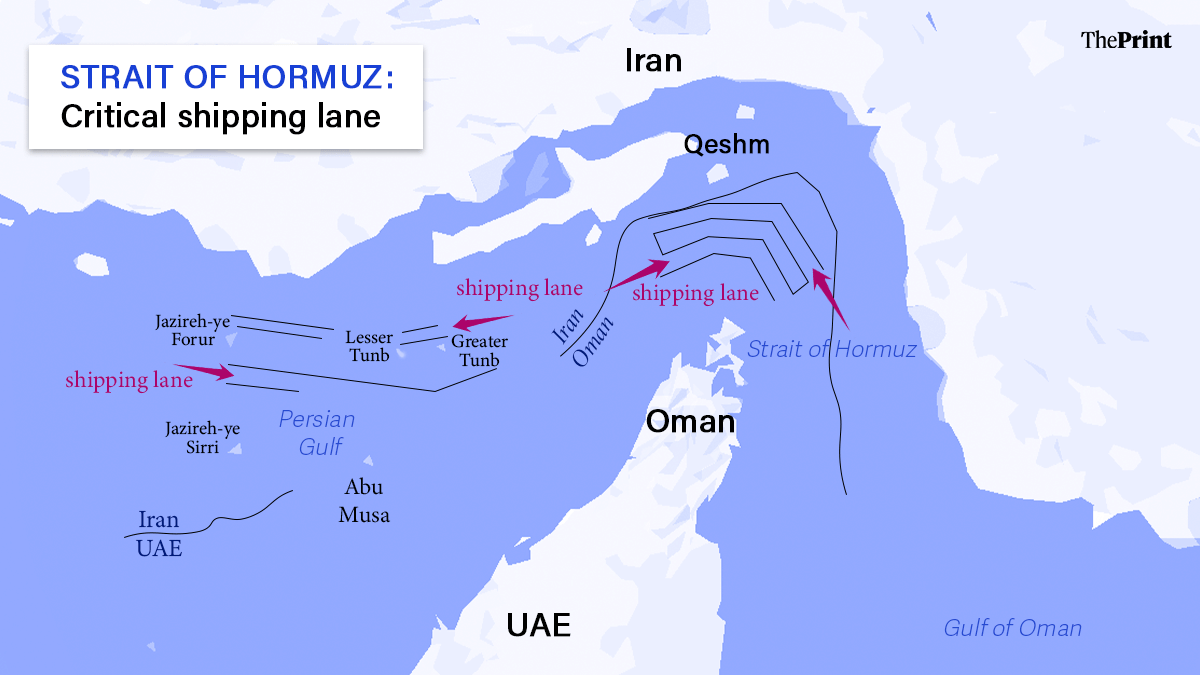
The Strait of Hormuz qualifies as an international strait. At its narrowest point, it is about 21 nautical miles wide — the entire navigable corridor falls within the territorial waters of Iran and Oman. But the transit passage regime was designed precisely for straits like this, where geography places the world’s shipping lanes inside someone’s sovereignty. The legal obligation overrides the geographic inconvenience.
Also read: India isn’t shaping the West Asia crisis—it pays the price for caution
Iran’s argument — and why it is not frivolous
Iran’s counter is carefully constructed and has been maintained consistently for decades — long before the current crisis forced it into public view. Iran signed UNCLOS in 1982 but never ratified it. While signing the instrument, Iran declared that only states that have actually joined the convention are entitled to its rights, including transit passage.
Iran prefers the framework of the older 1958 Geneva Convention, whose innocent passage regime it treats as the applicable customary law for states not party to UNCLOS, giving coastal states considerably more authority over foreign ships than transit passage does. Iran’s domestic legislation from 1993 uses the framework of innocent passage rather than transit passage throughout. This is not improvisation; it is a legal architecture constructed in advance of the crisis it was designed to support.
What Iran did during the closure — routing approved vessels through a five-mile corridor between Qeshm and Larak islands, entirely within Iranian territorial waters, with documented toll payments of up to $2 million per transit — was the operational expression of that long-prepared legal position. Whether one finds the argument convincing or not, it is sophisticated enough to sustain a prolonged legal contest. The ceasefire has suspended the operational pressure. It has not invalidated the legal claim. Iran’s Hormuz transit fee bill, approved by the Iranian parliament’s National Security and Foreign Policy Committee on 31 March, is before the full Majlis for a plenary vote. The toll corridor remains mapped and operational. The architecture is in place for the next time it is needed.
The Singaporean stand in its Parliament rests on a single powerful counter-argument: transit passage is not only a treaty right under UNCLOS. It is part of customary international law — meaning it binds all states, including Iran, regardless of whether they have ratified the convention. This was the decisive move in the Singaporean Foreign Minister’s parliamentary statement. It closes Iran’s escape route, even if they have not ratified UNCLOS. You cannot opt out of customary international law by declining to sign a convention.
Singapore and India’s stake
Singapore has skin in this game that is hard to overstate. The Strait of Singapore, at its narrowest, is under two nautical miles wide — tighter even than Hormuz. More oil and more container cargo flows through the Malacca and Singapore Straits than through Hormuz. If the principle that coastal states can manage transit in international straits as a service they provide — rather than a right they owe — becomes accepted at Hormuz, there is no principled barrier to Indonesia or Malaysia asserting something similar at Malacca. Balakrishnan said this directly in the Parliament of Singapore, explicitly drawing the equivalence. For Singapore, a city-state whose entire existence as a trading nation depends on ships of all flags moving freely, it is an existential question.
India’s exposure is comparable in strategic weight. Several countries — India among them, alongside China, Russia, Iraq, and Pakistan — secured transit for their vessels during the closure through what Tehran called a friendly nations framework. Iran’s consulate in Mumbai publicly confirmed India’s inclusion on this list. India’s External Affairs Minister S Jaishankar described this as ship-by-ship diplomatic engagement — every movement is an individual happening, no blanket arrangement. That framing is diplomatically careful. But Iran’s own consular communication contradicts it: India was on the list, and the framework was Iran’s, not India’s.
There is a further dimension that connects Hormuz directly to India’s most consequential long-term strategic relationship. China has signed and ratified UNCLOS — unlike Iran it cannot claim to be unbound by its framework. But China has consistently argued that military activities in its Exclusive Economic Zone (EEZ) require Chinese consent, and it rejected the 2016 International Arbitration Award that found comprehensively against its South China Sea claims. Every time India deploys a naval vessel through the South China Sea without seeking Chinese permission, it is asserting Freedom of Navigation rights. If India accepts — even tacitly, by operating within Iran’s friendly-nations framework without debating its legal basis — that passage through international straits is to be negotiated bilaterally rather than exercised as a right, it weakens its own position in any future confrontation with China over those same waters. The legal principle is indivisible. You cannot accept it selectively.
What India should say
The argument is not that India should have refused to engage with Iran, cut off energy supplies, or joined a Western-led coalition against Tehran. India’s energy dependency is real, the bilateral relationship has genuine value, and the pragmatic management of the crisis was defensible as crisis management. The ceasefire India has helped encourage is a constructive outcome.
The argument is that India should make a distinction it has not yet made publicly — between two different things Iran was doing simultaneously. Charging fees for genuine navigational services in a Traffic Separation Scheme segment within Iranian Territorial Waters, part of an International Maritime Organisation (IMO) scheme in place since 1973, is legally defensible, and India can accommodate it. Deciding which nation’s ships may pass based on their political alignment with Tehran is not legally defensible under any framework, including the framework of innocent passage that Iran itself invokes as customary law. It is the specific claim India should articulate clearly and on the record.
Singapore, a city-state with no power-projection capability in the Persian Gulf and a strategic calculus built entirely on the principle of open international straits, made that distinction in Parliament. India — a major naval power, an UNCLOS signatory, a state with direct energy dependency at Hormuz, trade dependency at Malacca, and strategic reach into the South China Sea — has not. That is not strategic sophistication; it is a strategic absence. And absence, in international maritime law, has a way of hardening into precedent.
A two-week ceasefire is not a legal settlement. Iran’s toll booth architecture remains operational, its Hormuz transit fee bill is before its parliament for plenary action, and its legal position has not been withdrawn. When the next crisis arrives — and in a region this contested, there will be a next crisis — the framework will be ready. The question is whether India’s legal position will be ready too. Speaking up now, while the guns are quiet and the ships are moving, costs far less than speaking up when they are not.
The author is a former Flag Officer Naval Aviation, Chief of Staff at the integrated HQ Andaman and Nicobar Command, and Chief Instructor (Navy) at DSSC Wellington. He tweets @sudhirpillai__Views are personal.
(Edited by Prashant Dixit)