






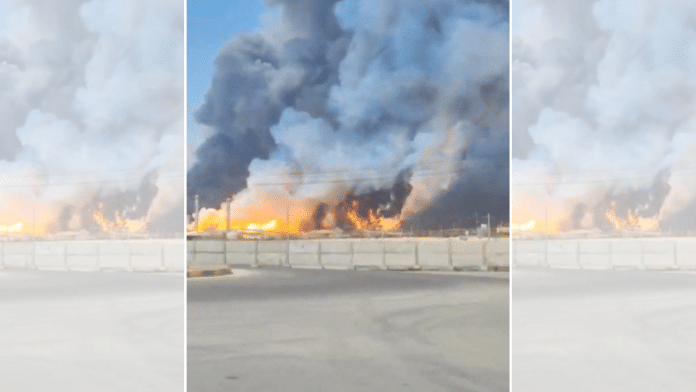



As I mark the first year of my confinement in Silivri Prison, events unfolding beyond these walls suggest that we are witnessing not merely a shift in policies, but the crumbling of the international order. The headlines are dominated by escalating violence in Iran and across the Middle East, offering a stark reminder that power politics is once again setting the terms of global affairs.
The Iran conflict epitomizes the “rupture” that Canadian Prime Minister Mark Carney described so eloquently in his address at Davos. The comfortable assumptions that shaped the past three decades – that economic interdependence would prevent conflict, that global governance would deepen over time, and that technological progress would expand freedom – are rapidly losing credibility.
In their place stands a harsher truth: the instruments designed to bind the world together have been repurposed as tools of intimidation. Indeed, the very vocabulary of cooperation has been emptied of meaning, first through overuse and today through mendacity and bad faith. Too often, “diplomacy” is reduced to pressure politics – threats dressed up as engagement, backroom deals, or photo opportunities.
In both Davos and Munich, the subtext was that crisis management is becoming less hierarchical. Great powers may still dominate when it comes to establishing deterrence, but as hegemonic players embrace disruption and violate international law with abandon, the tasks of de-escalation and mediation are increasingly being shouldered by middle powers operating through flexible, overlapping diplomatic networks.
These states are learning to act in concert not by forming a single formal bloc, but by building issue-based coalitions that can move faster than great-power rivalries would allow. Middle powers can coordinate sanctions and humanitarian corridors, broker prisoner exchanges, open discreet backchannels, and keep multilateral institutions functioning when the largest players pull back or engage in sabotage. When confrontations between the strongest states threaten the potential for compromise, it is often middle powers that create the narrow openings through which diplomacy can proceed.
But for any middle-power framework to endure, it must be built on a foundation of democratic trust, with all participants playing by the same rules. During periods of rupture, autocratic states often present themselves as “indispensable” to global stability. They may step up to help manage international crises in the short term, even as their leaders exploit the same circumstances to entrench their rule at home. But autocrats can never serve as credible stewards of a new rules-based order, because they do not treat rules as binding. Everything is transactional.
The Iran conflict illustrates both what happens when such openings are too weak and why legitimacy matters as much as capabilities. In the new geopolitics, great powers tend to take matters into their own hands, acting through coercion first and diplomacy second. But when authority at home rests more on coercion than consent, external stability becomes brittle: policy turns reactive, deterrence becomes improvised, and a state’s room for maneuver depends less on durable commitments than on shifting balances of power. The result is not a renewed order, but a landscape shaped by faits accomplis, with everyone else forced to adjust after the fact.
This is an insurmountable obstacle. A government that regards law as an instrument of convenience will always promise reform in principle and resist it in practice. It will endorse a fairer system, while quietly ensuring a continuation of the disorder from which it profits. For countries that feed on chaos and tumult, a truly just order is not a goal; it is a threat.
That is why any new global system must be led by democratic countries. In democracies, leaders change, but institutions endure. Law exists to constrain the arbitrary exercise of power, not to serve it. The ultimate test of a democracy’s sovereign independence is whether it can defend not only its territory and economy, but also its political way of life and the rule of law. These commitments are what make democratic countries predictable and trustworthy.
It is fanciful to think that geography can do the same. A “pivot country” that balances power between global rivals is no substitute for stable institutions. If a strategically important state has weak institutions, it will always be an unreliable partner – easily pressured by others and too costly to keep on side.
Democracy is what makes state power reliable. It enables long-term decision-making and enduring alliances. It underpins confidence that obligations will be honored, mistakes corrected, and crises met with resilience. In countries where law is weaponized to silence opposition, calls for a fairer international order lose all credibility. My own country is a case in point.
I take Carney’s call for solidarity among middle powers seriously. But for that solidarity to matter, it must be used to create a new system of states that are governed by the rule of law and genuinely committed to democratic norms and principles. Principled diplomacy is the disciplined pursuit of interests within international law, without coercion or the denial of others’ rights, aimed at outcomes that endure because they command legitimacy.
No, I am not advocating exclusion. Democratically challenged countries like Turkey should not be pushed to the margins. Any new global system must be more inclusive than the last one, anchored in the basic principles of international law. Shared standards would make participation durable, credible, and resilient over time, drawing countries forward together rather than leaving anyone behind.
Specifically, the effectiveness of any new order would depend on a dual commitment: to cooperate on the basis of shared values at the international level, and to strengthen democracy and the rule of law at the national level. With these criteria established, states should be able to negotiate and agree upon a shared set of principles.
Among these are that the “power of law,” not the “law of power,” should govern trade, financial flows, technology, and data; that multilateralism should not merely manage crises like migration and climate change, but address their root causes and share the burden more fairly; that resilience such as in digital infrastructure or cross-border supply chains requires shared mechanisms; and that legitimacy requires democratic institutions: an independent judiciary, a free press, genuine electoral competition, and a taboo against criminalizing one’s political rivals.
The message coming out of Davos and Munich this year is not that diplomacy has died, but that its center of gravity has shifted. As great-power rivalries harden, the practical work of lowering tensions is falling to those middle powers that are willing to keep their doors open. They must take this responsibility seriously, because a world of 8.3 billion people will not bear the weight of endless coercion and disorder. Concerted action by the world’s middle powers will benefit not only themselves but also developing countries across the Global South. In the absence of solidarity, these countries will be isolated and coerced, one by one, into a loss of sovereignty.
If middle powers come together, we can build a new foundation for the international order that restores balance. The Iran crisis makes clear that such a restoration is crucial for steering geopolitics away from a world governed by power alone. Even from a prison cell, I have faith that such a foundation is possible.
Ekrem İmamoğlu, the Mayor of Istanbul, was suspended from office and imprisoned after becoming the Republican People’s Party (CHP) candidate for the next Turkish presidential election, which must be held by May 2028.
This article has been republished with permission from Project Syndicate. This article was originally published on the Project Syndicate website.