









Experts and analysts are comparing the ongoing West Asian conflict with the Covid pandemic. The government has also stated in Parliament that the challenging global situation arising out of the conflict will have an enduring impact on India, underlining the need for the country to stay prepared, much like it did during the pandemic.
In this context, an obvious question arises. What will be the impact of the West Asian conflict on the Union Budget for 2026-27, presented about two months ago? The past is often a pointer to the future. Looking back, it would be instructive to see how the Covid pandemic played havoc with all the basic numbers that the Union Budget for 2020-21 had presented on February 1, 2020.
Remember that two days before the Budget, the World Health Organization had declared Covid-19 a public health emergency. From January 17 onwards, the Indian government had also initiated measures to manage the Covid impact. These included steps to initiate point-of-entry and community surveillance, establish quarantine facilities and isolation wards, and provide adequate personal protective equipment, trained manpower, and rapid response teams.
Yet, the written speech for the 2020-21 Budget did not refer to the impending challenges posed by the pandemic. Of course, the Covid situation worsened with every passing day after the Budget presentation. The government imposed a country-wide lockdown on March 24, 2020, which was lifted more than two months later, at the end of May. The demand for tax relief was on the rise. But the government did not go in for any major tax concessions, except for ensuring an expeditious refund of taxes to businesses and a 25 per cent reduction in the rates of tax deduction at source and tax collected at source. The government also increased financial allocations for many schemes to help small and medium businesses with increased credit guarantee and liquidity support.
The net impact of the Covid pandemic on the pace of economic activity and, therefore, the government’s tax collections was huge. The liquidity support and credit guarantee schemes for small and medium businesses inflated the government’s expenditure. Thus, actual gross tax revenues in 2020-21 were ~20.27 trillion, over 16 per cent lower than the Budget Estimate (BE) of ~24.23 trillion. Non-tax revenues also took a 46 per cent hit — against the BE of ~3.85 trillion, the actuals were ~2.08 trillion.
But revenue expenditure as per actuals in 2020-21 jumped by 17 per cent to ~30.83 trillion. Fertiliser subsidies rose by 80 per cent and food subsidies ballooned by 370 per cent over the BE. The only silver lining was that the government managed to keep its capital expenditure growth intact — the actuals were estimated at ~4.26 trillion, compared with ~ 4.12 trillion in the BE.
Quite understandably, the fiscal deficit ballooned to 9.2 per cent of gross domestic product (GDP), up from 3.5 per cent in the BE for 2020-21. Revenue deficit too widened to 7.3 per cent of GDP in 2020-21, up from 2.7 per cent as projected in the BE. Most importantly, the Budget for 2020-21 had projected India’s nominal economic growth to be at 10 per cent. But as the year went by and Covid impacted the economy, India’s nominal GDP contracted by 1.24 per cent.
Six years later, the Budget for 2026-27 was presented to Parliament on February 1, 2026. In just about four weeks, the West Asian conflict has flared up. What could go wrong for the government’s Budget numbers? Already, industry has urged the government to step in with a relief and support package to reduce the adverse impact of the war on the pace of economic activity. Among the suggestions are a time-bound conflict-linked emergency credit line guarantee scheme, like the one launched during the Covid pandemic, rationalisation of the tax and duty structure on energy inputs, and the extension of the delivery timelines for central and state public sector contracts.
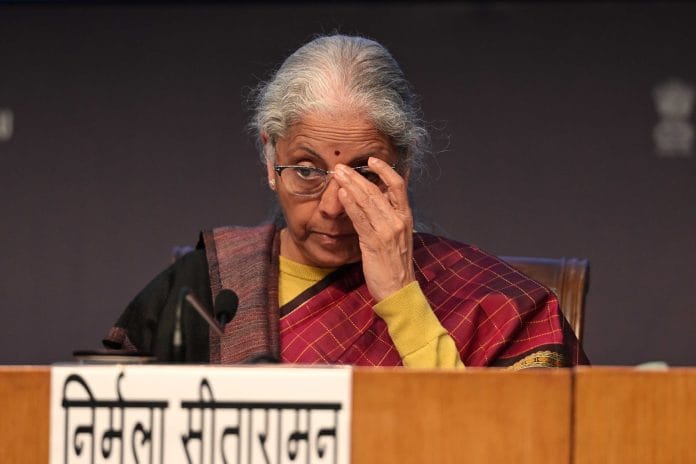
The government has already slashed the special additional excise duty on petrol and diesel to provide some financial cushion to oil refining and marketing companies. On an annualised basis, the Centre’s revenue loss could be around ~1.3-1.7 trillion, according to some estimates. Finance Minister Nirmala Sitharaman has admitted the enormity of the challenges arising out of the conflict in West Asia, but has reminded the country that the government has fiscal space to maintain its capital expenditure programme, the flexibility to reduce interest rates and the resources to provide targeted support to affected sectors. This would imply that the government is gearing up for a major slippage in its deficit, since its expenditure commitment would rise significantly during the year, even as revenues could shrink compared to what was projected in the Budget in February. The year, thus, could be a replay of the Covid year of 2020-21, although the impact on public finances in 2026-27 would not be that severe.
Therefore, the government has two clear ways to manage its public policy conduct. One, it should immediately identify areas where its expenditure and revenues would be impacted. Fertiliser subsidies were projected to decline by 8 per cent to ~1.71 trillion in 2026-27, compared to the revised estimate of 2025-26. Given the way fertiliser prices have already shot up, the government’s estimate for fertiliser subsidies for the current year should be revised upwards. Similarly, excise duty collections, which largely come from petrol and diesel, are likely to take a big hit after the duty cuts for petrol and diesel. It would be a good idea for the finance ministry to assess these developments and their impact on the government’s finances on a quarterly basis and make that public. This should improve the country’s preparedness for such a crisis.
Two, as during the Covid year, the government could use the current year as an opportunity to introduce some long-pending legislative reforms to improve the ease of doing business and attract foreign direct investment. Land acquisition laws, agriculture reform laws and further changes in the goods and services tax (GST) are among them. The Covid year of 2020-21 saw the Modi government bring about changes in labour and agriculture laws, but these ran into problems. Labour law changes were finally notified after a long wait of more than five years. Changes in agriculture laws were rolled back in the face of farmers’ agitation. GST rates saw a major rationalisation in September 2025. But more needs to be done, for instance, including petrol and diesel within the GST system. The Covid year’s mistakes of inadequate consultation should not be repeated. Let there be a more open discussion with farmers’ bodies and states and at the GST Council to bring about necessary changes in agricultural and GST laws. A crisis could be an opportunity for ushering in reforms.
AK Bhattacharya is the Editorial Director, Business Standard. He tweets @AshokAkaybee. Views are personal.