






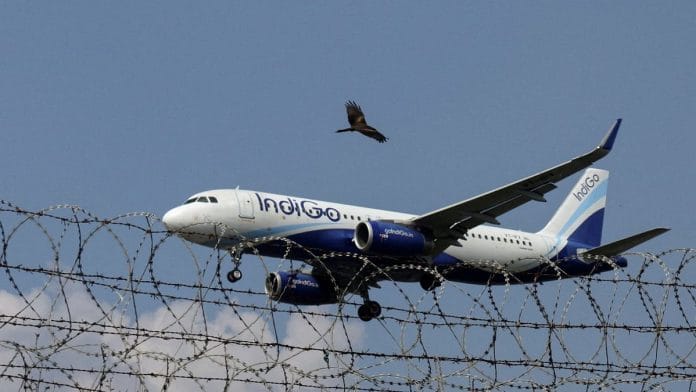



India often waits for a crisis to ask questions it should have asked much earlier. The IndiGo meltdown is the latest reminder of how easily a single shock can expose systemic fragility. A regulatory change that should have been manageable instead paralysed the sector because Indian aviation depends heavily on a single carrier. What began as a scheduling issue became a national stress test.
More than 3,000 flight cancellations in a few days thinned schedules, clogged airports, and sent fares soaring. There was no insolvency or safety breach — only new Flight Duty Time Limitation (FDTL) rules tightening crew availability. Yet the consequences spread across the country. When a player with a 60 per cent market share falters, the system has no redundancy to absorb the hit.
Civil aviation is not a statutory monopoly, yet it behaves like one because the ecosystem leans so heavily on a single dominant operator. For those of us who study defence and military readiness, this should ring alarm bells. If such concentration can destabilise a civilian system that still has alternatives and fallback options, the risks are far greater in defence, where platforms, suppliers, and certification pathways are often singular and irreplaceable.
India does not lack policy directions or reform prescriptions in the defence sector. What it lacks is a defence production system designed to absorb shocks and withstand failure. For decades, we have tolerated an architecture built around monopoly suppliers and a monopsonistic buyer, both insulated from competitive pressure and sustained external challenges.
Real reform must therefore break this single-point-of-failure logic. That requires genuine supplier choice, independent technical oversight, and a clear separation between design and certification so that no organisation is allowed to mark its own homework. It demands procurement rules that reward delivery discipline and penalise delay, whether the supplier is public or private. Above all, it requires redundancy across the industrial base — because a nation of India’s scale and ambition cannot rely on a single production line or a single airworthiness pathway for frontline capability.
IndiGo’s co-founder, Rakesh Gangwal, once used the colloquial phrase “paan ki dukaan” to warn against organisations that grow too large without building systems and discipline. India’s defence ecosystem now risks the same trap — too much riding on too few players, with little spare capacity, backup suppliers or alternative pathways for when something goes wrong.
IndiGo remains a well-run airline, but its recent disruption exposed a deeper structural truth: concentration magnifies fragility. If civil aviation can wobble under such pressure despite having alternatives, the warning for defence is far sharper. Defence production operates with far fewer substitutes, longer recovery times, and consequences that extend directly into readiness and deterrence. India’s defence-production challenge sits uncomfortably close to the space in which IndiGo found itself, and it demands the same level of hard introspection that other long-overdue reform areas now face.
How India runs defence production
For decades, India’s military capability has been dependent on a narrow cluster of public sector enterprises. In aircraft, helicopters, engines, ships, missiles, sensors, and subsystems, the Ministry of Defence presides over a vertically integrated system in which MoD organisations, Defence Research and Development Organisation (DRDO) units, and Defence Public Sector Undertakings (DPSUs) jointly define requirements, certify designs, and supply the forces. Private industry has expanded, but it still confronts certification queues, scarce test infrastructure, and slow approval cycles.
Recent public criticism of private defence vendors is a reminder that the private sector is not yet a fully mature defence industrial base either. Many firms perform well when assembling imported kits, but struggle when asked to develop complex, end-to-end systems within India’s constrained materials, testing, and certification ecosystem.
The result is a landscape in which the customer has limited real choice, where delay and inefficiency are normalised, and where producers — public or private — face few meaningful consequences for late, incomplete, or poor-quality delivery.
The IndiGo meltdown dominated headlines because the public experienced its impact instantly. Yet the prolonged grounding of all Naval and Coast Guard Advanced Light Helicopters (ALHs) this year drew almost no national attention, even as India conducted Operation Sindoor and prepares for follow-on contingencies. A frontline helicopter fleet grounded for months was treated as routine fleet management. When civil aviation sneezes, everyone hears it. When a military fleet is grounded, silence becomes routine. That silence is the danger.
Unlike aviation, national defence has no external fallback if HAL, Mazagaon Dock, BEL, or BDL falter. A single point of failure in defence production is not an inconvenience; it is a direct hit on deterrence and readiness.
A historical contrast helps clarify the problem. India’s acquisition of the Westland 30 civil helicopters in the 1980s — later written off after persistent technical and operational shortcomings — remains one of the rare instances where the country quietly cut its losses on a failed imported platform.
The ALH represents the opposite case: indigenous, central to all three services, and deeply embedded in operations. That difference matters. India has historically found it easier to walk away from flawed foreign platforms than to confront structural weaknesses in domestic programmes dominated by a single monopoly supplier. Once an indigenous platform becomes system-critical, the political and institutional cost of acknowledging deeper design or governance flaws rises sharply.
It is in this context that policy instruments such as the Positive Indigenisation List can also be looked at. The intent behind PILs is sound: to reduce import dependence and give domestic industry the confidence to invest. The risk lies in sequencing. In several instances, imports are restricted before domestic products, suppliers, and support ecosystems have fully matured. When prohibition runs ahead of capability, indigenisation stops being a resilience-building exercise and instead hard-wires dependence inward. The services lose fallback options, monopoly positions are reinforced, and delivery discipline weakens because choice has already been foreclosed.
Indigenisation by compulsion may reduce imports on paper, but without competition, independent oversight, and built-in redundancy, it can reinforce exactly the single-point-of-failure risks that defence reform must eliminate.
The lesson here is not about opposing indigenisation, but about governance. Political pressure and structural insulation can entrench long-tolerated flaws, and correcting them becomes harder the longer they are normalised.
Also read: IndiGo was irresponsible — but so was a regulatory system that failed to act on time
Public or private sector: opposite causes, same problem
Recent remarks by the Chief of Defence Staff, the Army Chief, and the Defence Secretary reflect a growing concern about vendors slipping on timelines. At a recent conclave, Defence Secretary Rajesh Kumar Singh even warned that emergency procurement contracts could be closed if suppliers failed to deliver within the one-year window. It was not a formal directive, but it was clearly meant to deter the pattern of over-promising and under-delivering seen across both domestic and foreign vendors.
But such warnings, however sharp, are tactical. They do not fix the incentives that create delay.
Private firms delay because the ecosystem around them is weak: certification flows through government channels, testing facilities are scarce, R&D risk sits entirely on the firm, procurement cycles crawl and payments can be uneven. Public-sector delays come from the opposite dynamic: monopoly positions, assured orders, and soft accountability. Put simply, the public sector delays because it fears failure; the private sector delays because it fears capital risk. Yet both logics converge on the same outcome — stalled capability.
A personal example stays with me. In 2018, I was appointed to an MoD committee meant to fast track acquisitions above Rs 500 crore. It never met. No reviews, no bottlenecks identified, no recommendations. It existed on paper but not in practice — a textbook illustration of how the system creates process when it cannot create momentum.
IndiGo showed how a single point of failure can ripple across a sector. In defence, where there is no external fallback, the consequences are far more serious.
One-off disruption or a national pattern?
Monopolies rarely collapse suddenly. They weaken quietly until a crisis exposes what had long been eroding.
Boeing’s 737 MAX failures did not stem from a single defect, but from years of diluted oversight, weakened engineering challenge, and internal incentives that prized tempo over rigour. South Africa’s power utility Eskom deteriorated over decades through political interference, weak maintenance and soft budgeting. Large-scale reviews by the Organisation for Economic Co‑operation and Development (OECD) and parallel Asian Development Bank (ADB) studies of state‑owned enterprises converge on the same finding: corporisation on its own does not improve performance. Sustained capability emerges only when strong boards, transparent metrics, competitive pressure, and genuinely independent oversight are in place.
European defence reform experience echoes the same lesson. France strengthened its Direction Générale de l’Armement (DGA) following inquiries that revealed fragmented technical oversight. At the same time, the United Kingdom brought competitive contracting and independent audits into naval shipbuilding following National Audit Office (NAO) reviews that documented chronic slippage, cost overruns and weak delivery discipline. Across these studies, the conclusion is consistent: capability fades when the challenge disappears.
India has equivalents in form but not always in function. The Comptroller and Auditor General (CAG) routinely flags delays, accountability gaps, and quality issues in defence programmes — findings that resemble OECD and NAO reports. But follow-through often stops at the audit table. India lacks an independent technical audit mechanism comparable to those that reshaped Boeing or strengthened the DGA. Our audits focus on financial compliance, while the deepest failures lie in engineering discipline, oversight design, and organisational culture.
Anyone who has worked in India’s audit ecosystem recognises the pattern. Difficult questions in audit paragraphs often meet the standard reply: “noted for future compliance”. The Action Taken Note closes the loop even when nothing changes. Mechanisms meant to drive correction become endpoints.
Parliamentary oversight should be the counterweight. In mature systems, committees pursue corrective action until reforms stick. India’s Public Accounts Committee is intended to play this role, but seldom applies the sustained pressure seen in the UK or Australia. This is not a partisan failure but an institutional under-use. Without persistent legislative scrutiny, even the strongest audit findings lose force.
Also read: IndiGo chaos forces DGCA to look inward—spotlight is back on the regulator
What the ALH episode reveals
Two decades ago, at the silver jubilee seminar of the Regional Centre for Military Airworthiness (Helicopters) — RCMA (H) — I argued that HAL, as design authority, should not dominate continued-airworthiness oversight for the helicopters it builds. In most mature systems, continued airworthiness is overseen by an authority structurally separate from the designer and operator because safety depends on the tension between innovation and interrogation.
HAL is certified as an Approved Design Organisation by the Centre for Military Airworthiness and Certification (CEMILAC). On paper, this demands strong internal standards and full support to operators when defects surface. In practice, CEMILAC, the RCMAs, HAL, and the services sit inside the same institutional loop under the MoD. The regulator, the designer, the overseer, and the operator sit too close for true independent challenge.
As a result, defects are often treated as isolated incidents rather than signs of deeper design or process weakness. And as long as the paperwork shows that “processes were followed”, the loop closes and systemic issues remain unaddressed. No Minister is ever required to answer for these lapses in the hallowed portals of Parliament.
MoCA-DGCA: a study in contrasts
A similar pattern is visible in civil aviation. The Ministry of Civil Aviation (MoCA) and the Director General of Civil Aviation (DGCA) oversee IndiGo, much as the Ministry of Defence oversees CEMILAC, HAL, the DPSUs, and the defence services. The DGCA framed and enforced the revised FDTL rules, while MoCA oversaw the broader policy and system impact. Both had nearly two years of lead time, yet presided over a transition in which a single dominant carrier slid into mass cancellations. The subsequent response — schedule curbs, show-cause notices and the partial suspension of the very regime meant to enhance safety — was largely reactive.
The question being asked of MoCA and DGCA is the same one that must be asked of the MoD: when a system is so dependent on a single actor, how thoroughly was it stress-tested by the ministry? Concentration is a policy outcome, not an accident.
The real message of the IndiGo crisis
The real message of the IndiGo crisis is simple. When a system depends too heavily on a single actor, it becomes fragile, regardless of that actor’s competence. When oversight turns into a ritual rather than a rigorous challenge, risk begins to accumulate quietly beneath the surface. When the designer also serves as the certifier and investigator, the challenge function that keeps systems honest starts to wither. And when delays become routine and unpunished, military readiness becomes uncertain long before a crisis makes that uncertainty visible.
These patterns exist across both public and private sectors. But they matter most in defence, where failure has strategic consequences.
India must now make structural choices. It needs genuine competition in defence production. It needs independent technical oversight. It requires transparent metrics aligned with global standards. It needs boards that treat quality and schedule as strategic responsibilities. Above all, it needs redundancy. A nation of India’s scale cannot afford single points of failure in systems meant to protect it.
The disruption may have come from civil aviation, but the warning it carries for national defence is unmistakably ominous.
The author is a former Flag Officer Naval Aviation, Chief of Staff at the integrated HQ Andaman and Nicobar Command, and Chief Instructor (Navy) at DSSC Wellington. He tweets @sudhirpillai__Views are personal.
(Edited by Aamaan Alam Khan)
WoW!!
Well researched and well written.
For the common citizen, this is a wake up call.
However, it would be helpful to know if multiple suppliers would bring in the advantage of back ups or simply spread the risks too thin – but still high risk.
Also, does India defence have the financial muscle to have multiple suppliers for what are basically closed, highly sensitive and secretive platforms?
Finally, don’t other countries also have the same problem of limited suppliers for cutting edge defence equipment?
BTW, paisa vasool for this write up. Pays to pay for The Print.