










In the late 1980s, when Ramayan aired every Sunday morning on Doordarshan, India paused as one. Streets emptied, tea kettles boiled in unison, and neighbours gathered around a single television set in the mohalla or village chaupal. That screen did not isolate; it assembled. That era was characterised by one channel, one episode, and one shared ending.
Four decades later, abundance has inverted that logic. India today is not merely a digitalised society, it is becoming a screened society. Television and mobile sets are no longer merely a source of entertainment. They have become a conduit for public information, a supplement to schooling, a forum for political messaging, and, increasingly, a substitute for absent public spaces.
The paradox of fragmented attention
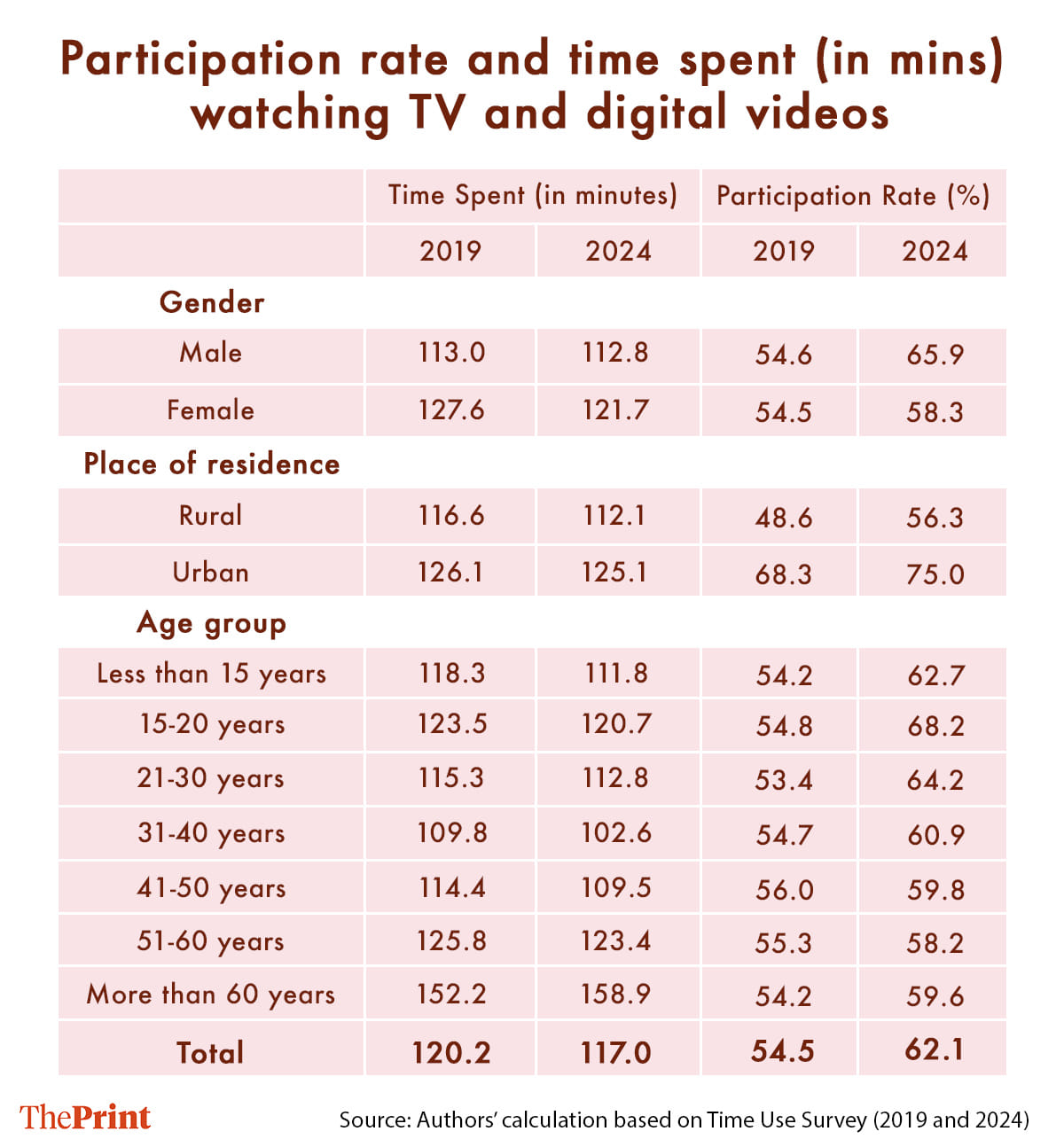
Time Use Survey (TUS) data (2019 and 2024) reveals a striking contradiction in how the nation consumes media. While participation in watching television and digital videos has surged from 54.5 per cent to 62.1 per cent, the actual average time spent viewing has dipped from 120.2 to 117 minutes daily. This shift signals the rise of a snackable India. We are watching more frequently but in shorter, more distracted bursts. This transition from deep, dedicated viewing to fragmented snatches, often occurring alongside work or chores, is the direct result of cheap data and the ubiquity of the smartphone.
Rural-urban convergence has limits
Between 2019 and 2024, average participation increased significantly from 48.6 per cent to 56.3 per cent in rural areas, reflecting gains from electrification, broadcast reach, device penetration, and cheaper mobile data. But viewing time has declined among rural residents. On the other hand, urban residents continue to enjoy a systematic advantage, where participation increased to 75 per cent from 68.3 per cent, with a marginal decline in viewing time.
Among children below 15 years in rural India, viewing time declined from about 115 minutes per day in 2019 to 106 minutes in 2024, while urban children consistently averaged close to 125 minutes.
Similar differentials are visible among working-age adults. In the 31–40 age group, rural residents averaged roughly 99 minutes per day in 2024, compared to 108 minutes in urban areas. Even among senior citizens (60+), urban residents recorded significantly higher viewing time — around 175 minutes daily, compared to 147 minutes in rural India. These disparities point to differences not merely in access, but in time availability, infrastructure reliability, and living conditions.
The myth of gender parity
Aggregate figures suggest a narrowing of the male-female divide. In both 2019 and 2024, women’s average viewing time (at 121.7 minutes in 2024 and 127.6 minutes in 2019) substantially exceeded that of men (at 112.8 minutes and 113 minutes, respectively). While participation rate was almost similar in 2019 for both the genders, there is a substantial rise in participation rate among males in 2024, with a modest rise among females.
Age as the most overlooked dimension
The most pronounced variations in viewing time emerge across age groups. The data exhibits a clear life-cycle pattern — high viewing time among children, declining through prime working ages, and rising sharply among older adults. It’s a distinct U-shaped pattern.
In 2024, individuals aged 31–40 years recorded some of the lowest viewing time, around 103 minutes daily, while those aged 60 and above averaged over 158 minutes. For children, high viewing time often compensates for the absence of recreational and playing infrastructure.
As social circles shrink and physical mobility decreases, viewing time rises sharply for those aged 60 and above, who average over 158 minutes daily. For the elderly, the screen has become a vital substitute for social interaction, yet the content available rarely reflects this specialised need.
Also read: India must build its own AI stack. It is now a strategic necessity
Policy implications and institutional gaps
India’s policy framework has yet to fully recognise media consumption as a capability, rather than a mere by-product of connectivity. Initiatives under Digital India, educational broadcasting efforts, recreational consumption, and welfare communication strategies often assume a homogeneous audience with uniform access to time and attention.
This assumption sits uneasily with constitutional commitments under Articles 14 and 21A, especially when audio-visual media increasingly mediates education, public information, and civic participation. The absence of time-use sensitivity in policy design risks reinforcing existing inequalities, even as access expands.
It is important to acknowledge progress. The expansion of regional-language content, improvements in rural electrification, and declining device and data costs have meaningfully broadened access. Rural-urban gaps in viewing time, though persistent, are narrower than in the past. Yet inclusion measured by ownership and averages cannot substitute for inclusion measured by effective use and autonomy.
However, as the Economic Survey 2025-26 calls for a comprehensive national strategy to combat digital addiction and establishing multi-dimensional metrics to track usage and mental health outcomes, having a balanced approach is the need of the hour. The way forward emphasises a shift toward digital wellness across all age groups, advocating for the introduction of a specialised curriculum in schools, the establishment of offline youth hubs, and the promotion of “digital diets” and detox centres for adults. We also feel that integrating a policy focus on senior citizens (60 and above) is a vital addition to this discourse.
Toward a more equitable media ecosystem
A more calibrated policy response would require three shifts:
– Incorporating time-use data into policy design, particularly in education and public communication.
– Strengthening collective and public viewing spaces, such as libraries and community centres, especially in rural areas.
– Designing content that accounts for interrupted and constrained viewing, particularly for adult women.
India’s screens have become a public institution, but its benefits remain unevenly distributed. The challenge ahead is not merely to expand access, but to ensure that time, attention, and agency are more equitably shared.
Viewing time, measured in minutes, may appear mundane. But in reality, it is a precise indicator of how inequality quietly reproduces itself, after work hours, between chores, and across generations.
Palash Baruah @DrPalashBaruah is a fellow at the National Council of Applied Economic Research (NCAER), Delhi and DL Wankhar is a retired officer of the Government of India. Views are personal.
(Edited by Aamaan Alam Khan)