






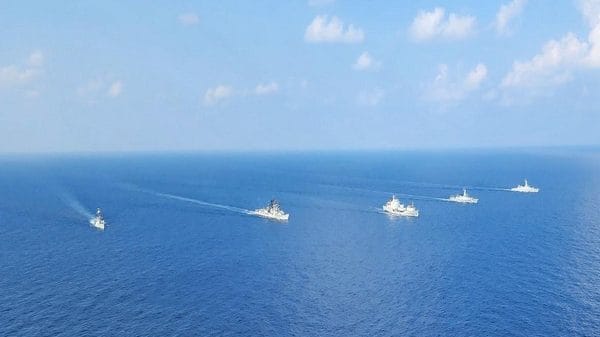



In the early hours of 4 March 2026, the United States Navy sank the Iranian frigate IRIS Dena in international waters off the southern coast of Sri Lanka — in the heart of the Indian Ocean, the very waters India claims to steward — as part of what it designated as Operation Epic Fury, a named, publicly owned kinetic action. The operation triggered an unusually wide public discussion in India about naval warfare, maritime law and the risks inherent in operating at sea. Questions surfaced across television studios, social media and policy forums: Was the ship a lawful target? What rules govern attacks on warships? What happens if such an incident occurs near our own waters? The questions that episode forced into the open are what further motivate this essay. Much of the professional nuance that naval officers, maritime lawyers and practitioners grapple with routinely rarely finds its way into mainstream narratives about India’s maritime rise. Yet if India is serious about thinking and acting as a maritime power, those nuances must not just enter our public discourse — they must inform capability choices, legal frameworks and operational doctrine in deeper and more demanding terms. The essay that follows tries to ask them honestly.
India’s oceans have been getting nastier for some time, but our public discourse has struggled to move beyond familiar reference points — India’s anti-piracy operations, Chinese actions in the South China Sea, or the US Navy’s so-called Freedom of Navigation exercises through the Lakshadweep Islands. Russian operations in and around Ukrainian waters, persistent grey-zone coercion in the Western Pacific, and unmanned and missile campaigns against shipping in the Red Sea have driven home a core argument made by Geoffrey Till (the author of “Seapower: A Guide for the Twenty-First Century” ): that navies today operate along a spectrum. At one end lie blue-economy governance and constabulary policing; at the other, outright naval war. Between them stretches a wide zone of competition — grey-zone probes, coercive signalling, enforcement actions — through which maritime order is continuously contested.
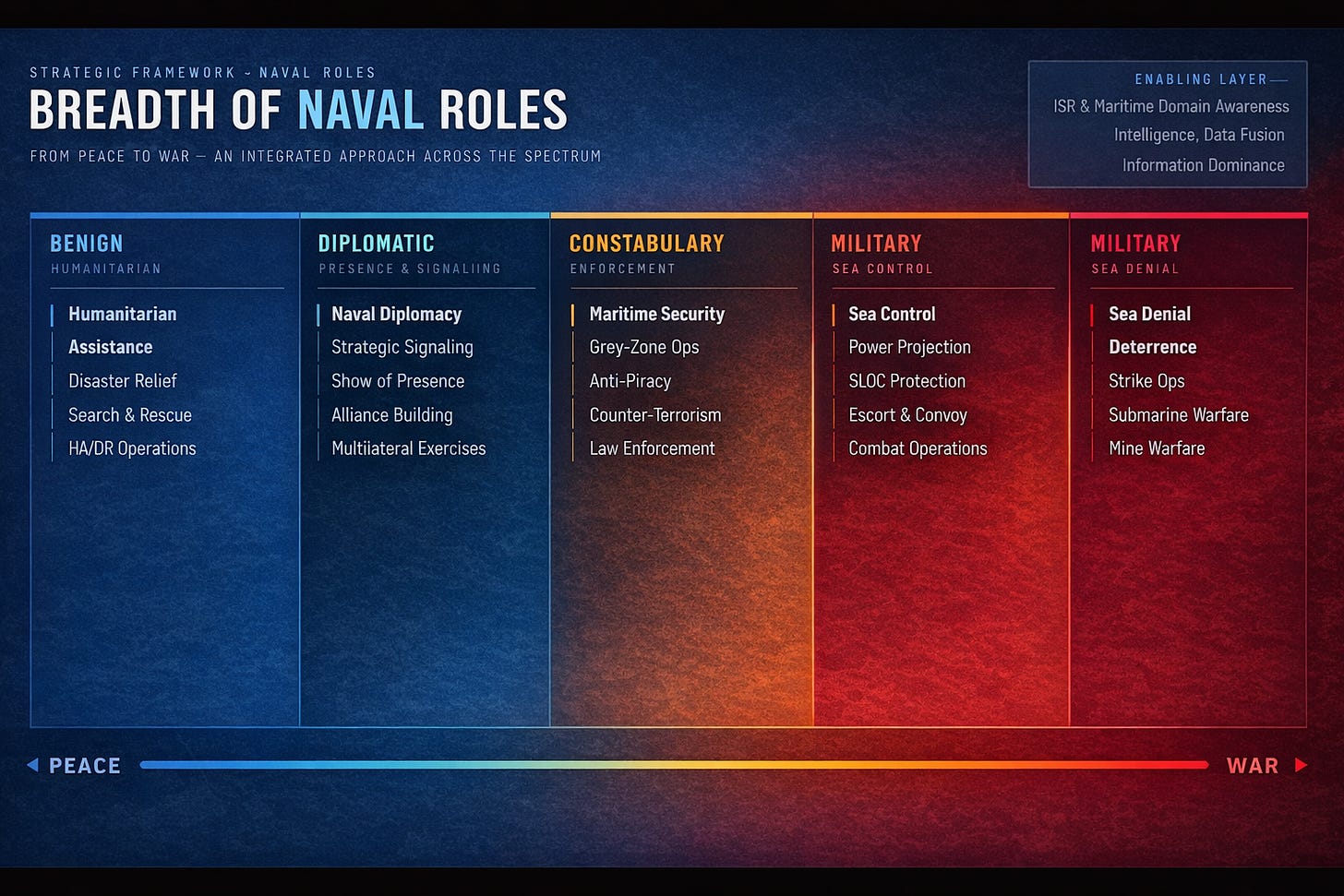
Good order at sea, in other words, is not a static condition. It is a political project that sometimes demands the credible use of force.
Amidst all this, India has over the past two decades evolved to talk like a maritime power. We now possess a vocabulary — SAGAR, MAHASAGAR, Indo-Pacific, the aspiration to be a “net security provider” — and an ecosystem of institutions and forums that constantly affirm the centrality of the sea to our future. Official language has already edged away from the older “net security provider” formulation towards India as the Indian Ocean’s “preferred security partner” and “first responder” — a semantic shift that softens hierarchy but further emphasises benign, demand-driven roles over the harder business of coercion and enforcement at sea.
The Indian Navy’s public outreach, the work of the National Maritime Foundation (NMF), multilateral groupings such as the Indian Ocean Naval Symposium (IONS), and spectacles such as the International Fleet Review (IFR) all reinforce the same message: India has rediscovered the maritime dimension of its strategic identity. Popular histories such as Sanjeev Sanyal’s The Ocean of Churn have carried that rediscovery into wider culture, reclaiming the Indian Ocean as a civilisational space central to India’s past and future. That is not a small thing. The old complaint that New Delhi “thinks only in continental terms” therefore no longer captures reality. Yet recognising the importance of the sea is only the first step.
The deeper question is what kind of maritime power a state ultimately chooses to become — and whether its political leadership is prepared to use that power as a deliberate instrument of statecraft, accepting the risks and the moral weight that serious seapower has always carried.
My contention is that India’s official and semi-official maritime narratives have converged around a benign conception of seapower — one that emphasises stewardship, cooperation and the provision of maritime public goods — while systematically underplaying the coercive, high-risk and legally contentious practices that serious seapowers must also be prepared to undertake. The challenge lies not only in residual continental instincts in Delhi, but in the way India’s maritime community itself has chosen to imagine the sea.
That IRIS Dena episode made the gap this essay addresses uncomfortably visible — not in the questions it raised, which are the routine currency of naval professionals worldwide, but in the silence around them. There was no institutional voice, no prepared public framework, no settled vocabulary with which India’s maritime community could meet the moment. The sea had forced its way into the conversation as a theatre of conflict governed by its own technical rules and strategic logic. The conversation was not ready for it. This essay tries to understand why — and whether it can be made ready.
India’s benign maritime self-image
India’s declaratory maritime frameworks are now well known. SAGAR—Security and Growth for All in the Region—casts India as the steward of shared commons and the provider of regional public goods. Later formulations, including MAHASAGAR and broader Indo-Pacific visions, extend this language to include blue-economy cooperation, environmental protection and regional governance.
Within this framework, India’s maritime role is increasingly described in terms of being the Indian Ocean’s “preferred security partner” and “first responder.” These formulations emphasise responsiveness to regional needs and the provision of maritime public goods rather than hierarchy or dominance. In practice, they are used to describe a wide spectrum of activities: anti-piracy patrols in the Gulf of Aden, Humanitarian Assistance and Disaster Relief across the Indian Ocean, evacuation missions from conflict zones, and capacity-building programmes for smaller littoral states.
Institutions reinforce this narrative. Think-tanks such as the NMF emphasise “holistic maritime security”, integrating economic development, governance and environmental stewardship. Multilateral naval engagements showcase India as a convenor rather than a coercive hegemon. Exercises and gatherings such as MILAN, the IONS, and the IFR combine diplomacy with operational interaction and ceremony, projecting a reassuring image of India as a cooperative maritime anchor in the region.
None of this is objectionable. A country with India’s history and geography has good reasons to prefer stewardship to domination. Yet the cumulative effect is striking.
The benign idiom of maritime discourse has gradually crowded out a more candid conversation about the harder military tasks that India’s maritime geography and ambitions inevitably imply.
NEOs as quiet stress-tests of risk appetite
Non-combatant evacuation operations (NEO) offer an instructive example. In public narratives they appear as emblematic expressions of India’s humanitarian maritime role. Operationally, they often unfold in far harsher conditions.
During the peak years of Somali piracy and jihadist instability in 2008–09, Indian warships were dispatched at short notice into ports such as Aden, Djibouti and Salalah. I took one of those ships, INS Mysore, into these harbours. These were not benign flag-showing visits. They were penetrations into unstable littoral environments where state control was uncertain and the threat to a capital-intensive surface combatant was real. A Guided Missile Destroyer entering such a port becomes three things simultaneously: a high-value symbol, an evacuation platform and a potential target in a confined, surveillance-rich environment.
Many navies approach such operations differently — lower-value auxiliaries conduct the lift under naval escort, with combatants providing layered security from outside. In India’s case, the benign framing of NEOs has normalised a different instinct: the combatant itself becomes the ambulance. That choice reflects something deeper about India’s maritime self-image and its risk calculus.
India’s recent maritime postures
India’s recent posture in the Red Sea and Persian Gulf reinforces the pattern. Indian naval deployments have maintained a steady presence in contested waters, escorted merchant shipping and responded rapidly to threats against commercial vessels. These operations have reinforced India’s reputation as a dependable maritime partner.
Yet beneath the surface lie structural limitations that go beyond any single capability gap.
The long neglect of mine countermeasure capability is one example. Naval mines remain among the most effective tools of sea denial, particularly in narrow waterways such as the Strait of Hormuz or Bab-el-Mandeb. Should serious mining occur in such regions, India’s contribution would likely be limited to escort operations and general presence, while relying on partners for the specialised and dangerous work of mine clearance.
The Red Sea campaign conducted by Houthi forces since late 2023 has exposed a different and arguably more demanding challenge. For the first time in the modern era, a non-state actor sustained a prolonged campaign of sea denial using ballistic and cruise missiles and armed drones — conducted from a land base against international commercial shipping. Indian-flagged and Indian-crewed vessels were among those targeted. Yet India’s operational response remained in the escort and presence roles — valuable and professionally executed, but not sufficient for the harder task. Disrupting a sustained land-based sea-denial campaign is a different order of problem. It requires the ability to locate, track and suppress shore-based missile and drone launch infrastructure — missions that demand strike options, persistent intelligence integration and coalition interoperability of a kind India’s current posture has not yet fully developed. Escort keeps ships moving. Suppression stops the threat. The two are not the same capability, and India currently has one without the other.
The current building programme is impressive in breadth but less so in depth. It funds a wide spread of capabilities — from carriers, destroyers and frigates to submarines, shallow‑water ASW craft, auxiliaries and an increasingly sophisticated airborne ASW tier — yet often at levels that allow only token force structures rather than robust, campaign‑sustainable fleets. The result is a Navy that appears comprehensive on paper but remains thinly layered in practice, with critical gaps in enablers such as ocean‑going MCM vessels and sufficient high‑end ASW escorts to generate multiple, fully balanced flotillas across its vast area of responsibility.
Even within multinational frameworks, India gravitates towards less coercive roles: domain awareness, information sharing, training exercises and interdiction against non-state actors — the portfolio broadly reflected in India’s current participation in the Combined Maritime Forces. These are valuable contributions, but they sit some distance from the high-end combat missions that determine whether a strait remains open or a sea-denial campaign is broken.
Law, force and India’s legal posture
Capability gaps are not the only area where India’s maritime practice has lagged behind its ambitions. The same pattern is visible in the legal architecture that supports operations at sea — or more precisely, in the absence of one.
This tension surfaces in the way India talks about the law at home versus abroad. Domestically, it emphasises a restrictive reading of UNCLOS, insisting that foreign warships may not conduct exercises in the EEZ without consent. On multilateral stages, it speaks the more generic language of “freedom of navigation and overflight,” aligning itself with a rules-based order without advertising its own reservations. The result is a strategic ambiguity sustainable in diplomacy but increasingly difficult to sustain in professional education, operational planning, and the courtrooms where enforcement eventually arrives. The ambiguity is not accidental — strategic flexibility has its uses.
But flexibility sustained long enough without internal resolution becomes drift, and drift in legal-operational doctrine has consequences that show up not in communiqués but in operational orders and acquittals.
The contrast with states that treat maritime law as a strategic instrument — rather than a compliance obligation or an unresolved background condition — is instructive and uncomfortable.
Iran has maintained a precisely engineered legal position across decades: it signed UNCLOS in 1982 without ratifying it, declared at signature that only states parties are entitled to its contractual rights including transit passage, enacted domestic legislation in 1993 using the language of “harmless passing” rather than transit passage, and has consistently invoked the 1958 Geneva Convention — which it has ratified — as its preferred legal framework precisely because it gives coastal states significantly more authority over foreign warships. This is not improvisation under pressure. It is a legal architecture constructed in advance of the crisis it was designed to support, maintained with doctrinal consistency across governments and administrations.
Russia’s approach in the Black Sea and Sea of Azov follows a similar but coarser logic: bilateral treaties with Ukraine from 2003 designating the Kerch Strait and Sea of Azov as common internal waters were negotiated in good faith, then invoked after 2014 as a jurisdictional shield against UNCLOS scrutiny; the Kerch Bridge was built before any tribunal could rule on its legality; the undeclared blockade of 2022 was calibrated to sit in the gap between UNCLOS peacetime law and the Law of Armed Conflict, where neither framework provides adequate enforcement tools.
Both states have invested in maritime legal architecture the way serious naval powers invest in platforms: as an instrument of statecraft, shaped deliberately, maintained consistently, and deployed at the moment of operational need.
India’s legal posture is something qualitatively different — and the difference is not flattering. The domestic-international contradiction is not strategic ambiguity in the Iranian or Russian sense, where the ambiguity is itself the instrument, maintained deliberately to preserve operational flexibility while retaining a defensible position in any forum that might examine it. It is an unresolved contradiction that has been deferred rather than managed.
Iran and Russia know precisely where they stand in international maritime law, have chosen their positions with full awareness of the operational consequences, and have built the domestic legal architecture to support those positions consistently. India does not yet know where it stands — or has chosen not to decide. That is a different condition, and a more dangerous one: not because ambiguity is always wrong, but because ambiguity without resolution is indistinguishable from absence.
How states that have resolved that question — Iran, Russia, Turkey through the Montreux Convention — have used maritime law as a force multiplier rather than a compliance burden, and what building that kind of legal-strategic architecture actually requires of India, is the subject of the two subscriber essays that follow this one on Nitividya.
Anti piracy legal frameworks
Only in 2022 did Parliament enact the Maritime Anti-Piracy Act. The legislation incorporated the piracy definition contained in UNCLOS, granted Indian courts universal jurisdiction over piracy on the high seas and in India’s EEZ, and created a clear set of offences and penalties. India had prosecuted pirates before — most notably in the Alondra Rainbow case, where the accused were tried under a patchwork of general criminal law, including the Indian Penal Code (IPC), the Foreigners Act and the Arms Act, until the Bombay High Court acquitted them in 2005 on jurisdictional grounds. Against that background, the ongoing trial of Somali pirates captured in the joint operation to rescue MV Ruen is widely regarded as India’s first major prosecution under the Act and the country’s first such case to reach an Indian court in more than a decade — even as the Navy’s operational counter-piracy posture remained continuous throughout. In effect, India spent more than a decade performing the kinetic and constabulary work at sea without the legal architecture needed to complete the cycle of enforcement ashore.
Andaman & Nicobar as the hardest test
Nowhere do these tensions converge more sharply than in the Andaman and Nicobar Islands. Strategically, the archipelago sits astride major sea lanes linking the Indian Ocean with the Western Pacific. In any future crisis involving China, the islands would become a strategic fulcrum — capable of influencing maritime traffic through the Malacca Strait and the wider eastern Indian Ocean. But geography cuts both ways. The same position that makes Andaman and Nicobar a potential lever of pressure also makes it a target — vulnerable to surveillance, interdiction and the kind of grey-zone coercion that does not require a formal declaration of hostilities.
A serious Andaman strategy would demand difficult capabilities: convoy and escort operations, persistent surveillance across air and subsurface domains, specialised forces, resilient logistics and hardened infrastructure capable of surviving sustained pressure.
The vocabulary in which we discuss the islands, however, shapes the investments we are prepared to make in them. And that vocabulary remains dominated by connectivity, tourism and transshipment — legitimate aspirations, but ones that carry none of the strategic weight the location demands.
Infrastructure built in such a position inevitably carries consequences that the benign idiom struggles to accommodate, let alone fund.
From continental neglect to maritime discipline
India’s maritime debate has, in some respects, become a victim of its own success. Once it became clear that the country could no longer be blind to the sea, the conversation shifted toward celebration — of maritime destiny, of blue-economy potential, of India’s growing naval presence. The harder questions received less attention. That is the counter-narrative this essay has tried to push.
Operational experience — from evacuation missions in unstable littorals to escort-heavy deployments in the Red Sea — suggests that India’s maritime posture remains strongest in the constabulary and cooperative roles that dominate our public narrative. The more demanding tasks of coercive presence, specialised enablers and integrated legal-operational doctrine remain underdeveloped and, in places, deliberately skirted.
A word on tone. Much of India’s maritime literature — official, semi-official and popular — is written in a narrative of arrival and affirmation. That literature has done important work: it has built institutional momentum, educated a generation of policymakers and created the vocabulary without which serious maritime strategy cannot even be discussed. This essay does not dismiss that achievement. But affirmation, sustained long enough, becomes a substitute for rigour.
The gap between what India says about itself at sea and what it can actually do — and is actually prepared to do — is not closed by more affirmation. It is closed by honest diagnosis, sustained investment and, above all, political will. This essay has tried to be honest rather than affirmative. If it reads as uncomfortable, that discomfort is the point.
There is a historical parallel worth pausing on. Andrew Gordon’s account of the Battle of Jutland, The Rules of the Game, traces how the Royal Navy lost its way between Trafalgar and 1916 — not through incompetence or cowardice but through a century of institutional drift toward centralisation, signal-dependence and a culture of ceremonial display that rewarded appearance over tactical initiative. The Fleet Reviews, the pageantry, the obsession with looking like a navy rather than fighting like one — these were symptoms of a deeper command pathology that Jellicoe inherited and could not escape in the heat of battle. The parallel with India’s current maritime moment is uncomfortable but instructive. The drift here is not identical — the Indian Navy has an honourable operational record and has not lacked for professional seriousness in its counter-piracy, escort and evacuation missions. But at the level of public narrative, political imagination and institutional self-presentation, there is a recognisable tendency: the Fleet Review, the Naval Symposium, the Maritime India Summit have become the primary idiom through which seapower is communicated to the political class and the citizenry.
That tendency does not stay at the level of public narrative. It reaches into institutional behaviour — into the willingness, or otherwise, of professional military judgment to push back when policy choices cut against operational requirements. The Agniveer scheme is the clearest recent illustration. A force that aspires to operate at the harder end of the maritime spectrum — sustaining underwater operations, mastering mine warfare, developing the high-end ASW and propulsion skills that determine effectiveness in a prolonged naval contest — requires precisely what Agniveer systematically undermines: long service, deep training pipelines and the accumulated professional knowledge that cannot be downloaded in four years and cannot be recovered once it walks out of the gate. That the scheme was accepted without visible institutional resistance is itself a data point. It suggests that the habits Gordon identified — deference to authority, the suppression of professional judgment in favour of institutional compliance — are not merely a problem of public narrative. They reach into the command culture itself.
Spectacle crowds out strategy. Ceremony substitutes for doctrine. And the harder, less photogenic questions — about mine warfare and sea denial, about the legal architecture that must underpin enforcement, about the propulsion and endurance that determine how long a submarine can hold a space — receive less attention than the theatre of maritime arrival. This essay has tried to ask some of those questions. The pieces that preceded and follow it try to ask the rest.
An honest maritime debate would therefore move beyond diagnosing continental biases and ask three demanding questions:
What are the concrete hard tasks India must be able to perform at sea, given its geography and threat environment?
How far do current forces, doctrines, legal frameworks and basing arrangements actually enable those tasks — particularly under grey-zone pressure or in war?
And is the benign public-good idiom that dominates our maritime discourse helping to close that gap — or making it easier to live with?
That third question is the hardest, because it implicates not just policymakers and procurement planners but the maritime community itself — the analysts, the institutions, the retired professionals who shape the conversation. A narrative that consistently emphasises stewardship over coercion, cooperation over enforcement, and arrival over honest audit does not merely reflect a capability gap. It helps sustain one. The idiom becomes the alibi.
If those questions can be answered honestly, India’s maritime conversation may finally move beyond celebration of destiny toward something more demanding: maritime discipline.
Only then will phrases such as “net security provider” and “guardian of the commons” describe what India actually does at sea, rather than what we like to say about ourselves.
A Note on What Follows
This essay has been diagnostic. Diagnosis is only useful if it opens into something more than itself. The two essays that follow on this platform attempt that opening, in a pitch deliberately different from this one.
The first takes the Strait of Hormuz crisis not as an episode of Middle Eastern conflict but as a structural event — one that has simultaneously exposed the operational limits of American naval power in contested littoral waters, collapsed the normative architecture that underwrote seven decades of open sea-lanes, and demonstrated how a mid-sized power converts military capability into institutional standing. It arrives at a specific claim: that India is a maritime passenger in a world reorganising itself around maritime principals — and that the reorganisation is already in progress.
The second takes up the institutional question that the first leaves open. What does building maritime power actually look like for a continental state with oceanic ambitions? It closes on four specific deficits in India’s maritime institutional architecture and what closing them requires.
Sudhir Pillai is a former Flag Officer Naval Aviation, Chief of Staff at the integrated HQ Andaman and Nicobar Command, and Chief Instructor (Navy) at DSSC Wellington. He tweets @sudhirpillai__
This article was originally published on the नीतिविद्या | Nitividya – Strategy, Institutions, Power website.