






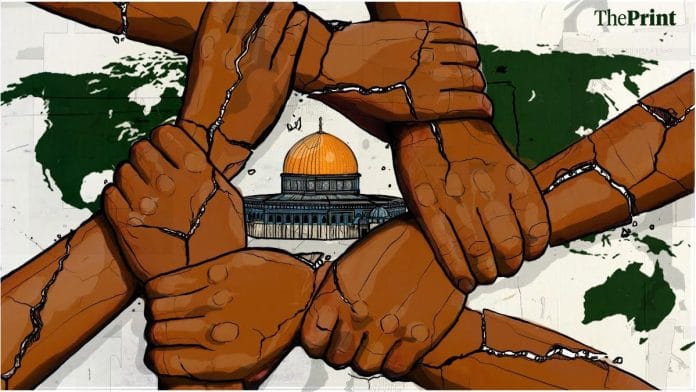



War between the US–Israel and Iran is not just an international affair unfolding far from home. It crosses borders not through soldiers, but through ideas, emotions, and narratives—shaping conversations and political imagination in societies far removed from the battlefield.
Much has already been written about how sections of the Indian Right-wing support Israel, often linked to their own views on Islam. I have also written earlier that Indian Shia Muslims have the right to mourn Ayatollah Khamenei peacefully, even if he remains a deeply controversial figure. I’ve also criticised the Indian Right-wing for villainising the entire community.
But what we rarely examine with the same honesty is the other side—why sections of Indian Muslims, including some intellectual voices, express support for Iran. What shapes that response? Is it purely religious solidarity, political positioning, or something deeper tied to identity and a sense of global belonging?
Many Muslim communities, Shia and Sunni alike, often respond through a religious lens. And to be honest, that lens slips into a tribal thinking, shaped by ideas like the ummah, or by the messaging of religious leaders.
In the case of Iran, especially among Shia Muslims, there is a layer of sympathy rooted in history. Khamenei is not just seen as a political figure but as someone who challenged Western dominance, who turned Shia identity from something passive into something politically assertive.
You can see this playing out in different ways. In India, Shia communities have largely expressed themselves through peaceful mourning and protests. In Pakistan, however, similar sentiments have spilt into more intense and sometimes violent demonstrations, with accusations against their own state being complicit with the US.
I can understand these emotions. They are shaped by religious identity and tribalism. But what unsettles me is that even intellectual voices struggle to move beyond that same tribal framework. You would expect a more layered, more balanced view. But often, the argument remains confined within identity.
I have heard arguments like Iran has been a friend to India, and therefore India should stand with Iran. But then what about Israel? Israel, too, has supported India at critical moments, especially in defence, intelligence, and technology. If foreign policy is reduced to picking sides based on selective memory or identity, then it stops being analysis and starts becoming alignment.
And that, perhaps, is the line many Indian Muslim intellectuals are still struggling to cross.
Also read: Nation bigger than 200-cr Ummah. Muslims don’t get it and that makes them powerless
A simpler argument
The other argument I consistently hear is about human rights violations by Israel—and that is a fair concern. Civilian suffering, loss of life, and questions of accountability deserve to be raised, no matter who is responsible. But then a question naturally follows: Where are the same voices when it comes to human rights violations carried out by the Iranian regime under Khamenei?
I am not trying to compare tragedies or rank suffering. That is not the point. But celebrating or romanticising one authoritarian figure, while condemning another actor for similar or different forms of violence, is not what one expects from intellectuals or those who claim a liberal position. Human rights are a lens that cannot be applied selectively.
The only argument I truly find myself agreeing with is a simpler one—that war is not something to cheer for. It comes at too high a cost, and it is still, at its core, aggression. Whatever language we use around it—strategy, security, prevention—the reality remains the same.
At the same time, using human rights violations in Iran as a justification for military strikes opens a dangerous door. Because if that becomes the logic, then any state can claim the right to attack another by pointing to its internal failures. Where does that end?
Also read: Indian Muslims must stop being delusional about the Global Ummah
Beyond narrow identities
What I keep hearing in interviews and speeches by some prominent Indian Muslim voices is references to pan-Islamism, to the idea of a unified ummah. And that is where they expose themselves. This framing has very little to do with humanity and much more to do with identity.
Ironically, if we look at the current geopolitical reality, a united ummah does not even hold in practice. Muslim-majority countries themselves are divided by interests, alliances, and politics. Yet the emotional appeal of that idea continues to shape reactions.
This is not just about a war far away; it also shows how we think and what shapes our moral compass. It is easy to take sides, to align with identities, to see the world through “us versus them.” It feels natural, even comforting.
But that is also when we lose something important.
When intellectuals, voices who are supposed to rise above immediate emotions, begin to echo the same tribal lines, the space for honest thinking shrinks. If our positions on war, human rights, and justice change depending on who is involved, then they are not really principles.
India, with all its diversity, has always had the opportunity to think beyond these narrow identities. To look at global events not through religious solidarity or political convenience, but through a more grounded, human lens, and that should continue.
Amana Begam Ansari is a columnist, writer, and TV news panellist. She runs a weekly YouTube show called ‘India This Week by Amana and Khalid’. She tweets @Amana_Ansari. Views are personal.
(Edited by Theres Sudeep)
This is an apologia, plain and simple. She spots the problem, gives it a sympathetic nod, and quietly moves on.
Every criticism of Muslim tribal thinking is immediately cushioned with ‘I understand these emotions’ or ‘that is a fair concern.’ This is a deliberately constructed both-sides-ism, designed to appear balanced while delivering minimal accountability.
The whole piece is designed to look courageous while making sure nobody gets uncomfortable. Ms. Ansari identifies ummah thinking as the problem but never asks why it persists despite being demonstrably self-destructive. That’s the actual question. Instead she puts on a naqaab of a self-critical Muslim intellectual. It fools no one.