








Under consumer sovereignty, four desiderata are integral to the functioning of the system. First, to seek consumer patronage, entrepreneurs would strive to reduce costs and improve quality. With consumer approval and appreciation of such effort, high-cost and low-quality products would continually tend to be replaced, through resource shifts and technological progress, by low-cost and high-quality products; and this will continually tend to lift up production, and hence employment, income and the level of living.
Secondly, rapid expansion of employment is built into the economic system where everybody’s concern is to meet the demands — which, it may be noted, are most exacting, in addition to being ruthless — of the consumer. The expansion of employment at current, or rising, wage rates is a function, not of investment, as Indian experience has shown; nor of stepping down the technology of production, which is currently in use. It is solely a function of the expansion of overall production. Since consumer sovereignty makes for rapidity of growth of the national product, it may, therefore, liquidate unemployment with corresponding rapidity.
To illustrate the working of this built-in urge to expand employment: in Japan, low wages, the heavy pressure of population on land, 291 persons per square kilometer, – the average land holding in the country, as a result of this population pressure, is but 1.01 hectares — the scarcity and high cost of capital, induced farmers to adopt labour-intensive methods of cultivation in agriculture.
Japanese agricultural output is well above the world average. The Japanese output of paddy, per hectare, in 1974 was 5.84 tonnes, as against the world average of 2.36 tonnes. Japanese agriculture employs 2,031 workers per 1,000 hectares of cultivated land. In the US, on the other hand, capital is less scarce; the average holding is 157.6 hectares, population density is 22 per square kilometer, and the country adopted capital-intensive methods of cultivation, the labour employed per 1,000 hectares of cultivated land being a mere 17.
These differing systems of cultivation were adopted, not under the direction of a planning commission, but by independent farmers in free economies, the course and destinies of which are, on the whole, determined by sovereign consumers. By contrast, the Russian Gosplan copied the American method of capital-intensive cultivation, notwithstanding low wages, with none too complimentary results.
Thirdly, under full consumer sovereignty, there is no need, nor room for monopolies in production, distribution, imports or exports; and incomes of all individuals — wages, interest, rent and profits — would correspond to their respective contributions to the national product. Such a situation permits no windfalls. Hence, none can appropriate someone else’s earnings, i.e., there can be no social injustice. Social injustice, on the other hand, is inevitable under socialist economic systems, which abound in monopolies, privileges and subsidies; and hence bring to privileged individuals and groups unearned and also unmerited incomes, at the expense of the rest of the community.
Fourthly, income contrasts tend to decline as economic development progresses, under consumer sovereignty. This is so not merely because of the absence of social injustice, but also as a consequence of, on the one hand, a natural decline in interest, rent and profits, the earnings of the economic elite, and a natural increase, on the other, of wages and salaries. As a free economy progresses, the proportion of wages and salaries to the national product tends to increase and the proportion of interest, rent and profits tends to decline.
In Japan, wages and salaries rose continually from 41.3% of GDP, in 1960, to 50.8%, in 1974. In West Germany, this percentage rose from 46.9 to 54.7. By contrast, in Socialist India, this percentage fluctuated within a narrow range and was, in 1974-75, 28.2 or lower than in 1960-61, 29.9.
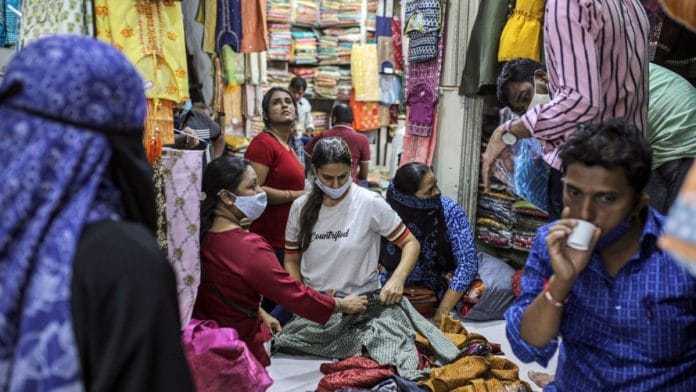
The growing prosperity of the masses of the people in free societies is evidenced by the overwhelming proportion of economic activity being directed to the turning out of articles of mass consumption and by the vast multiplicity of departmental stores, safeways, shopping centres and the endless series of retail shops which purvey these products.
Many of these products would be, if then available, matters for envy among the noblemen and the elite of the 18th century. The shoppers that crowd these places are not plutocrats but farm and factory workers and salaried people. Except in Communist countries, cars are no longer a luxury transport, accessible only to the favoured top crust of the community.
In a communist society, none of the economic constituents of a free economy hold true. The state determines the needs of consumers, arranges the distribution of goods and services and allocates resources among alternative uses. Individuals do not enjoy fundamental economic rights; and forward markets do not exist.
This essay is part of a series from the Indian Liberals archive, a project of the Centre for Civil Society. This essay is an excerpt from a monograph published by the “Forum of Free Enterprise” titled “Economic Growth with Social justice” in August 1977. The original version can be accessed here.