





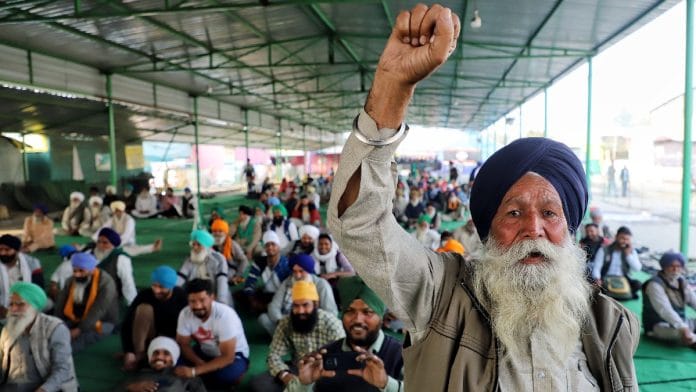



Though it manifested in full strength in the early 1980s, the new agrarian mobilization was launched in the early 70s. The farmers’ agitations did not start in the poorest of the states but in the more developed and progressive ones such as Coimbatore district of Tamil Nadu in 1970 and Ludhiana district of Punjab in 1972. Unlike many parts of the country having subsistence agriculture, these districts were well endowed with irrigation facilities and their agriculture, by the late sixties, had already become heavily market-oriented. The leaders of agitations in Maharashtra and Tamil Nadu showed a remarkable capacity to formulate effective political strategies and articulate powerful idioms for rural mobilization. Sharad Joshi, in Maharashtra in particular, stood out as the strategist and communicator, whose imaginative slogan of the ‘Bharat-India’ divide became a new idiom of rural mobilization.
With “remunerative agricultural prices” and “Freedom of access to markets and Technology” as its principal slogans, the Shetkari Sanghatana and other associated farmers’ organizations led many successful agitations under the banner of the Kisan Co-ordination Committee (KCC), which attracted farmers in numbers ranging between 1,00,000 to 5,00,000 on successive occasions over the last three decades.
By 1982, over 36 farmers were shot down by the police for the ‘crime’ of demanding fair prices. At the global level, this was far more massive movement than the one led by Lech Walesa in Poland. The farmers’ cause is not a popular one in the urban intellectual milieu. Consequently, the farmers’ revolt in India went largely unnoticed.
Also read: Social injustice is inevitable under socialist economic systems: BR Shenoy
The role of Shetkari Sanghatana
SS (Shetkari Sanghatana) underlines five distinguishing features of the new agrarianism.
First, the new agrarianism does not put on a pedestal lifestyle as being particularly virtuous for its blissful simplicity and spiritual richness.
Second, it does not glorify the pastoral/agrarian pattern. Rather, the new agrarianism is aimed at ensuring, for the farmers, highest possible degrees of freedom as also a life of self-respect on par with that of the non-farming communities.
Third, the SS recognizes that capital formation of the new industry needs to come out of surplus from agriculture. In the Soviet Union, the matter was debated in during the Stalin reign, to the conclusion by Stalin sending tanks against farmers. In India, the debate was resolved by establishing a complex of economic system which encouraged higher production but denied the farmer remunerative prices.
Fourth, unlike peasants’ movements of the past, which pitched tenants against the landlords, the lower castes against the higher castes, the SS farmers’ movement was not ‘divisive’ of the rural community. The significant line of internal contradiction was between “Bharat” and “India”. Mahatma Gandhi as also Marx have emphasized the conflict between the town and the country. Sharad Joshi’s view does not make a geographical division. As he states it, “Bharat is that notional entity which continues to be exploited by the same policies as those of the Colonial Rule even after the British left; while India is that notional entity which has obtained the inheritance of Colonial exploitation.”
The misery in the village is not caused by the “slightly” better-off farmers in the neighborhood but by an “outside exploiter” – the urban India. “Transcontinental imperialism” represented by the British has been replaced by “internal colonialism.”
Finally, since surplus in agriculture expropriated through a policy of cheap raw materials and artificially depressed prices constitute the main technique used by the exploiters (the government) the agenda of the SS has been to bring in a one-point programme of “Remunerative prices”.
The remunerative prices for their agricultural produce are to be acquired not through a hackneyed system of Agricultural Produce Marketing Committees (APMCs), Commission for Agricultural Costs and Prices (CACP), Food Corporation of India (FCI), and Public Distribution System (PDS). These four institutions have been the basic instruments of exploitation of the farmers. A genuinely free market assures a price that adequately covers the cost of production. Freedom of market and opposition to all forms of State interventions in the market mechanism becomes the basic plank of the farmers’ movement.
The rationale for the remunerative price agenda is as follows:
- Farmers respond rationally to price movements; they will react to price incentives by increasing acreage and investment and by adopting improved technology.
- Farmers’ response will increase demand for labour and, hence, wage earners will benefit even more than the cultivators.
- As a consequence of additional income so received, farmers will undertake non-agricultural activities; thus, creating employment and the incremental income that will bolster secondary, tertiary as also service sector growth.
- Trade and the exchange are beneficial for attaining higher levels of production and higher standards of living. Self-sufficiency is the virtue of less cerebral species. The system based on self-sufficiency will often be exposed to lists of droughts and famines.
- The cerebral character of the human species would sit in a separate category. Human societies have ruled many Bloomsbury forecasters wrong through innovation and technology. The history of mankind shows that the good of the masses comes not so much from social or political institutions as from advancement of technology.
- All technologies have their good aspects and bad aspects. Societies accept technologies when their benign expressions are more relevant. Societies tend to question the use of those very technologies when the times change and the less savoury aspects thereof manifest themselves.
- The advancement of human societies has been achieved not by going back into obscurantist past but by innovating higher technology that will limit the bad effects of the old ones.
Thus, the overall philosophy of the Shetkari Sanghatana is that price incentives in agriculture and a “natural” process of capital accumulation driven by an agriculture revolution can benefit the entire economy and break the vicious circle of poverty. As opposed to this, an accumulation process driven by industrial revolution (before agricultural revolution takes place) is always premised upon a coercive expropriation of agricultural surplus.
The SS is the only farmers’ organization in favour of an uncontrolled market in agriculture produce and international free trade in both inputs and outputs in agriculture. Though regional in base, the Shetkari Sanghatana has been able to force a debate on the developmental path chosen by India in the context of its demands at the highest level. The organization has played a crucial role in shaping the ideology and the demands of the largest coalition of farmers’ organisations in India.
This essay is part of a series from the Indian Liberals archive, a project of the Centre for Civil Societ. This essay is an excerpt from a booklet published by “Shetkari Sanghatana” titled “Visionaries of a new “Bharat ” in 1999. The original version can be accessed on this link.