





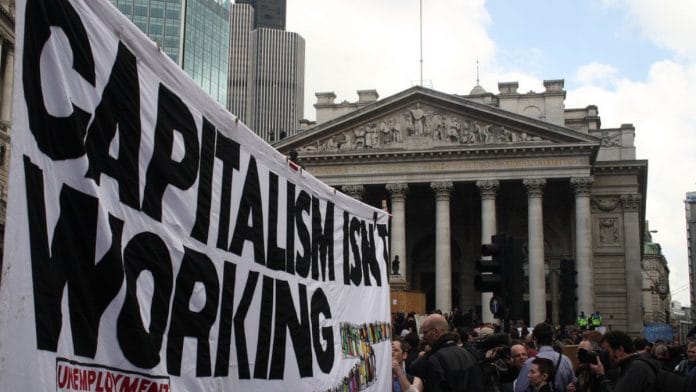



It is only in recent times that a good deal of attention has been given to the problem of unemployment. Not very long ago, it was thought that a person was unemployed because of some defect in him. It took very long time to realise that personal characteristics may not have anything to do with unemployment which may arise due to inefficiency of economic system. However, when this was realised, the problem was analysed in detail because the cost of unemployment is heavy. Further unemployment must be eradicated at the earliest because prolonged unemployment works like trap which turns unemployed workers into unemployable workers.
By unemployment let us take it to mean involuntary unemployment. Further in the context of Indian conditions it’s necessary for us to add one more branch of unemployment viz., that of disguised unemployment.
The problem of unemployment has taken a serious turn in India because of the high rate of growth of population and the consequent growth of potential labour force amounting to 1.5 to 2 million per year.
Is socialism the solution to the problem of unemployment?
Apparently there seems to be no relationship between a particular “ism” and the successful solution of the problem of unemployment. No economic system has “unemployment” as one of its implied or expressed feature.
The most important factors responsible for unemployment and underemployment in India is the scarcity of capital. The solution, therefore, lies in stepping up the rate of investment. We may have to invest as much as 20% of the national income to have any favourable impact on unemployment situation. There are certain factors which must be taken into consideration.
The first is the growth of consumption. If more employment is created, the demand for consumer goods will step up, and unless steps are taken to restrict the growth of consumption inflationary pressures in the economy will increase and either the pace of development will be reduced or the painful process of inflation will bring about a redistribution in consumption. Therefore, it becomes necessary to control prices of essential commodities and to restrain consumption of non-essential commodities by taxing them or stepping their imports or production in the economy. In addition, steps must be taken to increase the supply of consumer goods (mainly wage goods) and to increase productivity of available resources. Such drastic controls cannot function automatically in a free enterprise economy. But, in a socialist economy, there is ample scope for the introduction and success of such step when taken through governmental machinery.
There are many lines of production where labour can be utilised in schemes which have a short gestation period. Some labour intensive activities in rural areas are; local capital construction (to increase and regulate water supplies build roads, constructing storage facilities, improving village social services and amenities, more labour intensive methods of cultivation (double or treble cropping, heavy manure, deeper ploughing, closer planting, more wedding) development of rural industries or other productive activities (animal husbandry; afforestration, poultry farming, fruit growing, rural handicrafts, etc.) In urban areas more employment opportunities can be created by fuller utilisation of existing capacity, (multiple shifts) development of handicrafts cottage and small-scale industries, construction works etc. It may, however, be pointed out that the crux of the problem, of successful implementation depends much upon the ability and efficiency of a central organisation.
The effective supply of complimentary resources can be increased by raising the productivity of existing resources which does not require much additional investment. These measures will increase production of capital and consumer goods and thus improve the employment potential of the economy. In agriculture output can be increased by introducing simple improvements in farming methods, selection of seeds, rotation of crops, soil protection, use of machines insecticides etc. In handicrafts and small scale industries, productivity can be stepped up by providing adequate and cheap credit facilities improved arrangements for purchasing, a steady flow of cheap and good raw materials, improved marketing arrangements, merger of small uneconomic units, establishment of co-operatives etc. Further, small-scale industries can be establish by maintaining complimentary relationships with modern industries which will increase their productivity and also reduce the problem of displacement of labour. Lastly in modern large scale industries productivity and output can be raised by effective use of existing plant and equipment of the labour force, etc.
Also read: Welfare state is socially and economically a national disaster: GN Lawande
The role of capitalist enterprises in financing socialism
The fact that there exists in almost every country permanent mass unemployment is confirmed by public opinion as conclusive proof that capitalism is incapable of solving this economic problem and that, therefore, government interference, totalitarian planning and socialism are necessary.
Unemployment in capitalist countries is not a proof of the inefficiency of capitalist system, nor is the absence of unemployment in communist, Russia proof of the efficiency of communist system. It is not capitalism which is responsible for the evils of permanent mass unemployment but the policies of the stateman which paralyses its working. What has been done in recent years has been nothing else than a series of attempts to conceal the effects of an economic policy which is rightly blamed for the productivity of labour; which is now needed is a return to a policy which ensures higher productivity of labour.
The confidence in capitalistic methods to solve the problem of unemployment will be strengthened if we have a look at the miracle that capitalistic approach has played in countries like Japan, Singapore etc.
Should we then, therefore, ask ourselves why and how those and many other developing countries have done so much better than we have in creating mass employment, widely shared prosperity of stability for their people while, after twenty years of planning, draconian controls and Rs. 30,000 crores invested in development, our economy continues to stagnate, unemployment grows and wholesale shortages prevail?
All these countries, unlike India, are totally free from economic dogma.
All of them, including those with socialist governments, rely mainly on private enterprise for production and distribution and hence for creating employment opportunities.
All of them go out of their way to create conditions favourable to private investment, initiative and enterprise.
None of them impose on their business and industrial community India’s nightmarish licensing system and paralyzing all pervasive controls.
None of them seek to counter the mythical danger of a concentration of economic power in private hands by concentrating it in those of a handful of ministers and bureaucrats.
None of them believe, as our government does, that socialism primarily means the nationalisation of trade and industry and a dominant public sector. On the contrary, they consider a dominant private sector entirely compatible with socialism. None of them have adopted the savagely high rate of personal taxation prevailing here which have provided such a powerful deterrent to investment and initiative and hence to the creation of more employment opportunities. Thus we see modern socialist governments going all out to encourage private enterprise to create the wealth from which they can extract the tax resources required to pay for the welfare services of a socialist state. They have understood, what our socialists have failed to do, that capitalist enterprises can play a crucial role in financing socialism, and in making available the fruits of economic development to the people in the very process of development; the cake, so to speak, being distributed while it is being made.
This essay is part of a series from the Indian Liberals archive, a project of the Centre for Civil Society. It has been excerpted from the journal ‘The Indian Libertarian’, published in July 1971. The original version can be accessed here.