










India’s dairy shipments to the US and Australia face a high rate of rejection. Besides product quality issues, a key reason is issues pertaining to labelling and documentation. In this post, Bhandari and co-authors explain why such failures persist and the resulting economic costs that are imposed on exporters. They contend that in dairy and other agri-food exports, enhancing labelling compliance is a low-hanging opportunity for policy intervention.
Over the past two decades, Indian dairy exports have risen substantially, from US$170.46 million in 2009-10 to US$720.67 million in 2024-25. While export values have increased, India’s share in the global dairy trade has remained largely stagnant. Despite being the world’s largest milk producer, the country continues to occupy a marginal position in global dairy trade. This gap is commonly attributed to high domestic consumption and low productivity. However, less attention has been paid to what happens at the border when Indian consignments are inspected by importing regulators. Export rejection data offer a revealing window into this neglected dimension of India’s dairy trade performance.
What export rejection data bring to light
Publicly available data on Indian dairy export rejections is limited. However, records of the United Nations Industrial Development Organization (UNIDO) provide useful insights into rejection patterns. Under the Harmonized System code HS04 – which includes dairy products as well as eggs and honey – India faced 344 shipment rejections in the United States and Australia between 2010 and 2024. This translates to roughly two consignments being blocked every month. Not all HS04 rejections relate exclusively to dairy, as honey constitutes a significant share of India’s exports under this category. Still, these compliance patterns are highly relevant to dairy exporters who face the same regulatory scrutiny.
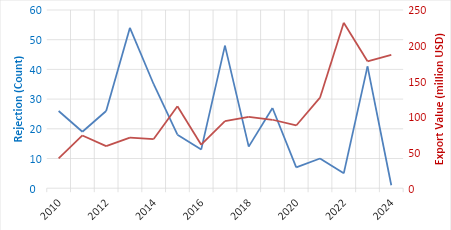
An examination of HS04 exports over the period 2010-2024 shows a weak and inconsistent relationship between rejection counts and export values (Figure 1). The rejection frequency does not closely track export value. For instance, the highest number of rejections occurred in 2013, even though export values that year were relatively modest. In contrast, some years with higher export values recorded fewer rejections. This suggests that rejections are not driven by export scale, but by shipment-level compliance failures.
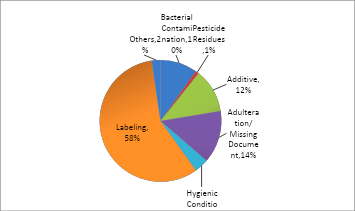
The causes of rejection are particularly telling (Figure 2). The majority of rejections had little to do with product quality. Around 57% of recorded rejections were attributed to labelling-related issues. These included missing allergen declarations, incorrect product descriptions, misleading claims, improper nutrition panels, and non-compliance with destination-specific formatting requirements. Other causes included bacterial contamination (10%), unauthorised additives (12%), adulteration and missing documents (14%), and hygiene lapses (4%). Chemical residues from pesticides or veterinary drugs accounted for less than 2% of rejections. This indicates that while India does face genuine challenges around food safety, there is also a big, low-hanging opportunity to cut rejection rates simply by getting labelling and documentation right.
Figure 1. Indian HS04 exports: Rejection count versus total export value (2010-2024)
Source: UNIDO.
Note: HS04 includes dairy products, egg, and honey.
Figure 2. Reasons for rejection of Indian dairy and honey exports
Source: UNIDO.
Why labelling failures persist
Labelling regulations in importing markets such as the United States and Australia are detailed and consumer-centric. A compliant label must state the correct product name, show declared net weight (in market-preferred units), include a full ingredients list, carry an explicit allergen declaration (for milk and milk-derived ingredients), present nutrition information in the prescribed format, offer storage instructions and traceability identifiers (batch/date codes), and list the manufacturer’s contact. Some markets also require country-of-origin statements and biosecurity notices.
Indian exporters often struggle to meet these requirements consistently. One reason is the widespread use of ‘one-size-fits-all’ labels across multiple destinations. While this practice reduces printing and design costs, it substantially increases the risk of non-compliance when regulatory requirements differ across markets. Even minor discrepancies – such as the absence of a mandatory allergen declaration or a nutrition panel in the wrong format – can trigger rejection.
Specific cases illustrate this clearly. In 2022 and 2023, several consignments of butteroil were rejected because labels failed to identify milk as a major allergen. In 2020, butter oil was again rejected when it was simultaneously described as “Vegetable Cooking Oil” and “Pure Ghee,” a contradiction deemed misleading by regulators. In another instance, products claimed to be a “rich source of Vitamin A” even though the declared nutrient content did not meet the legal threshold. Malted dairy foods met a similar fate in 2018, when consignments from well-known brands were refused entry due to missing or incorrect basic information such as the proper food name, correct ingredient listings, accurate nutrition details, and the right placement of net weight. Cheese exports also came under scrutiny in 2016, when shipments were rejected for misbranding. Taken together, these cases highlight that the challenge lies not only in the milk quality, but in how Indian dairy products are labelled and presented to regulators abroad.
Institutional coordination gaps further compound the problem. Export promotion and regulatory oversight functions are spread across multiple agencies, with limited mechanisms for destination-specific compliance support. While quality testing receives significant attention, pre-export verification of labels and documentation remains weak. As a result, errors that could have been corrected at minimal cost before shipment are detected only at foreign ports, where the consequences are far more expensive.
The economic cost of rejection
Each rejected consignment represents more than a failed transaction. Exporters bear immediate costs in the form of freight, demurrage, and disposal or re-export expenses. Repeated rejections raise perceived risk, prompting insurers to increase premiums and lenders to tighten trade finance conditions. Over time, overseas buyers may shift to alternative suppliers perceived as more reliable. These costs ripple backward along the value chain. When exporters face uncertainty, they are less willing to enter into long-term procurement contracts. This also weakens income prospects for farmers integrated into export-oriented supply chains. There are also cumulative reputational effects. When importing regulators repeatedly encounter labelling errors from a particular origin, they begin to expect non-compliance. This increases inspection intensity and scrutiny for subsequent shipments, raising transaction costs even for compliant exporters.
A low-cost opportunity for policy intervention
Unlike feed costs or productivity gaps, labelling compliance is a relatively low-cost area for intervention. The persistence of labelling-related rejections suggests not a lack of technical knowledge, but deficiencies in systems and accountability. One policy option is the development of market-specific label templates for major destination countries. Export facilitation agencies could provide standardised formats incorporating mandatory declarations, measurement units, and layout requirements. Pre-shipment compliance audits focused specifically on labelling and documentation could further reduce rejection risk. A centralised and publicly accessible database of export rejections, disaggregated by product and cause, would also be valuable. Greater transparency would allow exporters to identify recurring issues and adapt proactively. Capacity-building efforts are particularly important for small and medium exporters. Short, destination-specific training modules on labelling requirements could yield high returns relative to cost, complementing existing food safety and quality assurance systems.
Lessons beyond dairy
While this discussion focuses on dairy exports, the underlying issues extend to India’s broader agri-food export strategy. According to UNIDO, labelling errors accounted for 31% of total rejections of Indian agri-food exports in 2024. As global trade is increasingly shaped by non-tariff measures, market access depends not only on what is produced, but also on how products are regulated, documented, and communicated to consumers. In this context, labelling is not a peripheral requirement but a core component of export competitiveness. For India’s agri-food exports to move up the global value chain, regulatory credibility at the border must be accorded the same importance as production capacity at the farm. Fixing what is written on the package may prove as important as improving what lies inside it.
Gunjan Bhandari, ICAR – National Dairy Research Institute (NDRI)
Udita Chaudhary, ICAR – National Dairy Research Institute (NDRI)
Subhasis Mandal, ICAR – National Dairy Research Institute (NDRI)
This article was originally published on the Ideas for India website.