






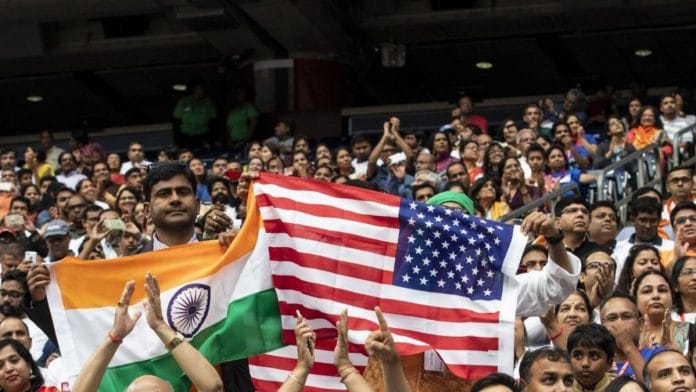



Anti-Indian sentiment is not new, but the recent surge across the US, Canada, the UK, and Australia reveals something deeper and more worrying than isolated acts of hate. It reflects a growing cocktail of economic anxiety, online radicalisation, and the populist hunger for easy villains.
The irony is hard to miss: even Indians who have built their public careers echoing the language of Western conservatism are not spared. In podcasts, comment sections, and even in the streets, their message is blunt—your politics may align with ours, but your skin, your name, your origins do not.
Yet, while racism against Indians grows louder in the West, the reaction back home is strangely muted. Perhaps because many Indians assume it has nothing to do with them. They assume it to be “foreign problems,” safely distant. But that detachment is an illusion. The Indian diaspora is not some abstract group living on another planet; they are our families, our cousins, our children, the people who still call home during every festival and crisis.
If humanity is not enough to stir concern for some, cold numbers might make them think. In 2023 alone, India received about $125 billion in remittances—the highest in the world for the third year running. NRI investments account for approximately 35 per cent of total foreign direct investment inflows to India. In other words, those facing hate abroad are the same people who keep the Indian economy, its global reputation, and its soft power breathing.
What’s becoming clearer now is how quickly the old “model minority” myth is falling apart. For years, many Indians in the West believed—and still insist—that because they work hard, follow the rules, and come “legally,” they will always be safe. You still hear this narrative in interviews: recently, Indian comedian Zarna Garg confidently claimed that most Indians arrive in the US legally, even if it takes them 15 years. It’s not just simplistic, it’s also factually wrong. While the Department of Homeland Security estimated in 2022 around 200,000 undocumented Indians, independent research from Pew and the Center for Migration Studies stated that over 700,000 undocumented Indians lived in the US by 2022, making Indians the third-largest undocumented group in the country.
Fall of model minority
Even this isn’t the real turning point. The real shock is how openly MAGA influencers—who once didn’t pay attention to the Indian diaspora—have now started attacking the community without hesitation.
In the run-up to the 2024 elections, prominent Indian-origin individuals, such as Vivek Ramaswamy, Tulsi Gabbard, and Kash Patel, were being touted as Trump allies and given key positions in the new cabinet. This was celebrated by many, even in India, as proof that the Indian diaspora has “made it” in American society. In less than a year, Ramaswamy was out, Patel faced increasing criticism and racist conspiracy theories, and Gabbard was attacked online by the MAGA base for celebrating Diwali; they told her to “Go back to India”. This was paralleled by increasingly racist rhetoric targeting Indians on social media. It took less than a year for the ‘respectable model minority’ to be recast as a deplorable, backward, and incompatible community.
What becomes obvious is something many of us knew all along: respectability doesn’t protect you, college degrees don’t protect you, and being a “model minority” certainly doesn’t protect you. Once a political movement decides to target you, it no longer needs a reason.
One of the most vocal and influential MAGA figures, Alex Jones—a proud Trump loyalist—has now dedicated not one but two full episodes to attacking the Indian diaspora. According to him, Indians are “taking all the jobs,” their culture is “incompatible” with American values, and he even waved around a viral video of a cow-dung festival as proof of our supposed backwardness. In another moment straight out of the hate-politics playbook, Jones claimed Indians “take dowry and burn their wives,” turning a complex social issue—one that Indians themselves fight against—into a caricature meant to provoke disgust.
Watching this felt like opening a familiar book: take one incident, distort it, exaggerate it beyond recognition, and then weaponise it to manufacture fear of an entire community. It’s the same old template, just with a new target. I have witnessed something similar back in India, too, when Right-wing extremists target Indian Muslims by generalising.
Also read: Why did nati koli saaru become a moral crisis for BJP? Breakfast menu isn’t a battlefield
The MAGA-Indian mindset
While the “model minority” myth is slowly collapsing for many Indian-origin immigrants, there is another category that troubles me even more: Indians who treat everything Indian with contempt, as if distance has given them moral superiority. You see them online—often the loudest voices—nodding along with MAGA influencers, agreeing that people from the “third world” shouldn’t be allowed into the US. When someone like Indian-American influencer Priya Patel goes on X to declare, “Not all cultures are equal,” the mindset becomes painfully clear.
People like Priya Patel believe they are the exception—more assimilated, more enlightened—and therefore somehow insulated from the racism others face. They imagine hate will spare them because they’ve detached themselves from their Indianness. As if racism works like that. As if bigotry stops to check passports, accents, or curated identities.
Like it or not, for many, this is the era of cultural and civilisational war. Anyone who thought that the “assimilated, right ones, ideal ones” would be spared is naive. Racism and xenophobia don’t work like that, and distancing oneself from one’s own roots offers no protection. Indian-origin immigrants—regardless of their success, education, legal status, honesty or “assimilation”—will become targets more and more as prejudice keeps increasing.
There’s an old saying: “How fast do you have to run to escape a bear? You don’t have to outrun the bear; you just have to outrun your friend.” The truth, however, is that the bear of racism only feeds on one group for so long. Eventually, everyone’s turn comes. We have to turn around together and challenge the hateful ideology behind it instead of arguing over who is “deserving” and who is not.
Amana Begam Ansari is a columnist and writer. She runs a weekly YouTube show called ‘India This Week by Amana and Khalid’. She tweets @Amana_Ansari. Views are personal.
(Edited by Ratan Priya)
Tulsi Gabbara is not an Indian diaspora as the author reports! Tulsi is out and out 100% white born of white arents. She just happens to have a Sanskrit first name as she is aHraKrishna follower after her parents.
Lazy fact-checking: Tulsi Gabbard is NOT of Indian origin. She is Hindu by faith, but her ethnic ancestry Somoan and European.
Tulsi Gabbard is not of Indian origin. She is mixed white and Samoan who adopted Hinduism as her faith.