






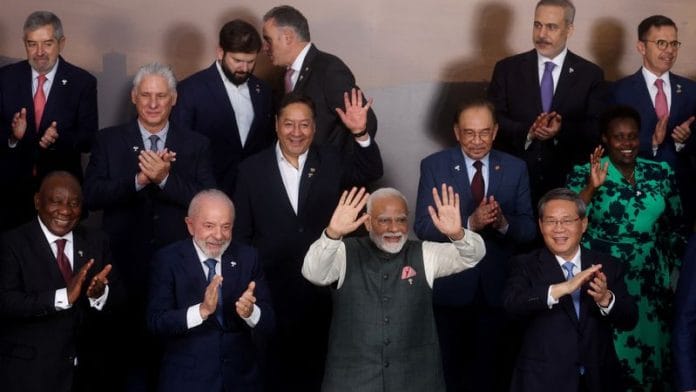



In a recent phone call with External Affairs Minister S Jaishankar, Iran’s Foreign Minister Seyed Abbas Araghchi urged India, as the BRICS chair, to take the lead in condemning the combined attack by the US and Israel on his country. He underlined that “it is essential for the institution to play a constructive role at the current juncture in supporting regional and global stability and security.”
However, India has been non-committal on the issue and has avoided even a formal call for dialogue and diplomacy using the BRICS+ platform, while other members such as Brazil, South Africa, and China have taken stronger positions against the attacks on Iran. What does this reveal about the effectiveness of the expanded BRICS+, of which Iran is also a member, and India’s approach within the institution?
Challenges of navigating complexities
India’s hesitation to issue even a formal condemnation of an attack on one of the newly expanded BRICS+ members is complicated by a range of factors. The crisis in West Asia involves multiple Indian partners and three of the newly admitted BRICS+ members in 2024—Iran, Saudi Arabia, and the United Arab Emirates. While India faces challenges in managing energy security and the safety of its diaspora, its geopolitical options are constrained by several factors.
As a result, it has condemned targeted attacks on American assets in Gulf countries by Iran, while maintaining that it prefers diplomacy and dialogue to resolve the crisis. Nonetheless, the direct or indirect involvement of three BRICS+ members makes India’s role as chair difficult.
Additionally, the fragility of India-US relations, particularly President Donald Trump’s combative approach toward BRICS+ members, including India and Brazil, is a crucial factor shaping New Delhi’s moves within the group.
Also read: India uses BRICS to push reforms—not to challenge the US
India-China competition in the BRICS+
While India’s response to Iran’s request to use BRICS+ as a platform to voice support is shaped by contingent factors, its hesitation to invoke BRICS+ also stems from a longer-term strategy aimed at two objectives.
First, BRICS+ should continue to serve as a bridge between the West and the emerging economies. This aspiration is not shaped by Trump’s threats, but reflects India’s effort to navigate a shifting global order and counter China’s expanding influence within the group.
Second, the group should remain focused on geoeconomic issues and global governance reform, rather than taking partisan positions on geopolitical conflicts. In other words, BRICS+ should build collective consensus in the developing world while abstaining from projecting the group as a counter to the West.
This approach directly conflicts with China’s strategy. In the mid-2010s, as India-China relations deteriorated and China’s ties with the West became strained, Beijing began promoting BRICS expansion more aggressively. A key premise was to use BRICS+ and similar institutions as a “strategic handle” in its global competition with the US.
Over the next decade, China consistently pushed for expansion, including advocating membership for countries such as Pakistan. It seeks to redefine BRICS+ beyond a platform for economic cooperation and institutional reform, pushing it to take positions aligned with its geopolitical preferences. This aligns with China’s approach in forums such as the Shanghai Cooperation Organisation.
India has resisted efforts to shift the identity and role of BRICS+. For instance, at the BRICS virtual summit in November 2023, Prime Minister Narendra Modi skipped the meeting and did not endorse China’s call for an immediate ceasefire in Gaza. This is one of several instances when China and India diverged within BRICS+ and other multilateral institutions.
Also read: 16th BRICS Summit was about building dollar-free world order. India can use it to expand trade
A daunting task before India
India is navigating the immediate fallout of the war in terms of energy security and diaspora safety, while balancing ties with multiple regional partners. New Delhi’s muted response raises questions about its willingness, and even ability, to play a major role in such crises, in line with its aspirations as an emerging power.
However, its hesitation to use the BRICS+ platform underscores longer-term geopolitical calculations, especially the need to ensure its choices do not provide China a fertile ground for its long game within the institution. As BRICS+ chair in 2026, India faces the daunting task of building consensus in an expanded and more diverse grouping. At the same time, it must work to ensure the institution remains insulated from geopolitical entanglements.
Devendra Kumar (@DoctorDev) is associate fellow at the Centre of Excellence for Himalayan Studies, School of Humanities and Social Sciences, Shiv Nadar Institution of Eminence, Delhi-NCR. Views are personal.
(Edited by Prashant Dixit)