







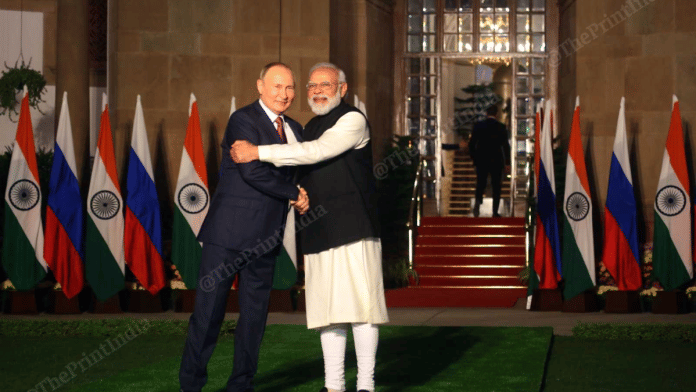



India-Russia partnership in the 21st century is a testimony to endurance and resilience shaped by calculated strategies on both sides to push the ties on a multidimensional path of cooperation beyond defence and energy. Although respective national interests guide decisions in New Delhi and Moscow, this bilateral relationship has stood the test of time despite strategic realities—such as the “China-Russia” and “India-US” partnerships, that pose challenges to alignment and congruence.
Russian President Vladimir Putin’s visit to India for the 23rd Annual Summit comes at a moment of profound churn in global politics—the Ukraine war, US President Donald Trump’s erratic tariff salvos and inconsistent strategic signals on major power relations at the Alaska and Busan summits. Trump’s hyper-transactional approach has produced countercurrents, particularly in the form of BRICS expansion, a de-dollarisation push, and a potential rebirth of the Russia-India-China triangle, as well as supply chain diversification aimed at de-risking the US.
Amidst this strategic flux, the persistence of India-Russia cooperation reflects not just Soviet-era nostalgia but a new strategic logic that injects relative predictability and mutual utility in a world where incentives of cooperation are becoming increasingly low. Despite several geopolitical headwinds, the India-Russia partnership exudes an unmistakable flavour of organic chemistry grounded in consistency yet adaptability.
Therefore, the 23rd Annual Summit is not just another box to be ticked in the fixture of diplomatic calendars, but one shaped by an imperative to revisit the relationship and work on the rough edges in bilateral priorities amid a turbulent global order.
Dynamic partnership rooted in history
India–Russia ties have deep institutional foundations. The 2000 Declaration on ‘Strategic Partnership’, elevated in 2010 to a Special and Privileged Strategic Partnership, created the framework for regular high-level engagement across defence, energy, nuclear cooperation, space, and multilateral diplomacy. For two decades, annual summits have acted as calibration points, allowing both sides to advance ongoing projects while adjusting to geopolitical changes.
Anchor of defence cooperation
Defence has long been the axis around which India–Russia relations revolve. From Sukhoi aircraft to T-90 tanks, from submarine technologies to the S-400 missile defence system, Russian supplies have formed the backbone of India’s military inventory, and the legacy continues. Although the joint statement did not announce big defence deals, both sides aim to further enhance their expansive defence partnership through collaboration, including in niche military technologies and stronger defence-industrial cooperation.
Both sides stressed inking a protocol on ‘ongoing and prospective areas’ of defence cooperation, which might include ongoing talks on additional S-400 regiments, seeking clarification on stalled military deliveries, and revisiting conversations around the S-500 missile defence system. The agreement on Reciprocal Exchange for Logistical Support (RELOS) signed in February 2025 is expected to boost military-to-military interoperability to the next level. Maritime cooperation also formed an important component of the discussions, including in the Arctic.
The high point of any defence cooperation is co-development and co-production, and the success of the “Brahmos” cruise missile and its advanced variants is a test case of the potential for bigger achievements. Moreover, the accelerated enthusiasm for greater cooperation, including the transfer of technology on fifth-generation aircraft, could be a force enabler to advance India’s air assets. This shift from off-the-shelf procurement to joint R&D and manufacturing aligns with India’s priorities for its defence industrial conclave, while giving Russia a stable partner in a sanctions-heavy environment.
Both sides would have to find traction and space of operation in the midst of strategic challenges posed by a closer China-Russia defence cooperation, as well as India’s diversification drive aimed at creating defence synergies with the US and the European defence partners.
Also read: Putin’s India visit a lesson for Europe on how to maintain foreign ties when Trump is against it
Beyond defence
In the energy sector, both sides have agreed to work on keeping the flow of energy uninterrupted while navigating the Western sanctions. During the joint media address, Putin emphasised providing ‘uninterrupted’ shipments of fuel for the growing Indian economy. For India and Russia, one of the primary drivers of this summit is creating economic leverage. As sanctions cut off traditional buyers and banking channels, India’s crude purchases at discounted prices not only created incentives for both India and Russia but also helped to stabilise global oil prices, an arrangement conveniently forgotten by the West now.
The trade volume between the two has grown to $70 billion by 2025, and both sides have set a target of $100 billion by 2030. However, the trade balance is skewed in favour of Russia, with India’s exports to Russia standing at a low of 2 per cent. The annual summit has brought a huge delegation of Russian businesspeople and entrepreneurs to discuss and attract Indian exporters under the ‘Sell to Russia’ banner to help correct the imbalance. Areas such as food and health safety, fertilisers, automobiles, pharmaceuticals, heavy commercial vehicles, agriculture, etc., have been agreed upon.
To increase the level of cooperation in the economic sector, there is a push toward signing the Eurasian Economic Union (EAEU) FTA between the two sides that promises to help Indian exporters with access to more markets, including in Russia. Addressing logistic bottlenecks for ease of trade in goods includes talks to double down on connectivity projects like the Chennai-Vladivostok Maritime Corridor. Putin, during his address, also spoke about connectivity through the North-South Transport Corridor from Belarus to the Indian Ocean.
On the payment mechanism, both sides are also trying to digitalise the sector for a smooth transaction. Already, India and Russia transact digitally in the areas of Customs and taxation agencies, although a lot of ground still needs to be covered. Though it may not make it to the public releases, cooperation in banking sectors that can avoid the sanctions radar must have featured in the bilateral talks.
Other emerging areas of cooperation include small modular reactors to boost civil nuclear cooperation, emerging technologies, agreement on migration and mobility, etc. People-to-people ties, including in the field of culture, education and tourism (both sides agreed on creating e-visa-free entry for Russian tourists), formed critical areas of bilateral cooperation during the bilateral discussions.
Renewed interest in Asia
Beyond bilateral issues, Putin’s visit inevitably intersects with wider geopolitical flashpoints in Europe, West Asia and in India’s immediate neighbourhood. New nuclear dangers in the Korean peninsula and growing confrontations in the Indo-Pacific also lurk in the background. Russia’s renewed interest in Asia and its return as a potent geopolitical player provide a platform for deeper consultations with India on these regional developments.
With Washington and Beijing keenly keeping an eye on developments, New Delhi and Moscow must signal that their partnership, based on realpolitik yet reinforced by consistency, trust, and convergent interests, remains “time-tested” and of high strategic relevance for both sides. The India-Russia friendship, in that sense, has truly remained steadfast like a ‘pole star’.
As the world order undergoes structural changes, India and Russia will face new challenges that could test the resilience of their engagement. Keeping their national interest intact, both sides must figure out ways to address and iron out issues diplomatically. Hence, adaptability, flexibility, and mutual recognition of each other’s strategic interests will help the partnership to not only endure but also continue to evolve, strengthening its foundations to face strategic storms. They must reshape the strategic partnership to find answers to immediate, mid-term and long-term challenges in the interlocking realm of geopolitics and geo-economics.
Indrani Talukdar is a Fellow and Monish Tourangbam is a Senior Research Consultant at the Chintan Research Foundation (CRF), New Delhi.
(Edited by Saptak Datta)