









War as a continuation of politics by other means underscores the critical role of politico-military synergy, which underpins effective strategic decision-making in democratic nations such as India. To ensure these principles remain applicable, they must be explicitly connected to contemporary challenges like Grey Zone warfare, cyber threats, and hybrid tactics, thereby reinforcing their ongoing relevance and guiding strategic thinking. This connection enhances understanding of how historical lessons shape current policies and operational approaches.
India’s strategic decisions flow from the National Security Council to the Cabinet Committee on Security (CCS), culminating in a politico-military directive to the Chiefs of Staff Committee (COSC). For joint decisions to work, protocols and communication channels must be clear, ensuring that political objectives translate seamlessly into military strategy and operational plans. Mechanisms must also be incorporated to adapt these processes to emerging threats, such as Grey Zone tactics, to reassure leaders of their ongoing relevance and resilience.
The directive is then refined into achievable military objectives through detailed planning at Headquarters Integrated Defence Staff and the respective Service Headquarters. This process prioritises threats, allocates resources, and sets timelines. Political leaders provide the “why” and “what”; military leaders define the “how.” Jointness, under the Chief of Defence Staff, who chairs COSC meetings, is intended to harmonise these domains. In India, as observed in many cases, the politico-military directive is not issued in writing but conveyed verbally or through cryptic communication.
Effective directives demand clarity. When directives are consultative and shaped by mutual trust, they foster confidence among stakeholders, reassuring political and military leaders of their shared purpose, which is vital for strategic coherence.
Also read: ‘Jo uchit samjho woh karo’—five words that exposed India’s civil-military ambiguity
Translating directives into objectives
Once received, the COSC translates political guidance into theatre-specific objectives, taking into account intelligence assessments, logistics, terrain, and risk. Service Headquarters then craft operational plans aligned with the directive. Feasibility remains central: objectives must be specific, measurable, and adequately resourced to avoid overreach. Contingency planning is embedded at every level of command.
Historical experience plays a defining role. Lessons from past operations are integrated into planning processes, simulations, and exercises to ensure joint coordination and rapid mobilisation. Feedback loops between the COSC and political principals remain essential and drive success. Strategic direction is not static; it evolves as ground realities change.
Lessons from 1967 clashes and 1971 war
A pivotal lesson emerges from Lt Gen Sagat Singh’s audacity. During the 1967 clashes at Nathu La and Cho La, he confronted Chinese aggression when they shot and killed Indian Army soldiers laying barricade wiring and took an assertive forward position, repelling incursions without waiting for higher clearance.
In 1971, tasked with securing Eastern Command objectives, he drove decisively toward Dacca, bypassing cautionary pauses and accelerating the campaign to a swift conclusion. His actions, rooted in battlefield assessment and operational clarity, demonstrate that calculated autonomy within broad political intent can decisively shape outcomes.
The 1971 India-Pakistan War stands as a benchmark of politico-military synergy under Prime Minister Indira Gandhi and Army Chief Sam Manekshaw. Political clarity and military preparedness moved in tandem.
In 1971, Gandhi had laid down that operations did not have to be cleared with her; she only needed to be kept informed. She continued her normal routine, even attending parliamentary committee meetings. It was during one of those that an aide slipped her a note saying that Chhamb had fallen. She showed zero reaction, impassively folded it, and put it in her bag. 1971 was a good case study in which the political leadership set clear strategic objectives and left the details to the forces. It remained nonchalant even after the IAF lost 20 jets on day one and persisted with its super-aggressive, high-attrition posture.
Political diplomacy complemented military readiness. Gandhi mobilised international opinion, secured strategic backing through the Indo-Soviet Treaty, and maintained parliamentary transparency. Manekshaw’s candid counsel prevented premature military engagement. The lesson is enduring: trust between political authority and military leadership, combined with preparation and timing, determines strategic success.
Also read: Modi 3.0 must improve civil-military relations. Bring NSS, relieve CDS of extra duties
Lessons from the 1999 Kargil War
The Kargil War exposed intelligence lapses and Pakistan’s duplicity under Pervez Musharraf, even as Prime Ministers Atal Bihari Vajpayee and Nawaz Sharif publicly symbolised reconciliation. Vajpayee issued a directive on 7 June limiting operations to evicting intruders without crossing the Line of Control. While militarily restrictive, the decision was strategically astute. It reinforced India’s global credibility and framed Pakistan as the aggressor.
External diplomatic pressure, notably from US President Bill Clinton, compelled Pakistan to withdraw. On the ground, adaptive air-land integration and junior leadership displayed tactical brilliance. The conflict also exposed surveillance deficiencies, which were later addressed through improved real-time intelligence and doctrinal evolution toward proactive deterrence.
Operational restraint, when aligned with strategic intent, can yield long-term gains. Subsequent calibrated responses, including at Uri and Balakot, reflect this evolution. Operation Sindoor further highlighted how coordinated politico-military action enhances deterrence while preserving escalation control.
Grey zone warfare challenges
Contemporary security challenges increasingly operate in the grey zone between peace and open war. Tactics such as salami-slicing, incremental territorial assertions, information warfare, and proxy forces demand responses that blend military preparedness with diplomatic and economic instruments.
India has faced persistent friction in areas such as Depsang and Demchok in Eastern Ladakh since 2020, alongside radar deployments and infrastructure consolidation by the People’s Liberation Army (PLA). Responses require integrated domain awareness, robust patrol patterns, forward infrastructure such as the Daulat Beg Oldi Road, and sustained diplomatic engagement with China. The ‘grey zone’ demands agility: rapid force mobilisation, calibrated signalling, and economic countermeasures that deter without triggering escalation.
Also read: India’s civil-military fusion order of the day but not at the cost of military identity
Ladakh 2020 Standoff: A Strategic-Operational Test
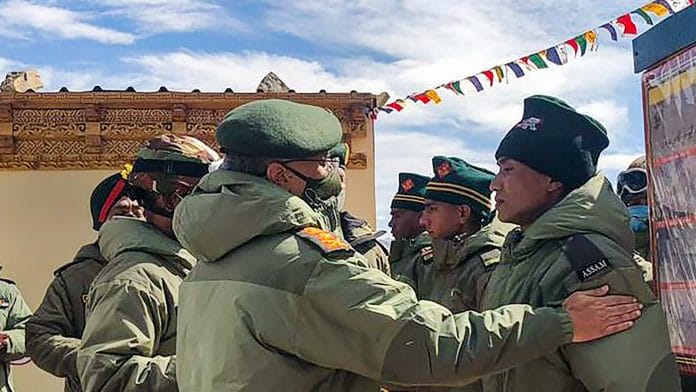
In May 2020, the PLA initiated multi-point incursions in Eastern Ladakh, targeting Pangong Tso, Galwan, Gogra, and Depsang. India responded with mirror deployments and bold counter-manoeuvres, including the occupation of tactically significant heights on the Kailash Range. The 15 June Galwan clash resulted in the loss of 20 Indian soldiers, prompting substantial reinforcements and accelerated infrastructure development.
Politico-military coordination was tested but remained cohesive. Prime Minister Narendra Modi emphasised firmness alongside de-escalation, while CDS Gen Bipin Rawat ensured military preparedness. Seventeen-plus rounds of talks unfolded alongside sustained deployments by both sides.
Such scenarios should have been visualised and war-gamed at the operational level, with internal deliberation before political escalation. It is therefore surprising that this tactical situation was not addressed at an appropriate Army level, while keeping higher authorities informed. Throwing a hot military situation at the political authority was, therefore, an extraordinary act. The China Study Group is meant to provide politico-diplomatic and military guidelines, not to direct military operations in hot situations.
This episode raises a deeper question: why does a tendency sometimes emerge to “look over the shoulder” in crunch situations, despite prior wargaming? Professional confidence within defined domains is essential. Political leaders must not be burdened with decisions that rightly fall within the military’s responsibility.
However, while the situation was “nervy” on 30 August 2020, in military parlance—though then-COAS MM Naravane’s unpublished book Four Stars of Destiny makes it seem “complex”—all that was required was a direct order to the troops on the ground: “Confront physically; if they open fire, be prepared to demolish them,” or orders to that effect.
In hindsight, as in 1971, the political leadership in 2020 did not get involved in military matters and issued the political directive correctly, with the Raksha Mantri advising the Army Chief, “Jo uchit samjho woh karo (Do what you think is right).”
Enduring principles
Politico-military leadership rests on synergy and autonomy. Politicians define national objectives; the military determines the methods and operational pathways to achieve them. The 1971 War, the Kargil conflict, Operation Sindoor, and the Ladakh standoff underscore the need for preparation, clarity, trust, and adaptive responses.
India’s ongoing theatre reforms aim to strengthen jointness and operational coherence. Yet structural reform alone is insufficient. The absence of a formally articulated National Security Strategy remains a significant gap in the 21st-century security environment.
Strategic decision-making demands more than process. It requires confidence within domains, clarity of intent, institutional memory, and a shared understanding of national purpose. The senior civil and military hierarchy must internalise this dynamic and refine the art of integrating military capability into statecraft. Only then can India safeguard sovereignty amid the shifting pressures of hybrid conflict and great-power competition.
Lt Gen AK Singh PVSM, AVSM, SM, VSM (Retd) tweets @AK7CAV and Lt Col Manoj K Channan (Retd) tweets @manojchannan. Views are personal.
(Edited by Prashant Dixit)