









The T20 World Cup match between India and Pakistan in Colombo had three compelling, overlapping and competing pulls, which made it irresistible to the news media—in India and the foreign press.
First, there was the grandest rivalry of all on the pitch. Then there were the geopolitical tensions involving India, Pakistan and Bangladesh, which led to Bangladesh’s absence from the tournament and Pakistan’s threats to boycott the match with India.
Finally, there’s the oxygen the game—and the International Cricket Council—needs to exist: money.
As The Telegraph (UK) said in its headline after the game was over: ‘India thrash Pakistan in grudge game ICC cannot afford to do without’.
The match as a sport was lost to us even before it was played—with Pakistan’s will-they-won’t-they hide and seek game over facing India, and the geopolitical significance of a handshake.
“Even if India against Pakistan on the cricketing turf is seen as war minus the shooting, a certain etiquette was in vogue,” wrote The Hindu, upset that there was no handshake between the two captains. (16 February).
Who could resist it? Nobody even tried to. From Indian newspapers to TV news channels and the foreign press, everyone had a point of view on the importance of the encounter and what it said about cricket today.
Question mark of two palms
The hype created around the match barely lived up to the reality.
Several Indian news media first pumped up the match and then burst the bubble they had created around the contest.
‘India ready for Pak showdown’ read a headline in the daily Hindustan Times (15 February), ‘Cricket’s biggest rivalry is back’ said Times Now television news channel, ‘It’s super Sunday’, it added.
Many saw problems ahead of India in the form of a tall, lanky “mystery” spinner: “Pakistan’s off-spinner Usman Tariq has become a talking point during the 2026 T20 World Cup,” wrote The Indian Express (15 February) in an article headlined ‘Tariq’s pause can disrupt batter’s rhythm but is legal’.
On News18 India, former cricketer Sanjay Manjrekar repeatedly imitated the danger man’s action, and The Times of India told us how India’s captain has also bowled like Tariq in the nets to figure out the answer to the “out of syllabus” question.
Then there was the question mark of two palms, eight fingers, and two thumbs. It became the other talking point. ‘Handshake or no handshake?’ asked CNN-News 18, reminding us that during the recent Asia Cup, India captain Suryakumar Yadav did not shake hands with his Pakistani counterpart, Salman Ali Agha.
‘Handshake suspense’, added NDTV 24×7, ‘Will there be a handshake?’ asked Times Now.
The Guardian (UK) answered this one: “A day of no handshakes, and for Pakistan many head shakes,” it wrote after India beat Pakistan.
Well, we all knew that – so why the hype? Just to generate more interest, tension – and more viewership, of course.
Underwhelming rivalry
The ‘great rivalry’ angle was also blown out of proportion, given that India now holds a handsome record of wins against Pakistan in T20 World Cup matches—8-1.
The rivalry was long dead. It receives artificial respiration from the ICC and the news media whenever the two countries are set to play. According to ETV Bharat, India and Pakistan have played in the same group in the T20 World Cups of 2014, 2016, 2021, 2022, and 2024, and now 2026.
So once India won the match, the tone changed.
“The result (of this game) added to the history of what is, given the hype, perhaps the most underwhelming rivalry in all international sport,” wrote The Guardian.
‘India land another blow on once-great rivalry’ was The Indian Express headline, while The Hindu headline read, ‘Kishan and bowlers help India annihilate Pakistan’.
The Hindustan Times, in its editorial ‘Pakistan cricket is stuck in the amateur era’, summed it up accurately: “The broadcasters of the ICC T20 World Cup have tried really hard to convince everyone that India vs Pakistan is the greatest rivalry in cricket.’’
“The game has changed, but Pakistan has remained the same and unless they realise that, the India vs Pakistan rivalry will remain a relic of the past,” it concluded.
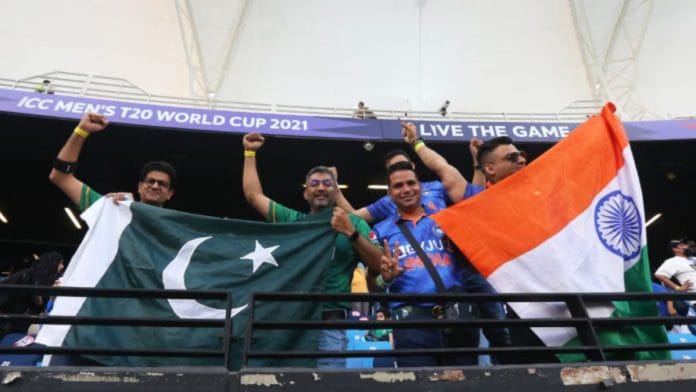
And you know what’s funny? Indian and Pakistani fans and even the players seemed oblivious to all this talk of rivalry and geopolitical friction.
The Times of India wrote in ‘When hate didn’t get a complimentary match pass’— “…you could see that people around the sport (in Colombo) were ready to move on from off the field animosities.” It noted that Indian and Pakistani fans got their faces painted in their national flags by the same artist, and there “wasn’t an iota of animosity” among them.
Also read: Hindi TV news has found Trump’s ‘secret file’ on Iran. They’re waiting for ‘world war’
Money of the match
Let’s go back to the money and how several commentators in the foreign media saw India vs Pakistan as a business transaction caught up in tense bilateral relations.
The Economist weekly magazine (UK) looked at the big picture in South Asia. It noted how Bangladesh and Pakistan were on “bad terms with their domineering neighbour, India… and they pushed back” by refusing to play in India or refusing to play India, full stop. “The result has reduced a global event to a stage for South Asia’s pathologies,’’ it wrote.
In its opinion, Pakistan had simply tried to hit India where it hurt most by its initial refusal to play in Colombo: “Matches between the two countries are the most watched in any cricket tournament. Advertising rates are set accordingly, with much of the benefit accruing to India.”
The New York Times and former England cricket captain Michael Atherton made the same point in different ways.
Atherton wrote in The Times (London), “This is the fixture that has become too big to fail — the contest that allows for the functioning of the international cricket system as it stands — even though it has become an unattractive game in its present guise, as a proxy for political point-scoring.”
The New York Times also took note: In ‘When Pakistan and India Play Cricket, It’s Never Just a Game’, Francesca Regalado and Pragati KB wrote: “…the money-spinning match with a viewership expected to dwarf the Super Bowl will be about more than just sport. It will be inextricably tied to national pride, or embarrassment…these financial concerns are big enough to override any nationalist or political pressure in India and Pakistan not to play cricket against each other.”
If you look back at coverage of the India-Pakistan match, many news outlets felt issues outside the game had queered the pitch, quite literally. This wasn’t a game of cricket any longer – it was politics, it was business by another name.
The author tweets @shailajabajpai. Views are personal.
(Edited by Ratan Priya)
Interesting take on team combinations. Squad balance often gets overlooked, but it makes a massive difference in ICC tournaments.
Yes, business indeed. Hope the two countries realise the importance of doing business with each other, bury enemy mentality, and become developed countries.