





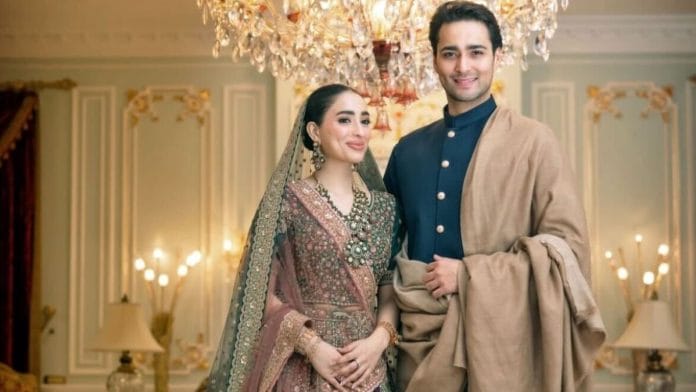



From European Union President Ursula von der Leyen’s dramatic Benares brocade Bandhgala tunic, designed by Rajesh Pratap, to Pakistani Begum Maryam Sharif’s fashion diplomacy (or the lack of), the outfits handpicked by high-profile foreign ladies are being closely scrutinised by hawk-eyed couture police, looking for subliminal context and messages in costumes. Headlines and hemlines often overlap.
Sometimes, we end up embroidering the truth as we overthink and overanalyse a fastidious lady’s personal wardrobe preferences for significant occasions.
In the case of Maryam Sharif—Chief Minister of Pakistan’s Punjab and daughter of former Prime Minister Nawaz Sharif—her startlingly different appearance at the second wedding of her beloved beta, Junaid Safdar, raised not just eyebrows but curiosity and tempers too. The other Botox Begums of Lahore wondered whether the 52-year-old mother of the groom had undergone a “head transplant”. There were questions galore about the new, improved beauteous Begum and her altered features.
But even more than her face, the outrage focused on her wedding wardrobe. “She is dressed like a bride herself…so self -obsessed!” chorused detractors. “She did it to her first bahu, too.” “We need tabdeeli in our society,” mocked another critic, “but does the tabdeeli have to be this blatant… this obvious?”
Tabdeeli loosely translates to transformation or change.
To heat up the debate further, pictures of Shanzeh Ali Rohail, the new dulhan, surfaced on social media. “Why couldn’t she wear something more Pakistani? Why a Tarun Tahiliani saree? Our craftspeople are far superior.” Oh ho! Relax. Shapes change. Contours shift—in society, in politics. And definitely, in fashion.
Cross-border accusations revolved around “couture-terrorism”—certainly the least harmless form of attack. It was Advantage India as the freshly-reconstructed Begum smiled, simpered, dimpled and sashayed for the cameras, while political watchers snarkily pointed out the bizarre optics: Maryam looked younger and prettier than her newly minted bahu. And she’d picked a Sabyasachi Mukherjee creation earlier for her nephew’s nikah. Tauba!
Meanwhile, orders for identical desi lehengas were hitting new highs, as Pakistani designers fumed, “What an insult to our talented couturiers… our embroidery, our cuts.”
Silly! In the larger interests of peace in the neighbourhood, we could kickstart another round of lehenga diplomacy to replace the latest international hiccup over India and Pakistan allegedly distorting details during Operation Sindoor.
How about sending Sabyasachi and Tarun Tahiliani on a special diplomatic assignment to Pakistan? They could easily achieve what monotonous rounds of military sabre waving couldn’t. Start packing those lehengas, Sabya! Drape the Begums, Tarun.
Saas bahu drama—UK version
Ironically, at around the same time, another shaadi was witnessing a meltdown, again involving a high-profile mother of the groom.
Fashion Diva Victoria Beckham, former Spice Girl and wife of David Beckham, was recently accused of disgracing herself and embarrassing her son Brooklyn at his wedding reception by dancing inappropriately “on” the dulha! AI-generated videos of the celebrity-studded party showed Victoria adding a generous dollop of spice to the dance floor, twerking away with a visibly embarrassed Brooklyn, grinding provocatively and alarming the posh crowd with her brazen moves.
At Davos, the dashing David made it worse by saying, “Children make mistakes.” (Huh—and not parents?), before getting back to his favourite topic: Brand Beckham.
So, according to mum and dad, it was all Brooklyn’s fault for marrying a girl of his choice. Brat Beckham, it seemed, had to be publicly shamed and humiliated for daring to dent Brand Beckham.
All these wedding tamashas point to just one thing: Ekta Kapoor was right. Is right. Will always be right. “Kyunki Saas Bhi Kabhi Bahu Thi.”
The masculine bandhgala
The undisputed queen at the Republic Day parade was the supremely elegant Ursula von der Leyen, who went desi with a vengeance. Opinions were divided over her rich crimson and gold bandhgala tunic, with some finding it “unflattering” and “a bit too masculine”.
In these lovely, lovely times of gender fluidity, what’s “too feminine” or “too masculine”? Wear what you like, folks. Wear it and rock it! Like Ursula certainly did.
Earlier, she had asked followers on X for fashion tips – should she wear a saree to India’s Republic Day Parade, and if so, what kind? Glad her well-wishers dissuaded her. India’s Republic Day is not the Met Gala, darling. We don’t do “costume” at the parade.
Also read: Mumbai’s elite host Cocktails Pe Charcha before BMC polls. Netas & their wives are invited
Our mega celebrity
Fashion is such a deep and fascinating subject. Fashion is politics. What we wear, how we wear it, why we wear it and where. These are intensely political statements disguised as personal choices.
Prabal Gurung, the 46-year-old, New York-based fashion designer from Nepal, launched his memoir Walk Like a Girl at the recently concluded Kolkata Literary Meet. His session followed mine at the historic Alipore Jail, now a museum and the venue of the wonderfully curated Lit Fest (take a bow, Malavika Bannerjee).
Gurung has dressed international icons, including Michelle Obama, Kamala Harris and Oprah Winfrey, besides our very own Deepika Padukone and Diljit Dosanjh, over his 19 years as a top designer and co-founder of House of Slay. The American press likes to call him a “Nepalese immigrant”. In a country built by immigrants, thriving because of immigrants, and proudly electing immigrants (Zorhan Mamdani), the tag feels unnecessary.
Not that it bothers Gurung, as was obvious during his very assured responses to well-researched questions posed by journalist Shefalee Vasudev. “Does gender have a colour?” she asked, referring to the “pink is for girls and blue is for boys” trope.
The designer answered smoothly as the audience cheered. A lady seated behind me told her bewildered companion, “This man is a mega celebrity… mega!’’ Neither knew his name nor work.
Prabal Gurung had meticulously dressed Punjabi superstar Diljit Dosanjh for his red carpet appearance at the Met Gala 2025, in a sharply cut “Maharajah of Patiala” style ensemble, turning maximum heads. In India, we happily appropriate Gurung as one of our own. Why not? To us, he is not a “Nepalese immigrant” – he is our gifted, successful neighbour and we are proud of him. That’s positive politics at work. Let’s call it cutting-edge soft power.
Kuch toh seekh lo, Pakistani designers. We love and admire you, too. No need to jalo so much.
Shobhaa De is an author, columnist, social commentator, and opinion-shaper. She has written 20 books. She tweets @DeShobhaa. Views are personal.
(Edited by Ratan Priya)