









It has been a week dedicated to science and technology. I engaged with students of the prestigious Nalanda University, BITS Pilani, Pandit Deendayal Energy University, and IILM—institutions that are at the forefront of technical education in India today.
I spoke about the role of youth in the country’s journey toward Viksit Bharat 2047. What better place to raise this conversation than at renowned centres of science and technology? I also had the opportunity to participate in a discourse organised in association with the Ministry of Science and Technology, where Vice President CP Radhakrishnan spoke on the topic “Transformation of tribal lives through science and technological invention-preserving language, faith and culture.”
He clarified that in embracing the innovations of the modern world, we do not have to lose sight of our cultural traditions and our heritage. And as we move toward Viksit Bharat 2047, we would do well to return to the sustainable and scientific traditions that have long been part of Indian culture.
At the same time, we can explore our rich natural resources, such as India’s thorium deposits, and leverage them to meet our growing energy needs through clean and green nuclear energy.
The criticality of Kalpakkam
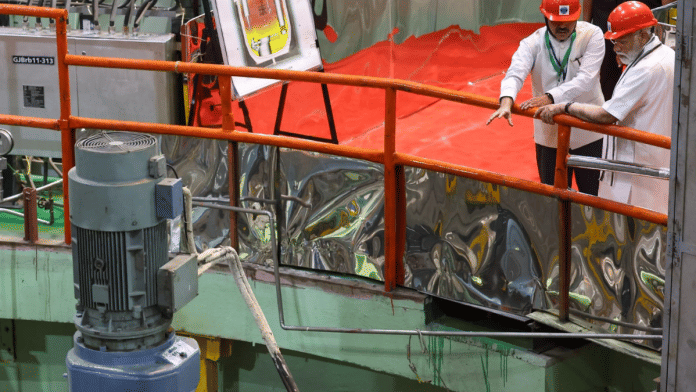
An important scientific achievement for India in the past week was the ‘going critical’ of India’s indigenously designed nuclear reactor in Kalpakkam, developed by the Indira Gandhi Centre for Atomic Research. Prime Minister Narendra Modi lauded the criticality of the 500 Mwe Prototype Fast Breeder Reactor (PFBR), calling it a ‘defining step’ in India’s nuclear journey, as it enhances the country’s capability to manufacture more fuel than it consumes.
But what is “criticality”? It is the point where the nuclear chain reaction becomes self-sustaining, which is a major milestone in itself.
The PFBR uses plutonium-based mixed oxide as fuel and liquid sodium as coolant, marking the acceleration of India’s fast breeder reactor programme. Though it requires uranium, it needs far less than heavy water reactors do to generate electricity.
This development means India will be able to extract greater energy from its limited uranium reserves. It will also pave the way for the large-scale deployment of thorium-based reactors.
History of India’s nuclear programme
India’s nuclear journey began in the years following Independence under the visionary leadership of Homi J Bhabha, who laid the foundation for a robust atomic energy programme that focused on the peaceful utilisation of a powerful energy source. Unlike many of our neighbours, India refused to enter the nuclear arms race; instead, we aimed to meet the needs of 1.5 billion people through the effective and safe utilisation of atomic energy.
The Bhabha Atomic Research Centre was established with a view to pursuing a three-staged nuclear power strategy to maximise India’s limited uranium and abundant thorium reserves.
After Bhabha died in an air crash over the Alps, India’s atomic energy journey was derailed for some time until Pokhran.
Pokhran I shifted the trajectory by signaling India’s technological capability through a ‘peaceful nuclear explosion’. The more definitive Pokhran-II followed this under the leadership of former Prime Minister Atal Bihari Vajpayee, which established India as a declared nuclear state.
Under the spotlight of global scrutiny, India maintained a doctrine of credible minimum deterrence and a no-first-use policy, which emphasised responsibility and a checks and balances system. At the same time, India continued expanding nuclear energy for civilian use.
Agreements such as the India-US Civil Nuclear Deal enabled India to integrate into global frameworks without signing the treaty on the Non-Proliferation of Nuclear Weapons (NPT). Today, India’s nuclear journey stands as a testament to its pursuit of energy security, scientific excellence, and strategic sovereignty. This is highly relevant in today’s complex and conflagrative geopolitical landscape.
Also read: What is the cost of this ‘Nobody’s War’ in Iran? Morality
Is thorium India’s titanium?
India has huge untapped thorium resources, holding about 25 per cent of the world’s reserves. These deposits are found primarily in the monazite-rich sands along the coast of Tamil Nadu, Kerala and Odisha. These reserves are the key to giving India a long-term advantage in nuclear energy planning. Unlike our limited uranium reserves, the thorium deposits are a barely tapped resource that can meet our future energy needs.
Thorium is considered an effective alternative to uranium as it can be used to produce nuclear fuel through a different but effective pathway. Even though thorium itself isn’t fissile, it is fertile. This means it can absorb neutrons and transform into uranium U233/235, a fissile material capable of sustaining a nuclear chain reaction, making this a viable alternative in nuclear reactors.
Thorium is also more eco-friendly as it produces less long-lived radioactive waste and carries lower risks of weapons proliferation. This makes thorium an ideal option for cleaner and more sustainable nuclear energy.
According to research at Stanford University by an Indian scholar, Aanand Joshi, India’s thorium reserves could theoretically power the country for over 700 years at current energy consumption levels, making it potentially a cornerstone for India’s long-term energy needs.
India’s long-term energy needs
AI is an energy guzzler. As we move away from traditional, nature-based ways of living to a largely urbanised system, our energy needs are skyrocketing. The old adage of “early to bed and early to rise” is giving way to all-nighters powered by a constantly expanding digital ecosystem.
With the increase in digitalisation, there’s likely to be an acute need for data centres to store digital information. Data centres consume approximately 1.5 per cent to 2 per cent of global electricity, estimated at 415-460 TWh annually, and demand is increasing at nearly 12 per cent annually. This is predicted to double by 2030 due to AI growth.
Artificial Intelligence itself is highly energy-intensive. Training and running generative AI models will significantly accelerate the demand, with projections indicating that global data center energy demand could approach 1,000 TWh by 2026. In addition, significant energy is required to cool these data centres. Statistics state that energy requirements for these energy guzzlers will multiply manyfold, to the extent of 8 per cent of energy production.
Additionally, global warming is pushing up the demand for energy, which historically grew by 1-2 per cent but has recently grown by 2.4 per cent every year. In tropical countries like India, rising temperatures cause energy consumption for air-conditioning.
The government of India aims to have over 30 per cent of cars on the road to be EVs by 2030. There is a persistent gap between rapidly growing energy requirements and energy production. The current crisis in the Middle East has further exacerbated this issue.
Demand for electricity in one of the world’s fastest-growing economies has surged due to higher living standards, apart from the above reasons. Installed capacity has increased tremendously but remains insufficient due to transmission and distribution losses as well as dependence on fossil fuels.
Renewable energy sources such as solar, hydropower, and wind have their own issues, like storage, intermittency, etc. Coal is still the backbone of India’s power supply, but it isn’t a clean fuel, and the supply is finite.
Given India’s significant thorium deposits, nuclear energy offers a reliable and sustainable option to bridge the widening gap between energy demand and supply. Nuclear power plants are not dependent on the weather, therefore they will ensure a stable electricity generation.
The long-term strategy should be to focus on thorium-based nuclear fuel by leveraging the abundant domestic reserves. This will greatly reduce dependence on imported fuel. Expansion of nuclear capacities can also lower carbon emissions while meeting industrial and urban energy needs. India stands as a beacon of hope for emerging economies, especially in the field of science and technology, by showing its resilience in energy development.
Meenakashi Lekhi is a BJP leader, lawyer and social activist. Her X handle is @M_Lekhi. Views are personal.
(Edited by Ratan Priya)