





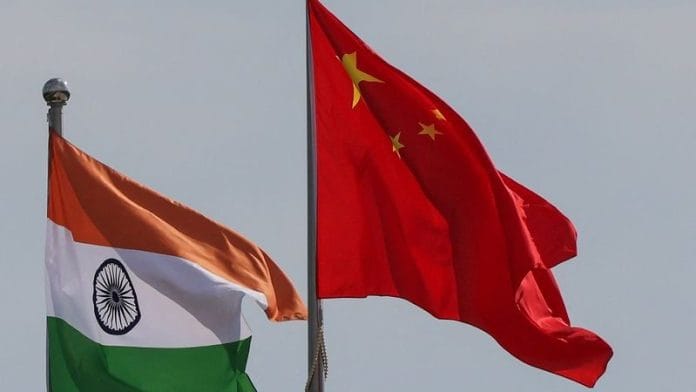



It’s still mid-winter in the high Himalayas, along the disputed border between India and China. But in New Delhi and Beijing spring has come. Relations, which had been frozen since 20 Indian soldiers were killed in clashes in 2020, have begun to thaw. Bilateral diplomatic visits have resumed and the two militaries have begun meeting again.
Most importantly, however, India has begun to re-evaluate China’s role as an economic partner. It was once the country most mistrustful of investment and trade with its giant rival; Chinese companies were banned from strategic sectors well before that became the norm elsewhere, and investment was completely prohibited in 2020.
It appears those norms will now be relaxed. Capital will begin to cross the border again — and Chinese companies might even be allowed to bid for government contracts, no small thing in a country where the state sector drives much investment activity.
This isn’t because China has retreated on the border issue. Far from it; if anything, it is India that has resigned itself to a new status quo, one in which it has lost several strategic advantages. Indian officials increasingly agree with their businesses that without access to Chinese inputs, capital and know-how, the economy will never be competitive globally.
Of course, President Donald Trump’s chaotic trade policies are also weighing heavily on New Delhi. The US continues to single out India with the highest tariff that it has applied on anyone. Its goods, like Brazil’s, face a 50% rate; and Trump periodically threatens to increase that further. As a consequence, exports to the US have begun to decline, and it has been replaced as India’s largest trading partner. That spot is now taken by China. Exports there shot up by 67% in December alone, though that’s still far from making a dent in the vast bilateral trade deficit.
Indian companies’ immediate need for China, however, is not as a destination for their products but as a supply-chain partner. Clothing manufacturers, for example, complain that they can’t produce the cloth they want because they can’t get the necessary equipment and chemicals. Similar complaints have been voiced by other sectors, including engineering and electronics, which are increasingly important export earners.
Not all the issues these producers face have been caused by New Delhi. Officials in Beijing only lifted curbs on rare earths and magnets, for example, after Prime Minister Narendra Modi agreed to meet President Xi Jinping in China last August.
Meanwhile, officials in charge of overseeing India’s vast state sector — including the extensive infrastructure build-out paid for by public funds — have been struggling with cost and time overruns. They think that re-allowing cheaper and more efficient Chinese companies to bid in the $700 billion procurement market would make their job easier.
Not everyone will be happy. Heavy engineering companies have been prospering without competition from the world’s most experienced builders. And national security strategists in New Delhi are scrambling to reframe their arguments against a growth-first lobby that appears to be in the ascendant for the first time in years.
But that might be a losing battle at the moment. Countries from Canada to the UK are re-examining China’s importance to their economies. The US is less reliable, the West is fracturing — and many want to believe, as Prime Minister Mark Carney said on a recent visit to China, that Beijing is more predictable than it was. At Davos, French President Emmanuel Macron called for more Chinese foreign direct investment in Europe in growth-creating sectors.
The hawks will have an even harder task if investment curbs are truly relaxed — because there’s bound to be some sort of a peace dividend in India. Many Chinese companies, particularly in new energy sectors, have been eyeing that market. Investment funds, some managed by large state-owned enterprises, are reportedly planning to apply for licenses to operate in their southern neighbor.
This is a fragile spring, however. A renewed flare-up on the border would bring winter back. And there are limits, as well, on how deep integration can possibly go while the Indian private sector sees China only as a source of inputs and not a destination for their goods.
In Davos, Vice Premier He Lifeng said that China was willing to be the “world’s market.” India may be willing, for now, to be China’s market again, but will never be easy in that role unless Beijing becomes its market in turn.
This column reflects the personal views of the author and does not necessarily reflect the opinion of the editorial board or Bloomberg LP and its owners.
Mihir Sharma is a Bloomberg Opinion columnist. A senior fellow at the Observer Research Foundation in New Delhi, he is author of “Restart: The Last Chance for the Indian Economy.”
Disclaimer: This report is auto generated from the Bloomberg news service. ThePrint holds no responsibility for its content.
Also read: Canada no longer ‘younger brother’ of US, says Indian envoy to Ottawa