






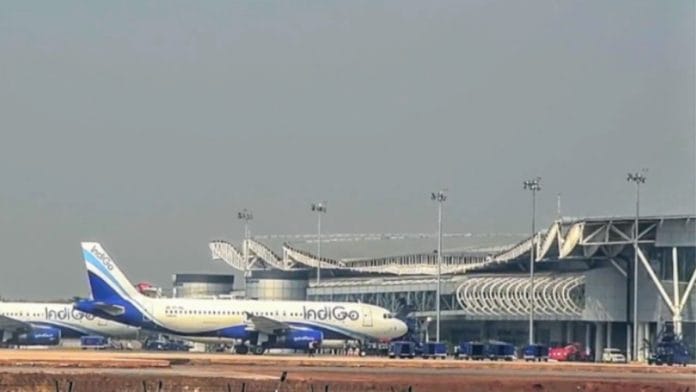



IndiGo’s early-December meltdown stranded thousands of passengers and ruined holidays. The airline deserves plenty of blame for poor communication and weak contingency planning, but stopping at IndiGo-bashing or accusations of outright extortion misses the deeper truth. What collapsed was not just an airline but a brittle ultra-lean operating model colliding with a rigid regulatory shock. IndiGo failed in planning. The Directorate General of Civil Aviation failed in the process. Passengers paid for both.
IndiGo runs one of the leanest schedules in global aviation—aircraft flying up to 14 hours a day with minimal standby crew and razor-thin turnarounds. Lean works in stable conditions; Indian winters rarely offer stability. Fog, congestion, and dense night operations are routine. When friction rises, lean becomes brittle.
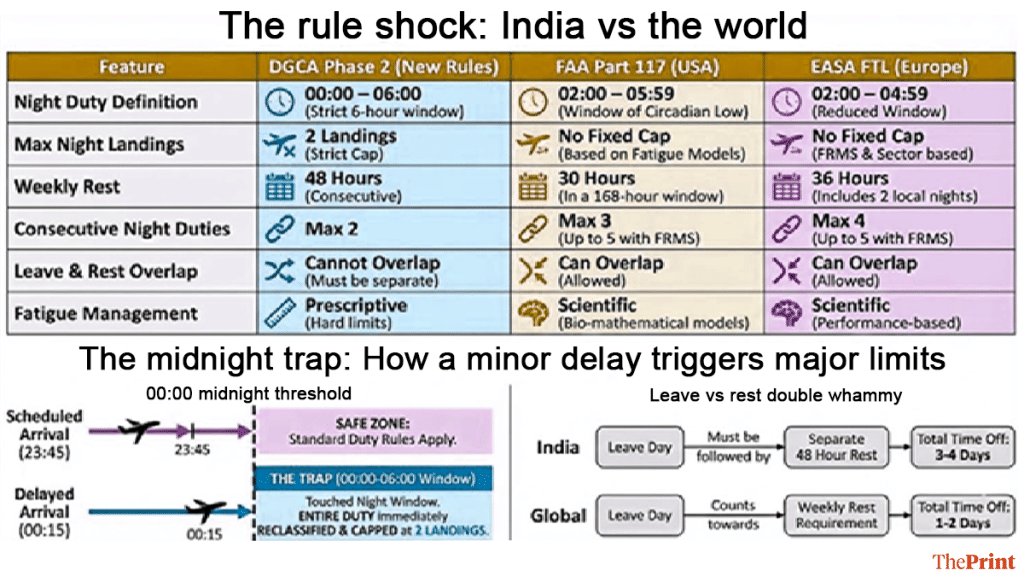
That brittleness was exposed when Phase 2 of the Directorate General of Civil Aviation’s (DGCA) revised Flight Duty Time Limitations (FDTL) took effect on 1 November 2025. The new rules redefined any duty touching the midnight-6 am window as night duty, slashed permissible night landings from six to two, and increased mandatory weekly rest from 36 to 48 hours—rising to a massive 60 hours for pilots performing more than three night duties. These are among the strictest limits in the world, exceeding even FAA Part 117 or baseline EASA rules.
Immediate impact
The impact was immediate. IndiGo’s on-time performance crashed from 84 per cent in October to 68 per cent in November, with over 1,200 cancellations in clear weather—long before fog arrived. When routine winter fog finally hit in the first week of December, an already strained system simply shattered, leading to over 1,000 more cancellations on 5 December alone and leaving tens of thousands stranded nationwide.
One rule caused particular havoc: any duty that crosses midnight, even by minutes, becomes night duty and is capped at two landings. For an illustrative example, consider a rotation like Delhi–Patna–Delhi–Mumbai that would typically end around 11:45 pm. A modest 25-minute delay pushes it past midnight, reclassifying the entire sequence as “night” and instantly violating the two-landing limit—the pilot has already completed two landings, so the third becomes illegal. With no standby crew available at midnight, the flight is usually cancelled, and the next day’s rotations unravel. A once-recoverable delay cascades into a system-wide failure.
Other clauses compounded the damage. The expanded night-duty definition meant thousands of duties suddenly counted as night operations. Pilots hit the three-night threshold faster, triggering 60-hour rest blocks that drained IndiGo’s thin staffing buffer overnight. A separate rule barred leave from overlapping with mandatory rest—meaning that, because leave cannot overlap with the new mandatory rest periods, a single day of leave now pulls a pilot off the roster for two or more days. Global regulators like the FAA and EASA allow rest and leave to coincide; India’s original approach was unusually rigid.
IndiGo suffered the most because its network is uniquely exposed. It operates India’s highest aircraft utilisation, with a large share of late-evening and early-morning flights that now trigger night limits. Its point-to-point model involves multiple short sectors and tight turnarounds, making it far more vulnerable to a two-landing cap than competitors with simpler patterns. IndiGo also runs the thinnest pilot buffer in the country—roughly 10 pilots per aircraft versus 12–13 at smaller rivals.
Some blame IndiGo’s market dominance. Size only magnified visibility; it did not cause the crisis. Cancellations stemmed from a sudden collapse in legal pilot availability, not monopoly power. Even if the same fleet and schedule were split among five smaller airlines, the same regulatory shock would have grounded the same number of flights. Smaller airlines stayed stable only because their networks rely far less on multi-landing night rotations.
Others claim IndiGo engineered the meltdown to pressure the regulator. That theory is implausible: no airline deliberately torches revenue and reputation. When the FAA introduced stricter fatigue rules in 2014, US carriers like JetBlue and Southwest still faced hundreds of immediate cancellations and thousands of delays despite years of notice—especially when winter weather compounded the strain. IndiGo simply misjudged the impact on a staffing model that had no margin for error.
Also read: DGCA is at fault for creating an airline that was ‘too big to fail’
Fatigue-related errors
Pilot fatigue is real and must be managed, especially in India’s night-heavy network. But fatigue reports are signals, not science. Global regulators like the FAA and EASA rely on biomathematical modelling, sleep research, and transparent impact assessments to set limits — a rigour that India’s approach largely lacked.
While India’s dense night schedule may justify tighter controls than some global norms, there is no publicly available scientific evidence — no trials, no modelling — showing that a blanket two-landing cap after midnight meaningfully reduces fatigue-related errors. Instead of moving toward the flexible Fatigue Risk Management System (FRMS) recommended by ICAO since 2008, the DGCA — despite issuing only draft FRMS guidelines in September 2025 — imposed a rigid cap that no major regulator in the world uses.
India needs a hybrid model: baseline duty limits informed by biomathematical fatigue models, combined with airline-specific FRMS programs that reward data-driven safety rather than procedural compliance.
India needs scientific, data-driven regulation—not prescriptive overreach. Safety is not achieved by strictness alone. It demands realistic modelling, flexible Fatigue Risk Management Systems, and rules that keep the system resilient under routine Indian delays.
Passengers deserve an aviation ecosystem that is both safe and reliable, not one that grinds to a halt the moment the clock strikes midnight.
Ajay Mallareddy is the co-founder of Hyderabad-based Centre for Liberty. His X handle is @IndLibertarians. Views are personal.
(Edited by Saptak Datta)