






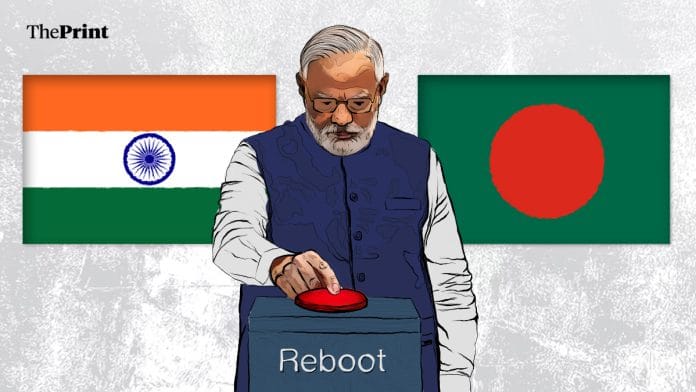



If trade ties and cultural exchanges are important for neighbouring countries to remain allies, respecting each other’s red lines becomes the most critical aspect of that alliance.
During former Prime Minister Sheikh Hasina’s almost 20-year tenure, which ended on 5 August 2024, Bangladesh was India’s key strategic ally, despite points of contention between Delhi and Dhaka. But Hasina made sure India’s security red lines were never crossed by Bangladesh.
By arresting young Bangladeshi politician Osman Hadi’s alleged killers in West Bengal in March, Delhi has extended a hand of friendship to the new government under BNP’s Tarique Rahman. Dhaka, too, should reciprocate this act of friendship.
A political killing, and a fallout
On 12 December 2025, 32-year-old Osman Hadi, a prominent leader of Bangladesh’s 2024 student uprising and the spokesperson of the political platform “Inquilab Mancha,” was shot by unknown assailants in Dhaka. He was taken to Singapore for treatment but died as the violence in Bangladesh magnified.
The death of Hadi, an outspoken critic of India, fuelled anti-India hate amid conspiracy theories about the country sheltering his killers.
Mobs attacked Indian missions in Bangladesh and targeted the country’s minority population, leading to the horrific lynching and burning of a Hindu garment worker, Dipu Chandra Das on 18 December, which shocked the world.
But anti-India hate had begun much earlier in Bangladesh, abetted in no small measure by the words and actions of Muhammad Yunus’s interim government. Yunus’ controversial suggestions on the “extension of the Chinese economy” and his framing of India’s northeastern region as “landlocked” during his 18-month tenure led to the soaring of tensions between the two neighbouring countries.
As recently as late October 2025, Yunus went to the extent of gifting Pakistan’s then Chairman Joint Chiefs of Staff Committee General Sahir Shamshad Mirza an artwork titled “Art of Triumph”. The painting showed Bangladesh with extended boundaries seemingly expanding into Indian territories in the region. Delhi viewed this as a provocative anti-India gesture and raised concerns about regional security in the vital Siliguri Corridor.
Even in his 25-minute farewell address on 16 February 2026, Yunus mentioned India’s strategically sensitive northeastern states and highlighted that Bangladesh could provide a huge economic potential for the region through its access to sea routes.
“Our open sea is not only a geographical boundary, but it is also an open door to engage with the world economy for Bangladesh. This region, along with Nepal, Bhutan and the Seven Sisters, has great economic potential,” Yunus said, referring to India’s northeastern region even as he avoided naming the country.
Since Yunus’s departure from Dhaka, India has shown willingness to work with the newly elected government under Rahman. The alleged killers of Hadi, Rahul alias Faisal Karim Masud and Alamgir Hossain, both Bangladeshi nationals, were arrested by a Special Task Force of the West Bengal Police from Bongaon, a border in the state’s North 24 Parganas district. In a statement, the police said that the duo, after committing serious crimes in Bangladesh, had illegally entered India, and were trying to take shelter in Bongaon “with the intention of crossing back into Bangladesh when an opportunity arises.”
The arrests show India’s stated promise to its eastern neighbour of never allowing its territory to be used for activities inimical to the interests of Bangladesh, and also its seriousness about working with the Rahman government.
Mohammad Ali Arafat, Bangladesh’s information minister under Hasina, told ThePrint over the phone that India will always maintain a friendship with Bangladesh, “especially with any government that is pro-Bangladesh”.
For Arafat, the equation is rather simple: As long as a government in Bangladesh sticks to the spirit of the 1971 Liberation War, it will remain a friend of India.
“If any government deviates from those ideals of 1971 and becomes pro-Pakistan, it will negatively impact Bangladesh-India relations,” Arafat said.
Also Read: Awami League desperately needs new leadership. It’s looking for it in wrong places
Need for a new slate
India-Bangladesh ties can only improve if there is a new, clean slate between the two. As far back as 2004, when Rahman’s mother, Khaleda Zia, was Bangladesh’s premier, relations between Delhi and Dhaka were strained.
A huge consignment of weapons – 10 trucks full of arms – was seized at Bangladesh’s Chittagong in April 2004. It was meant not only for the United Liberation Front of Asom (ULFA) but also for a few other rebel groups in the region to destabilise the country.
Deputy Director-General of India’s Defense Intelligence Agency Major General Gaganjit Singh revealed this in an interview with India Today in 2023.
Singh said that members of the Pakistan-based outfit Lashkar-e-Taiba were also present during the planning stage meetings for the joining hands with Pakistan’s ISI, which was also involved in the arms consignment.
However, the most troubling part of the interview for India’s national security concerns was when Singh said the arms were being supplied by taking advantage of the alliance between the BNP and Bangladesh’s Jamaat-e-Islami to use the country as a sanctuary.
Like in 2004, Bangladesh again has a BNP government. And though it is not in alliance with the largest Islamist party in the country, the Bangladesh Jamaat-e-Islami, the latter’s wins in Bangladesh’s India-border districts also raise security concerns for Delhi.
India and Bangladesh share a 4,096-km border, one of the longest in the world, and many parts of it are not fenced. A report by Moneycontrol quoted Indian intelligence sources saying that they do not expect the Jamaat to issue attack instructions, but argue “its rise could create a permissive ecosystem where recruiters and splinters expand as police, administration and society hesitate to act firmly.”
Manash Ghosh, veteran journalist and author of Mujib’s Blunders (2025), told ThePrint that by arresting Hadi’s alleged killers, India has once again demonstrated its stand that it would not be a haven for criminals from across the border.
“The Modi government had also taken a similar stand earlier. The dreaded gangster Subrata Baine and Captain Abdul Majed, a convicted assassin of Bangladesh’s founder Sheikh Mujibur Rahman, too, had been handed over in the past to face trial in Bangladesh. Now, it is Bangladesh’s turn to do the same in case Indian fugitives take shelter there to carry on anti-India activities,” Ghosh said.
He added that, supported by Khaleda Zia’s regime, ULFA’s commander-in-chief, Paresh Baruah, was able to carry out his terror activities against India.
“It is for the Tarique Rahman regime to demonstrate whether he would break from the past and reciprocate India’s gesture of good neighbourliness,” Ghosh said.
Even when Hasina and Indian Prime Minister Narendra Modi shared a great strategic partnership as premiers, Delhi and Dhaka often disagreed, mostly over the water sharing agreement.
This was articulated by Hasina in an interview with ANI on 4 September 2022, where the former PM said that India should show some generosity in water sharing. In October 2021, Hasina had also called on the Modi government to quell communal violence in India.
“They (India) have to be aware that such incidents should not take place there, which would have an impact on Bangladesh, and the Hindus in our country face attacks,” she said.
Despite such disagreements, what sustained the friendship between the neighbours was respect for security red lines. The new government in Dhaka should do the same.
Deep Halder is an author and a contributing editor at ThePrint. He tweets @deepscribble. Views are personal.
(Edited by Insha Jalil Waziri)