









I was once invited to see a Bollywood set, and I wish I hadn’t gone. The movie magic doesn’t quite hit the same when you’ve seen the green screen backgrounds, the half built frames, the taped marks where the actors have to stand. The illusion was shattered for me in much the same way—this time by accident—when it came to the latest Muslim row in the UK. A social media spectacle many seem all too eager to mistake for reality.
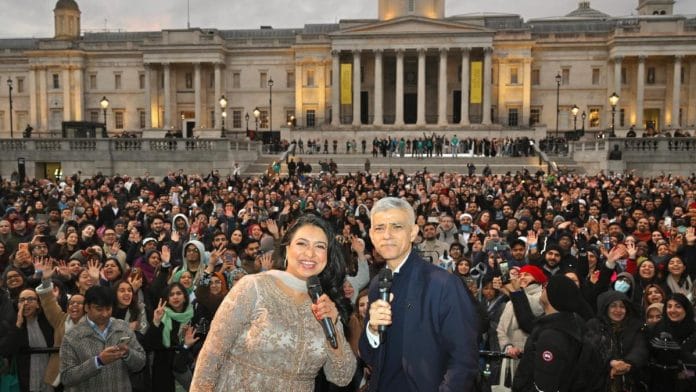
For those unfamiliar with London, Trafalgar Square is one of the most iconic open spaces in the UK capital. It hosts London’s yearly Christmas tree and Easter Passion Play, a Menorah for Hanukkah, Chinese New Year celebrations, Vaisakhi, Diwali—and, most recently, an Open Iftar event.
I was there myself that evening. The organisers were sharing a free dinner—with Muslims and others alike. There were speeches about coexistence, about belonging, about the values the country takes pride in. Even the Mayor of London, Sadiq Khan, was there, participating like anyone else. I was struck by how ordinary it all felt—people simply coming together to share a meal. It turned the idea of a city where all can feel at home into a lived reality—the same feeling I felt attending the many festivals of India growing up.
But it turns out my impressions were wrong, and I had unknowingly been at ground zero of the most dangerous Islamic attack of late on the very culture and identity of Britain—or so you’d think based on the social media reactions.
It started only a few hours later with a blurry image from the event, of people praying in the square. It was twisted into an act of “Muslim domination” of the public space. Commenters were quick to speculate that this was a show of force, Muslims showing up out of nowhere to take over the public square. Others remarked that any Christians organising similar events would immediately be jailed in “occupied London”, and many expressed their desire to have water cannons to clear the crowd or a van to drive into it.
The gathering was twisted into something entirely different and unrecognisable.
Also read: If UK’s ’emergency brake’ on study visas is really about rules, why is Pakistan not included?
AI-fuelled outrage
The row quickly gathered steam. The same night, videos from the event also appeared on social media, some real, some AI-generated. Conservative Party MP Nick Timothy posted criticism of Muslim prayers, repeating the line about it being a display of dominance. There was a heated discussion in Parliament about it. Reform UK leader Nigel Farage went a step further, calling for a ban on public Muslim prayer altogether at a party gathering, both less than 24 hours after the event.
Part of growing up in the modern information space is to develop healthy scepticism about social media, especially around political narratives. This was nothing new to me. But it was my first real experience of seeing in person how something completely normal on the ground gets twisted into its spiritual opposite online.
A simple event is picked, framed selectively, and slowly turned into something it was never meant to be and then used to justify a larger agenda. Shared celebration becomes communal hatred, cultural coexistence becomes cultural domination.
If I hadn’t been there myself, if I didn’t already know that Trafalgar Square is a public space where different communities celebrate their festivals and events, I could imagine how easily those social media narratives could have shaped my own understanding.
If the objection is that prayer is not the same as celebration, that it is a religious act, then that standard should apply across the board. Trafalgar Square hosts religious events from a wide range of communities. No one called those acts of domination. So what exactly is being objected to here?
It feels less about the act itself and more about who is performing it. The argument slowly shifts to something deeper—that Muslims should not have the same space, the same visibility, the same rights as others. And this is often pushed by invoking fear of cultural takeover, of an “Islamisation” of the West.
This is not a real threat. But that doesn’t stop a deluge of AI videos of Muslims praying in the streets of London, complaining about a lack of halal options in British pubs or about dogs on the beaches of generic seaside towns. This content can accumulate tens of thousands of likes and comments from unskeptical users (or bots) complaining about the state of Britain.
Even when there is no real catalyst, the fire must be fed at all times, the fear and hatred kept alive by those building their political careers on it, or simply making a quick buck off it.
Also read: England has been a melting pot for global jihadists since 1990s—Anjem Choudary is proof
The idea of the UK
When I first came to the UK in 2023, I carried a certain image in my mind—a place defined by individuality, freedom, multiculturalism, and tolerance. And to be honest, I wasn’t disappointed, especially in London. Meeting countless people from different communities, witnessing their festivals, seeing Muslim and Jewish communities living side by side, experiencing the freedom to travel alone at night as a woman, watching same-sex couples express love openly, the list was never-ending; all of it felt real, lived, and beautiful.
It felt like the kind of society many of us imagine when we talk about progress.
I’ve since witnessed one of the largest far-Right marches, centred around anti-immigration sentiment. I saw the growing popularity of parties like Reform UK. The covert misogyny, the unspoken stereotype of communities. And slowly, the image I had carried began to feel more complicated, as it is in India, and everywhere.
There is a quiet but real struggle between the different ideas of what the UK should be, what the world’s future should look like. One side pushing for a more open, inclusive society, the other questioning it, resisting it, trying to redraw the boundaries. It is something that is being negotiated every day.
This debate must be on the grounds of truth. The veil of unreality that I accidentally peeked behind by attending the open Iftar in Trafalgar Square rather than just hearing about it on social media and by politicians was deeply disturbing.
It’s likely that many events around the world are distorted in similar ways. We can’t be everywhere all at once, but we can question what we see online—especially when it reaches us stripped of context. A lot of outrage is fed and maintained artificially.
When we look around at our neighbours, friends, coworkers from different communities, we see people with love, frailty, struggles, triumphs—ordinary human beings like ourselves. How do those same people become something so different online?
Amana Begam Ansari is a columnist, writer, and TV news panellist. She runs a weekly YouTube show called ‘India This Week by Amana and Khalid’. She tweets @Amana_Ansari. Views are personal.
(Edited by Theres Sudeep)