





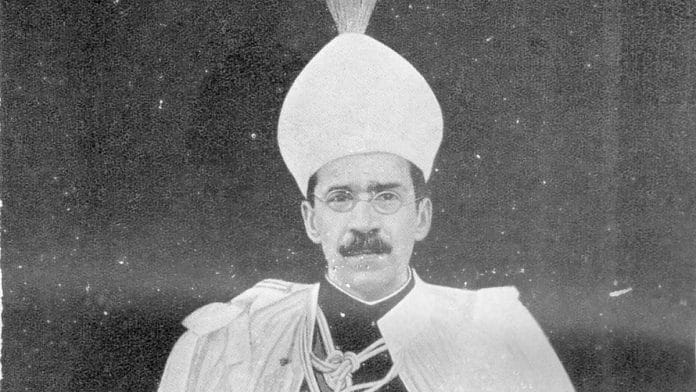



I don’t know about the rest of Hyderabad, but I was certainly very excited about Prince Azmet Jah’s first–ever public appearance in a talk at the 2026 Hyderabad Literary Festival.
Azmet spoke about his father, Prince Mukarram Jah Bahadur, who was ceremonially crowned as Hyderabad’s eighth Nizam in 1967, after the death of Mir Osman Ali Khan, the seventh and last Nizam of the erstwhile princely state of Hyderabad.
Osman Ali Khan’s state was annexed to India by the Indian Army on 17 September 1948 after he refused to accede following Independence in 1947. He later served as the Rajpramukh (Governor) of Hyderabad from 1950 to 1956.
People in Hyderabad, to this day, remember him walking around the city. Some people met him, most didn’t. But they, at least, had seen him being the ruler. The same, however, cannot be said about his grandson and the eighth Nizam Mukarram Jah, given that he virtually disappeared from public life after inheriting Osman Ali Khan’s wealth.
There is no known record of the two speaking at public events or addressing gatherings in general. While I can understand Osman Ali Khan for who he was, Mukarram Jah’s silence and decisions to live far away in Australia and Turkey for most of his life will always remain a mystery.
Mukarram Jah’s mother was Princess Durru Shewar, the daughter of Sultan Abdulmejid II, the last Ottoman king who was in exile in France after Turkey lost World War 1. She was married to Azam Jah, the elder son of Osman Ali Khan. Mukarram Jah’s Turkish bloodline is also why he made Turkey his home, and died there eventually — his body was brought back to Hyderabad for burial.
Eroding legacy
It is in this context that Azmet Jah, who was made the titular ninth Nizam after his father’s death in 2023, and his public talks are important. I was really hoping to understand more about the family, given that we have no idea about what both his predecessors were ever thinking, especially his father.
Unlike rulers of other princely states, such as the Scindias of Gwalior who entered active politics after Independence, Osman Ali Khan chose to keep himself and his family out of politics entirely. Maybe the Nizam felt he was beyond it, especially given that he once ruled Hyderabad. Mukarram Jah, however, choosing to stay abroad for most of his life only eroded the legacy of the Nizams.
At the literature festival, however, Azmet Jah gave no such insight. His talk was very facile at the best, and he, of course, only reminiscenced about the good things about his life and his father while growing up in Hyderabad. My expectations were maybe too high, I was thinking that he would speak in Dakhni. But his thick English accent was enough to cut down my expectations.
Also read: The other Nizam son speaks: Hyderabad royal feud out in open
A shadow of its past
The state of Hyderabad’s erstwhile rulers post-Independence has been rather sad. Even in Kashmir, Karan Singh, the descendant of Maharaja Hari Singh who signed the Treaty of Accession after refusing to join India (like Hyderabad), was not only made the head of state but also served as a Union Minister under Congress governments earlier.
He essentially transitioned into politics, and managed to hold on to his cultural and social power by doing so. In Hyderabad, because Osman Ali Khan and his family chose to stay away from active politics, the status of the family has been reduced to what it is today — a shadow of its past.
Of course, one can’t undo the past, but I can only imagine how different Hyderabad would have been politically had the Nizams been part of the state’s politics. Had that been the case, I doubt Asaduddin Owaisi’s All India Majlis-e-Ittehadul Muslimeen (AIMIM) would have emerged as a Muslim-led party. Because the Nizams still enjoy a lot of respect among Muslims.
If Mukarram Jah had at least been around in Hyderabad instead of spending most of his years abroad, the legacy of the Nizams would have been entirely different. People to a large extent still revere Osman Ali Khan, but not Mukarram Jah.
However, if Azmet Jah continues to appear in public in the coming days, who knows he may even undo some of the damage.
Yunus Lasania is a Hyderabad-based journalist whose work primarily focuses on politics, history and culture. He posts on X @YunusLasania. Views are personal.
(Edited by Aamaan Alam Khan)
This entire article is built on “what ifs” with zero proof. The author complains that the Nizams stayed out of politics and dreams about how great things could have been if they hadn’t. Really? Based on what evidence?
Here’s what the author conveniently forgets: AIMIM didn’t appear out of nowhere. It grew directly from the same people who supported the Nizam—specifically Kasim Rizvi and his Razakar thugs who terrorized Hindus trying to join India. The Razakars worked for the Nizam, doing his dirty work. So complaining about AIMIM’s communal politics while praising the Nizams? That’s rich. Owaisi’s party is basically carrying forward the Nizam’s own playbook.
The author is living in a fantasy World. This entire article is built on “what ifs” with zero proof. The author complains that the Nizams stayed out of politics and dreams about how great things could have been if they hadn’t. Really? Based on what evidence?
Here’s what the author conveniently forgets: AIMIM didn’t appear out of nowhere. It grew directly from the same people who supported the Nizam—specifically Kasim Rizvi and his Razakar thugs who terrorized Hindus trying to join India. The Razakars worked for the Nizam, doing his dirty work. So complaining about AIMIM’s communal politics while praising the Nizams? That’s pretty rich. Owaisi’s party is basically carrying forward the Nizam’s own playbook.
And calling Hyderabad “annexed”? Really!! Calling that “annexation” is either ignorance or dishonesty—pick one. This area was ruled by Hindu kings like the Kakatiyas, Chalukyas and Satavahanas, for centuries, before the Nizams even showed up in 1724. The Nizams refused to join India even though most people living there were Hindus. Treating Hyderabad like it was the Nizam’s personal property that got stolen is just bad history.
The author is nostalgic for rulers who would have played the same divisive, backward, regressive politics that we see today. He’s not writing analysis—he’s writing fan fiction about a family that doesn’t deserve it
This has much to do with the victor and the vanquished state of mind. the vengeance with which the govt of the day grabbed the Nizam’s properties on one pretext or the other and thus humiliated both the deposed King Osman Ali Khan and after his death, his successor Prince Mukarram Jah – that treatment forced Mukarram Jah to leave Hyderabad and stay far away from the humiliation that was being heaped upon him by the victorious Indian govt. The Mysore Maharaja was not treated this way, neither all the rest of the Rajas – only the Nizams were especially given the treatment of an enemy, as the Indian army had invaded Hyderabad to capture it – the Nizam was not allowed to merge with the Indian Union in a politically-settled peaceful manner – Patel ordered the army action when Nehruji was not present in the country, else Nehruji would have allowed for a peaceful merger.
I write to applaud your courageous article and its striking subheading. Your measured candour and historical clarity illuminate an uncomfortable truth with dignity and restraint. Such writing enriches public discourse and commands respect. It reflects intellectual honesty and rare moral confidence in our times today.